


 Shkruar nga Pamfleti
Although both sides claim firm control, data shows the naval blockade is not fully effective.
The video released by the Iranian Revolutionary Guards on Wednesday is shot like a Hollywood movie. An aerial view shows a speedboat approaching a container ship and docking next to it. Then, masked men armed with automatic rifles, dressed in military uniforms, climb aboard a rope ladder and enter the ship through an opening in its hull. Other scenes show soldiers moving around the ship with weapons at the ready and finally taking the bridge. The entire video is accompanied by dramatic music.
The footage shows the seizure of two container ships, the MSC Francesca and the Epaminondas, by the Iranian Revolutionary Guards in the Strait of Hormuz. The propaganda video aims to project Iran's power and show that it controls this strategic sea route.
It is not surprising that just a day later the US Department of Defense released a similar video on social media. In it, two combat helicopters approach the oil tanker “Majestic X” in the Indian Ocean, before dozens of soldiers descend to the deck using ropes. According to the Pentagon, the ship, which has been under US sanctions, was transporting Iranian oil. The US has also been implementing a naval blockade for nearly two weeks. But is this really a “great success”, as Donald Trump claims?
According to official US military data, the blockade is airtight. The Central Command (Centcom), responsible for the Middle East, announced that a total of 33 ships have been forced to turn back so far. However, media reports and data from companies that monitor maritime traffic cast doubt on its effectiveness. The company Vortexa, quoted by the Financial Times, says that since April 12, at least 34 ships bound for Iran have evaded the US blockade.
According to Vortexa, at least six of these ships were carrying oil, totaling about 10.7 million barrels. Since Iran sells its oil at lower prices due to international sanctions, the estimated proceeds amount to about $910 million, money that ends up in Iranian coffers.
Other data providers such as Kpler and Lloyd's List also confirm that some ships have passed the blockade, although the numbers vary. Collecting accurate data is difficult, as many ships turn off their transponders or falsify their positions. In some cases, the oil is transferred offshore to other ships to hide its origin.
“The blockade is by no means 100 percent closed,” says Christian Bueger, a maritime security expert and professor at the University of Copenhagen. According to him, this is not essential: “There will always be ships passing through. The main purpose is the signal and the deterrent effect. For Trump, this was the last way to create leverage in negotiations with Tehran.”
New mines in the Strait of Hormuz
According to Bueger, Iran has the advantage in this cat-and-mouse game: it continues to control the strait, also due to its geographical position. Iran operates from a coastline of over 1,500 kilometers and, despite the losses, still has hundreds of small vessels that can attack and stop commercial ships. Reports from the media "Axios" suggest that Iran has again laid naval mines in this area this week.
On Thursday, Donald Trump announced that he had ordered the US Navy to sink any vessel that lays mines without hesitation. He added that mine clearance efforts would be tripled. However, US ships do not appear to have ventured deep into the Persian Gulf, where they would be more exposed. Instead, the US has concentrated its presence in the Gulf of Oman, creating a defensive zone. Currently, more than 17 warships and about 100 helicopters and aircraft are in the region.
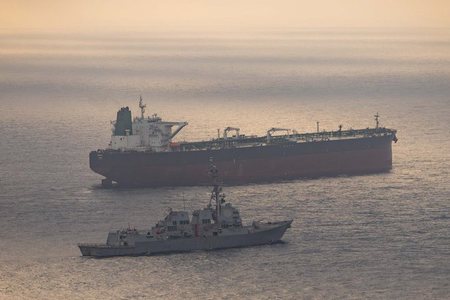
An example of the interventions is the case of last Sunday, when the container ship “MV Touska” was stopped in the Gulf of Oman after it had ignored warnings for several hours. The American destroyer “USS Spruance” fired into the engine room, rendering the ship immobile. Then, soldiers landed from helicopters and took control.
However, facing the US forces is a large Iranian fleet of merchant ships and tankers, with 440 Iranian-linked vessels on the US sanctions list alone. This makes it virtually impossible to stop any of the vessels.
Recently, the US has begun to seize Iranian-linked ships outside the region, such as the Majestic X in the Indian Ocean. According to experts, this constitutes a significant escalation of the conflict.
Ultimately, the decisive factor will be which side can withstand the consequences of this double blockade for the longest. Iran faces not only economic pressure but also limitations on its oil storage capacity. The decommissioned tanker "Nasha" is moving towards Kharg Island to store excess oil.
According to experts, by the end of April, the storage capacity could be completely filled. In this case, Iran would be forced to shut down several oil wells – a move that could have long-term consequences for production. /Adapted from NZZ /


Lini një Përgjigje