


 Shkruar nga Nesrine Malik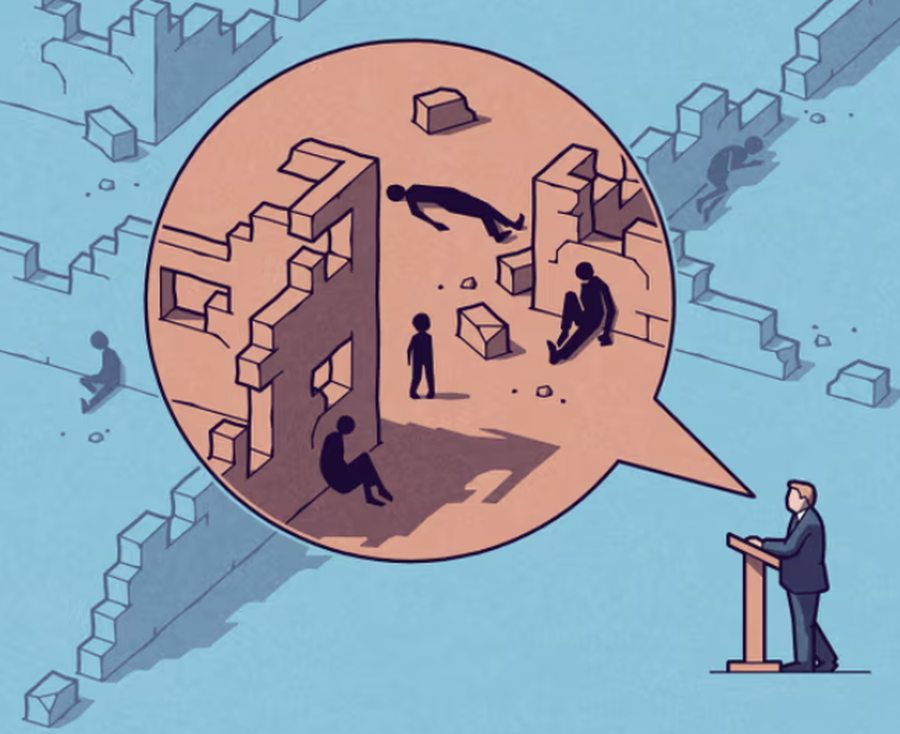
An atmosphere of complicity has fueled new rhetoric from UK and EU leaders. But it won't redeem them - or change the course of history...
An atmosphere of complicity has fueled new rhetoric from UK and EU leaders. But it won't redeem them - or change the course of history.
Why now? That is the question. Why now, after 19 months of relentless attacks that were clear to all and declared by the Israeli authorities themselves, has the tide in Gaza begun to turn?
The apparent change in tone this week from leaders in the UK and EU is a clear departure from the plethora of “concerns” and reiteration of Israel’s right to defend itself. The rhetoric now is that Israel’s actions are “morally unjustifiable” and “wholly disproportionate,” and its leaders’ threats “abhorrent.”
Some of this is relevant for the future. The war has reached genocide and ethnic cleansing in ways that are increasingly undeniable, indefensible, and unpredictable. Some tried it well for a year and a half, but now they can’t stand at a pulpit or sit at a dinner table and argue that, yes, there is indeed a case for killing 100 people a day, as was the case last week.
Or that Israel has any other plan than what its leaders have repeatedly declared as a relocation and settlement. The argument that this is simply about eliminating Hamas has long since fallen apart. Israel has let its friends down.
But there is a disconnect between the condemnation and the outrage, and what happens on the ground. When it comes to Israel, the levers of international criticism have been broken. Throughout the war, international organizations, humanitarian missions, and courts of justice have been rendered impotent by their inability to translate their findings into action.
Words alone have no value. They simply leap from Israel's iron dome of impunity. Every day, the world wakes up and is confronted with an Israeli leadership that violates every law of morality and logic. Victims are aggressors, humanitarians are biased, an army that kills unarmed doctors is the most moral army in the world. Up is down.
The recent shift in language from Israel’s international allies is remarkable. But it would be dangerous to overstate its significance. Israeli authorities are not only unconcerned, they are emboldened by the condemnation. All of this serves to prove that the country is alone and must move on because, as always, it is misunderstood, discriminated against, surrounded by enemies.
The change feels like progress only compared to what happened before. For so long, the act of calling what is happening in Gaza by its own name has been despised, even criminalized. There are people who are being held in detention on charges of describing reality.
Palestine, once a secondary issue, has become a major issue at the heart of Western politics and discourse. And yet, as long as governments with influence over Israel refused to act, none of this saved a single life.
Politics tends toward inertia - adherence to alliances and the status quo. It takes a real crisis to overturn this, yet Israel has managed to escalate its campaign in Gaza to a level that has reached even that high standard.
By standing idly by while a population starves, by watching the lives we lose, by seeing the ribs and empty eye sockets of children, governments are stained with the stain of complicity. To deprive people of food, to have such power over them, is not a military campaign with strategic goals that involve unintended collateral damage - it is the creation of a mass ghetto of punishment.
A defining chapter of history is being written. The sponsors of this act are clearly identifiable, strongly supportive, but now seem confused by the position they find themselves in. Time also plays a role.
If this new stance by Western leaders is designed to avoid accountability, then it is too little, too late: the record has already been set.
If it is to prevent Israel from pursuing its plans to destroy living conditions, force people to leave, and starve those who remain, then they are up against a giant who uses only press releases. The gap between Israel’s actions and the world’s response is still too wide to be proportionate. Israeli Prime Minister Benjamin Netanyahu has already insulted France, the United Kingdom, and Canada, accusing their governments of siding with Hamas simply because they have finally stated the obvious: that Israel must stop killing and starving people. In what world does a member of the government declare that he intends to eradicate what is left of an area and intends, “with God’s help,” to drive out its inhabitants, only to be met with nothing more than vague threats of “concrete action”?
It is ridiculous to believe that Israel is a stabilizing ally in a hostile region, that it is a country that shares Western civilized values and thus should be supported.
Then, the fear that a rift with Israel that would violate security agreements and historical synergies - after all, Israel has already brought this about. It has overturned regional and global political and moral agreements, and its allies have yet to catch up.
Once these truths are accepted, the tools, so easily deployed to sanction other countries, are there to be mobilized. The US remains the party with the greatest influence, but it is not the only player. The EU accounts for about a third of Israel's total global trade: an embargo should be sought.
Sanctions must be imposed, not only on the settlers, but also on the politicians in the government who enabled them. The decisions of the International Criminal Court on the Israeli leadership must be respected. A blockade must be implemented, which establishes in practice the status of the primacy that the Israeli government has long won in principle.
The fear of the uncertain world is already here, and fear has only hastened its arrival, rather than hindering its emergence.
Palestinians, from Gaza to the West Bank, are paying the highest price for inaction, but a grave wound has been inflicted on the rest of the world. If nothing is done, its moral and political morbidity will engulf everyone. / Adapted Pamphlet from The Guardian /







Lini një Përgjigje