


 Shkruar nga Pamfleti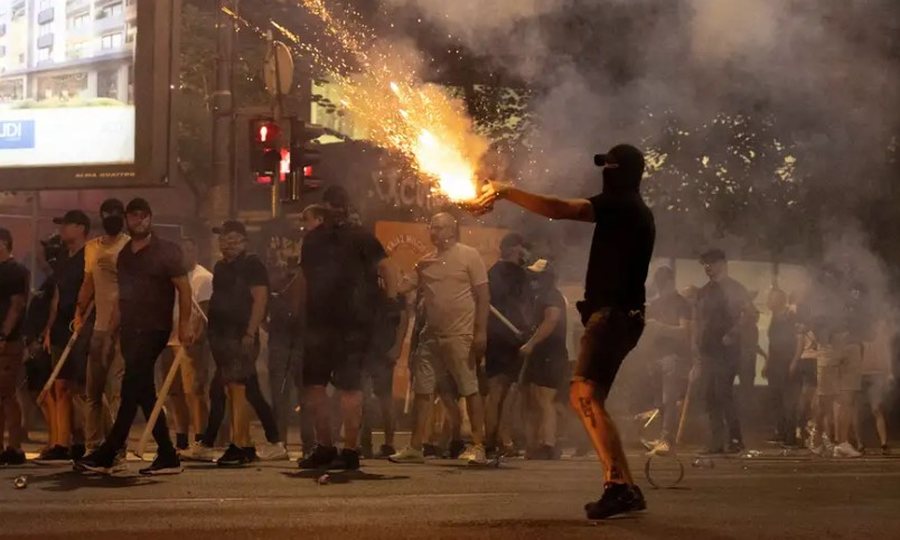
Many German media outlets have reported on the unrest in Serbia in recent days. Footage from Novi Sad and Belgrade was broadcast on the main news program of the public service television ARD. Shorter reports on the events were published by many portals and newspapers.
Here are excerpts from characteristic articles about these events:
Andrej Ivanji writes for the Berlin-based Tagesspiegel: “Nine months of student-led protests against the regime in Serbia have been largely peaceful. Then on Tuesday, clashes between supporters and opponents of President Aleksandar Vučić escalated in small towns in Vojvodina, Vrbas and Bačka Palanka. On Wednesday, students called for protests under the slogan Serbia, wake up! Citizens in the capital Belgrade, as well as in Novi Sad, Niš, Kruševac, Smederevo, Užice, Čačak, Pancevo and Lazarevac, answered the call. Severe riots broke out in several cities and around 70 people were injured on the second day, the Interior Ministry reported.”
“The regime is on a confrontational course with the students. Special police units play only a secondary role. They do not have enough people and when there are simultaneous demonstrations in several cities, they are usually completely overwhelmed. Activists and sympathizers of the ruling Serbian Progressive Party were let loose on citizens demonstrating against the corrupt autocracy and for the rule of law.”
After describing the very similar appearance of these Vučić sympathizers "with thick necks, broad shoulders, showing strong muscles and often with tattoos, black T-shirts and hats, and many of them are masked", it is said that critical media have identified many of them as criminals with extensive police records.
The article also briefly recalls the collapse at the Novi Sad railway station on November 1 last year. The opposition believes that this tragedy was caused by “endemic corruption” while hundreds of thousands of students suddenly entered the political scene, insisting over the past nine months on “tireless resistance against the Vučić regime.” “Student resistance is now the strongest political force in Serbia.”
Ivanji also gave a brief summary of the events of the last few days, the clashes and violence in front of the SNS party offices, and on the streets of Novi Sad.
“On Wednesday, Vučić appeared at the party headquarters in Belgrade during the mass protests. There, he encouraged SNS members to confront the demonstrators. The famous journalist Milan Qulibrk commented on this by saying that Serbia no longer has a president. That is, in the midst of the crisis, Vučić supported one side and came forward as the leader of the party and not as the head of state – Vučić only formally leads the party.
“Both announced what to expect now: SNS members will no longer retreat and will defend their homes and property from terrorist attacks, according to the principle: all for one – one for all.”
"Instead of simply announcing early elections, Vučić is plunging the country into civil war, the student movement announced on its Instagram account," Tagesspiegel writes.
The Rheinische Post newspaper published a short report on what is happening “From Novi Sad to Niš” under the headline “Anti-government protests are escalating in Serbia.”
Journalist Thomas Roser reports that President Aleksandar Vučić has announced that he will clear the streets of hooligans and that there will be no mercy for… them.
“In the politically divided country that aspires to join the EU, months of protests over corruption have escalated. Vucic blames his critics for the bloody clashes. However, student activists, the opposition and independent media say the unrest was orchestrated by thugs from the ruling party.”
Niklas Zimmermann also writes for Frankfurter Allgemeine Zeitung about what has happened in Serbia over the last three days and how students and the government view the situation.
“The specific cause of the latest wave of protests should not be sought in George Soros, who is often cited as their alleged initiator, but in the northern Serbian province. In the town of Vrbas, more than 50 people were reportedly injured. (…) These clashes also took on an international component, as one of them occurred in Bački Petrovac, where the majority population is Slovak. There, a group of SNS supporters destroyed a photo exhibition supporting student protests during an annual Slovak event.”
“The Slovak Ombudsman, Robert Dobrovodski, addressed the Serbian Ombudsman and asked him to investigate the actions of the police, who are accused of not having prevented this attack. The opposition leader, Michal Simecka, also traveled to Bakčki Petrovac to express his solidarity there. Slovak Prime Minister Robert Fico, who is politically close to Vučić, had previously said that these conflicts were an internal matter for Serbia. The opposition accused him of not caring about his compatriots abroad,” writes the Frankfurter Allgemeine Zeitung. /DW





Lini një Përgjigje