


 Shkruar nga Nesrine Malik
Analysts say that the American president's 'clownism' and lack of ideology make him somewhat less dangerous, but they are wrong.
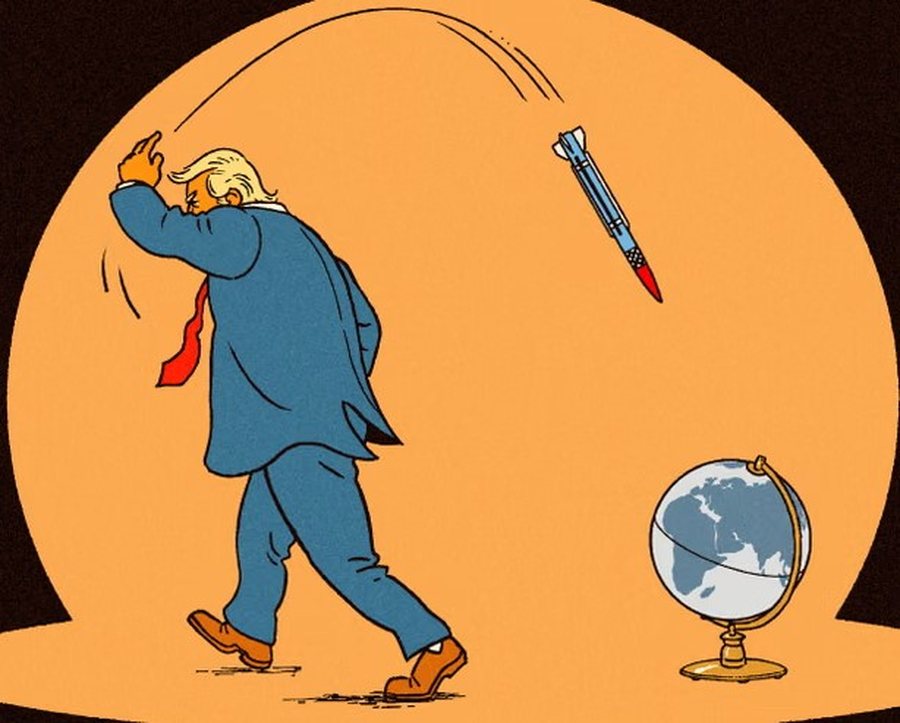
Over the past few weeks, a random kaleidoscope of images has been racing through my mind. Some are characters from movies I haven't seen since childhood. Others are fragments of iconic literature or art. What unites them all is an exaggerated, almost kitschy evil.
These images seem to be replacing the real carnage my brain is trying to process: bodies pulled from rubble in Gaza, a school full of young students destroyed in Iran. Over 1 million people in southern Lebanon driven en masse from their homes.
What is so disorienting about this atrocity is the way it has been allowed to happen, the ease of it. Donald Trump hovers over this circus of death and chaos. Trump defies any attempt to give his actions a clear strategy. His wars, the killing of innocents, even the threat of entire civilizations are reshaping the world, but without any grand orchestrated plan. He is driven by momentary impulses and resentments.
Trump’s apparent lack of vision or ideology is often misinterpreted as making him less dangerous than past authoritarians, who have become the model of what evil looks like. Take the debate over whether Trump can be called a “fascist.” “You can’t be a fascist,” said journalist Barton Swaim, “without having some intention of being one.” Trump is incompetent, unstable, “strange and irritating,” but not a fascist, he says.
Trump also doesn’t adhere to the style or appearance of the fascist model: he doesn’t hold large rallies in uniform or deliver fiery speeches from balconies to flag-waving crowds. He hasn’t yet completely overturned the constitution or dismantled democracy. He’s a perverse comic figure, a man who exposes his soul in angry outbursts on social media or in mindlessly rambling speeches. He talks about war with Iran accompanied by a giant Easter bunny, posts images of himself as Jesus. He always backs down, shouting, laughing, pursuing, then retreating when faced with opposition.
But isn't that exactly what's wrong?
A projection into the world not of a grand and imposing purpose, but of smallness and fear?
The consequences of violence are secondary to the sense of validation that comes from exercising it. Trump’s constant self-aggrandizement, his hostility toward political opponents, his anger at the media, his promises of revenge against the Iranian regime, are all ways to erase and avoid a perpetual fear of humiliation and worthlessness.
It is precisely in this smallness that an insatiable evil lies. In 1931, after Adolf Hitler’s Nazi party had gained ground, he was interviewed by the American journalist Dorothy Thompson for Cosmopolitan. “When I entered Hitler’s drawing room at the Kaiserhof Hotel,” she recalled, “I was convinced that I was meeting the future dictator of Germany. Within about 50 seconds, I was certain that he was not. That was enough to gauge the shocking insignificance of this man.”
“Think of Benito Mussolini,” wrote journalist Barbara Grizzuti Harrison in the LA Times, “with his military boots, his strong jaw, pompous and ridiculous on his balcony in Rome’s Piazza Venezia, with that absurd fascist salute and exaggerated oratory. Think of that funny man, that perfect owl,” and remember that “just because something is funny doesn’t mean it’s not dangerous.”
We tend to give history and its events a seriousness and coherence that we have difficulty seeing in the present. This is because it is difficult for the human mind to confront evil in a ridiculous form and recognize it as such. Thus it creeps in unnoticed. Thus the question arises as to how such crimes were permitted in the past. The answer is that it rarely comes with clear signs. It comes in the form of broken people, whose power lies in their insatiable desire to make themselves whole, regardless of the consequences. Alongside Trump’s absurdity is the fact that he has access to the means of nuclear destruction and a sociopathic appetite for escalation.
Evil consists of a lack of seriousness, carelessness and fragility, as much as of ruthlessness and brutality. Another memory from this mental “filmstrip”: in the film series The Purge, the US has passed a law that for 12 hours any crime is legal, in order to “purge” the dark instincts of humanity. But it is not enough for people to massacre each other for a day. They also dress up in costumes, masks and music, turning it into a ritual of celebration.
What the film captures is that crime is not enjoyable without the performance. Without the sense that power lies in its trivial handling. It’s not just the act, it’s the permission. It’s not enough that policies like ICE divide families and destroy lives, it has to be presented as a celebration, with images of Trump standing next to alligators in ICE hats and slogans like “Alligator Alcatraz.”
There is no way to mitigate or relativize this kind of celebratory evil that will stop Trump. It cannot be minimized as something without ideology or strategic purpose, and therefore manageable. The cruelty and violence that he is unleashing and enabling, at home and abroad, rests on historical precedents and can only be stopped by strong and urgent opposition, otherwise it will consume everything./ The Guardian







Lini një Përgjigje