


 Shkruar nga Pamfleti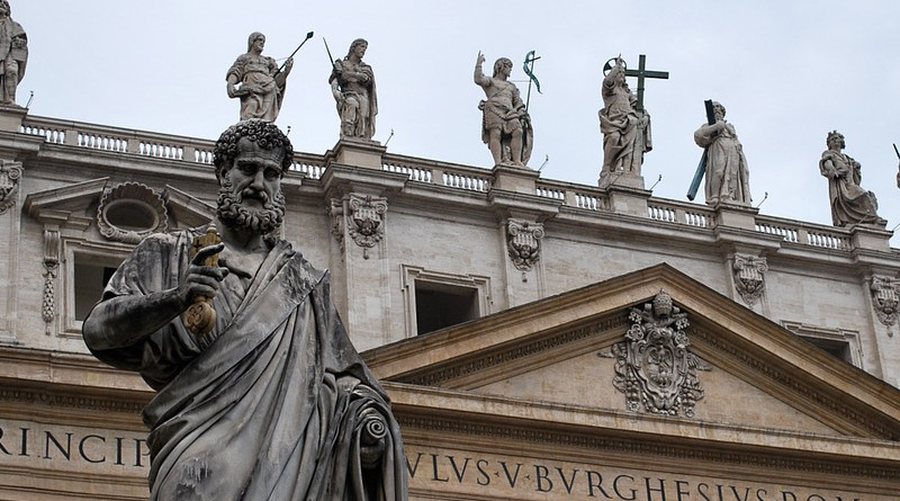
The recent death of Pope Francis on April 21 has revived interest in the “Centuries Prophecy of the Popes,” also known as the prophecy of Saint Malachy, which some say indicates that Pope Francis was the last pope the Church will ever have.
The over 900-year-old prophecy, according to the Catholic Encyclopedia, claims to describe every pope from 1143 until the end of time - and Pope Francis appears, at least at first glance, to be the last pope described in the prophecy, suggesting that the world will end now that his papacy has ended.
A closer look reveals that there is some significant evidence against the veracity of this supposed prophecy. Here's what you need to know.
What is the 'Prophecy of the Popes'?
The document in question is alleged to have been a private revelation given to the medieval figure Saint Malachy, who served as archbishop of Armagh, Ireland, in the 1100s. According to reports, he made a visit to Rome, during which he had a vision of future popes and wrote them down.
The prophecy consists of a list of 112 short phrases; enigmatic "mottos" in Latin that supposedly represent the popes from the time of Saint Malachy onwards.
Mottos generally contain references to one of several things, including the pope's name (his papal name, his birth name, or his family name), his place of origin, or a heraldic coat of arms associated with him (his papal coat of arms, his family coat of arms, or his order's coat of arms, or his place of origin). They often include puns on these things, although this is more apparent in Latin than in English.
Some believe that the mottoes predict the succession of Catholic popes, culminating in a final pope called "Peter the Roman."
The motto of the penultimate in the prophecy of the popes has been associated with Pope Benedict XVI, who resigned from the papacy in 2013 and died in late 2022. The election of Pope Francis as his successor brings us to the last name in the prophecy of the popes, which many have taken to indicate the last pope at the end of the world.
This passage reads as follows:
“Peter the Roman, who will feed the sheep in many tribulations; when they are over, the city of the seven hills will be destroyed and the terrible judge will judge his people. The end.”
Is it true?
This prophecy is not a private revelation approved by the Vatican, although it has had an influence in some Catholic circles for several hundred years. However, there is evidence that casts doubt on its authenticity.
First, the prophecy was not published until 1595, although Saint Malachy died in 1148. There is no record of the prophecy existing in the intervening 447 years. Apparently, this was because the prophecy had been forgotten in a Roman archive and was not rediscovered until 1590.
While the fact that the document is not mentioned in the hundreds of years between the time of its reported compilation and its rediscovery does not prove that it is false, it does cast considerable doubt on its authenticity.
It has been proposed that the document, rather than being an authentic revelation, is a forgery composed around 1590 and then inserted into the archive for political purposes - a claim that would explain the document's long absence.
Is its content true?
The logical approach is to examine the contents of the prophecy to see which theory of its origin is most consistent with it: Does the content seem to suggest that it was written in the 1100s, or does it suggest that it was written around 1590?
Many observers have thought the latter. One reason is that the "mottos" for the period before 1590 are very easy to associate with the popes they are supposed to represent. In contrast, the mottos assigned to popes who came after 1590 are much more difficult to associate with the popes they are supposed to represent and can often only be associated in a contrived way.
Let us now return to the motto that supposedly describes Pope Francis: “Peter the Roman.” The name Peter has no clear connection to Francis, whose baptismal name was Jorge Mario Bergoglio (except for the fact that he held the office of Saint Peter, the papacy). And despite having some Italian ancestry, Francis was not Roman by birth, but rather Argentine.
There is more: The Catholic Encyclopedia notes that, although the prophecy designates “Peter the Roman” as the last pope, the prophecy does not say that no pope will intervene between him and his predecessor, designated as “Gloria olivæ” (“Glory of the Olive Tree”). The prophecy simply states that Peter the Roman, whenever he appears, will be the last.
Thus, there is no compelling reason to believe that the Roman Peter is Pope Francis. Taking all of this together, Catholics need not worry too much about the prophecies of St. Malachi. It is not an approved apparition, and the evidence is consistent with it being a forgery composed around 1590.
More fundamentally, Jesus indicated that we will not know the end times—and in keeping with our Lord’s warning, Bible-based end-of-the-world predictions have a dismal record. Trying to predict the end times based on unapproved private revelation that shows signs of being tampered with is even more misguided.
We must trust God, live by his word, and leave the future in his hands.
As Jesus said: “Therefore do not worry about tomorrow, for tomorrow will worry about itself. Let each day have its own worries.”/ Adapted from “Pamphlet” “Euroasiview”






Lini një Përgjigje