


 Shkruar nga Diplomatico | Pamfleti.net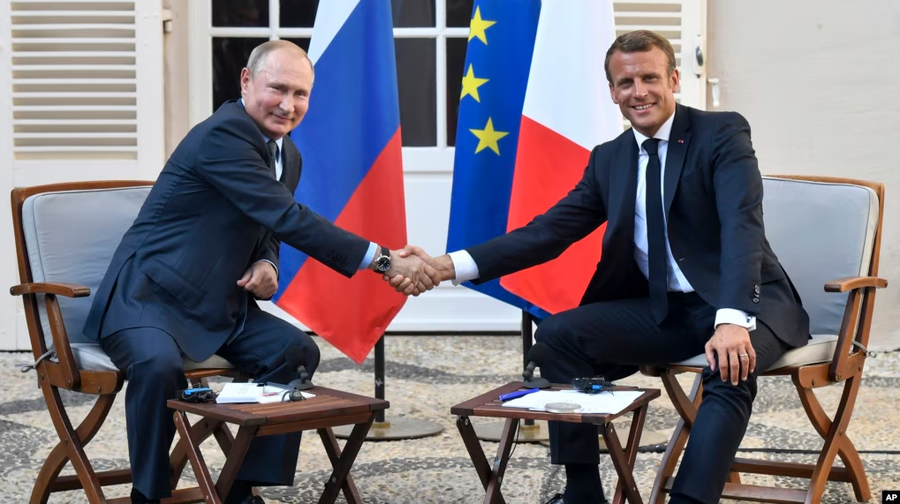
With peace still far away and Ukraine's fate hanging in the balance, the French president will begin his negotiations with Vladimir Putin, even though numerous meetings and talks between them in recent years have produced nothing. European media emphasize that the meeting comes after the blocking of the use of Russian assets in aid of the Ukrainians and as a blow to the new strong anti-Kremlin line of German Chancellor Merkel, whom Russian propagandists are attacking as the successor to Hitler who aims to build the "Fourth Reich"...
During difficult talks over shared debt and Russian assets to be given to Ukraine, French President Emmanuel Macron declared at a press conference that if the American peace proposal failed, Europe would have to talk to the Kremlin itself instead of the United States.
This offer was immediately welcomed by the Kremlin. Vladimir Putin's spokesman, Dmitry Peskov, declared that Moscow was "ready for dialogue." But why have the negotiations over Ukraine suddenly changed?
According to the Financial Times, it was Macron himself who blocked German Chancellor Friedrich Merck's plan to use frozen Russian assets in the European Union to finance Kiev. A "betrayal", writes the British newspaper, which could cause the breakdown of the historic axis between France and Germany within the EU.
This change, of course, does not bother the Kremlin, whose main goal is to divide European chancelleries. The Elysee Palace has already expressed its readiness for a meeting between Macron and Putin, hoping that there will be “mutual political will”, and adding that any conversation will be a “genuine attempt to understand each other” and not “a series of warnings”.
Meanwhile, the Italian "La Repubblica" reports that political scientist Sergei Markov rejoiced at the "betrayal" of Friedrich Merz: "France is realizing that everything could end with the creation of the Fourth Reich in Europe!"
Meanwhile, on the Mig41 Telegram channel, which is close to the Russian Ministry of Defense, someone wrote: "Perhaps the Frenchman Macron has realized where things are going between Russia and the United States, and is now trying to be the first to board the last carriage of the friendship train between Europe and Russia, which is about to depart."
Of course, there are those who are against the enthusiasm for this new round of negotiations. After all, this is not the first time that Macron has sought dialogue with Moscow. Before Russia's invasion of Ukraine, the French president was among the last to talk to Moscow, without achieving anything.
Paris's goal of stopping the military escalation on Ukraine's borders, with the famous meeting of February 7, 2022, around the long white table, failed spectacularly. However, Macron repeatedly called Putin in the first months of the conflict in Ukraine.
Then he went to the other extreme, becoming one of his most vocal opponents. In July of this year, after a hiatus of 3 and a half years, he contacted Putin again to discuss the issue of the Iranian nuclear program.
This offer also proved fruitless, partly because it was clear in Moscow that the French president was isolated on the international stage. The Elysee Palace stressed that any possible meeting should take place “in full transparency with Ukrainian President Volodymyr Zelensky and European partners” and with the sole objective of “promoting a strong and lasting peace.”
Paris has not given a timeline or details on a possible dialogue with the Russian president. However, it has stated that the terms of the meeting will be finalized "in the coming days."
Meanwhile, Putin's threats at his pre-Christmas press conference in Moscow have resonated widely in Europe:
"We are ready to work with Europe... but on equal terms and with mutual respect. We will work together and develop. If this does not happen, Europe will gradually disappear!"
Meanwhile, Moscow's envoy, Kirill Dmitriev, was in Florida to continue talks with the United States. He will return to Moscow today, where he will report on the latest developments to Russian President Vladimir Putin./ Adapted Pamphlet


Lini një Përgjigje