


 Shkruar nga David Brooks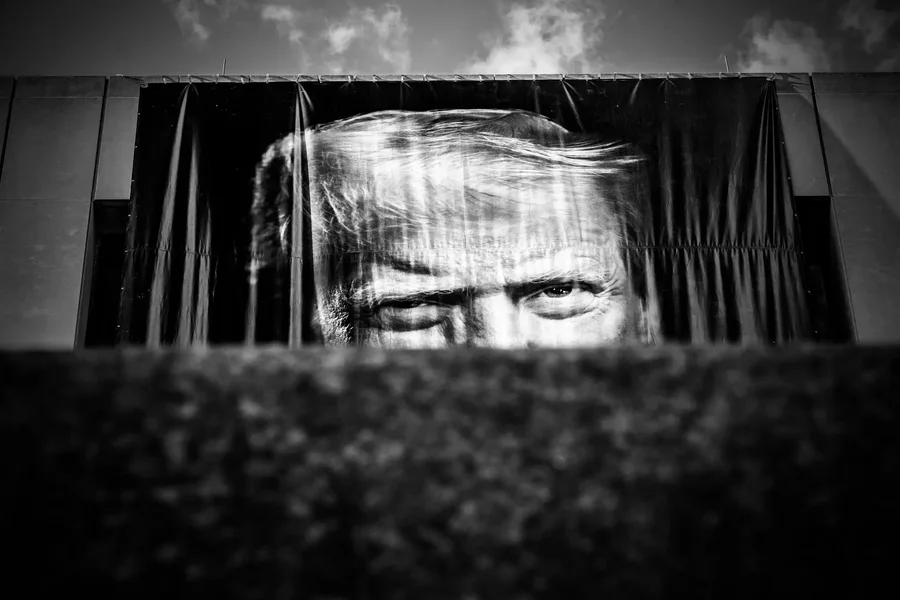
Trump has been increasingly quick to resort to violence.
Last week, Minneapolis Police Chief Brian O'Hara said that the thing that scares him the most is "the moment when everything explodes." I share that concern. If we follow the trajectory of events, it's pretty clear that we're heading toward some kind of disintegration.
We are in the midst of at least four debaucheries: the debauchery of the postwar international order; the debauchery of domestic tranquility wherever Immigration and Customs Enforcement (ICE) agents descend with their heavy boots; the further debauchery of the democratic order, with attacks on the independence of the Federal Reserve and, pardon the pun, trumped-up criminal prosecutions of political opponents; and, finally, the debauchery of President Trump’s mind.
Of these four, Trump's depravity is the main one, the one that leads to all the others. Narcissists sometimes get worse with age, as remaining inhibitions disappear. The effect is bound to be profound when the narcissist happens to be president of the United States.
Every president I've ever covered becomes increasingly self-absorbed the longer they stay in office; and when you start at Trump's level of self-esteem, the effect is excessive grandiosity, a strong sense of entitlement, a lack of empathy, and a vicious reaction to perceived insults.
Moreover, over the past year, Trump has been increasingly quick to resort to violence. In 2025, the US carried out or contributed to 622 bombing missions abroad, killing people in places ranging from Venezuela to Iran, Nigeria and Somalia, not to mention Minneapolis.
The arc of tyranny slopes toward degradation. Tyrants typically become intoxicated by their power, which gradually diminishes self-restraint, increases a sense of entitlement and self-centeredness, increases risk-taking and overconfidence, while escalating social isolation, corruption, and defensive paranoia.
I have recently found it useful to turn to the historians of ancient Rome, beginning with the originals like Cato and Tacitus. These men had a front-row view of tyranny, with case studies scattered before them, Nero, Caligula, Commodus, Domitian, Tiberius. They understood the close connection between private morality and public order, and that, when there is a decay of the former, there will be a collapse of the latter.
“Of all our passions and appetites, the love of power is the most tyrannical and the least social in nature, since the pride of one man requires the submission of the majority,” wrote Edward Gibbon in his 1776 classic, The Decline and Fall of the Roman Empire.
He continued: “In the confusion of civil discord, the laws of society lose their force, and their place is seldom taken by those of humanity. The zeal of conflict, the pride of victory, the despair of failure, the memory of past injustices, and the fear of future dangers, all contribute to the inflaming of the mind and the silencing of the voice of mercy. From such motives, almost every page of history is stained with civil blood.”
The 18th-century English historian Edward Wortley Montagu distinguished between ambition and the thirst for power. Ambition can be a commendable trait, as it can lead people to serve their community in order to gain public admiration. The thirst for power, he wrote, is another passion, a form of selfishness that leads us to “draw everything towards the center of ourselves, whatever we think will enable us to gratify every other passion.”
The insatiable thirst for dominance, he continues, “banishes all social virtues.” The selfish tyrant associates only with those others who share his selfishness, who are eager to maintain the mask of perpetual falsehood.
"His friendship and enmity will be equally false and easily interchangeable, if the change serves his interest."
These historians were impressed by the personal power that the old tyrants could generate. The power-hungry man is always active, the center of attention, ruthless, vigilant, distrustful, restless when something comes his way.
Tacitus was particularly adept at describing the effect a tyrant has on those around him. When a tyrant first assumes power, there is a “rush to slavery,” as vast servile crowds bow down to the great man. The flattery must continually escalate and become more and more humiliating, until the dignity of each follower is completely stripped away.
Then comes what you might call the disappearance of goodness, as morally healthy people hide to survive. Meanwhile, the whole society tends to collapse. The incessant flow of shocking events eventually overloads the nervous system; the rising tide of brutality, which once seemed shocking, begins to seem commonplace.
As the disease of tyranny progresses, citizens may eventually lose the habits of democracy, the art of persuasion and compromise, interpersonal trust, intolerance of corruption, the spirit of freedom, the ethic of the masses.
"It is easier to suppress the spirit and enthusiasm of people than to revive them. In fact, a connection with the imposed passivity itself falls upon us, and the laziness that was hated at first, is loved in the end," wrote Tacitus.
I don’t have enough imagination to know where the next meltdown will come from, perhaps through some domestic, criminal, or foreign crisis? However, I was struck by a sentence that Robert Kagan wrote in an essay on the effects of Trump’s foreign policy in The Atlantic : “Americans are entering the most dangerous world they have known since World War II, a world that will make the Cold War look like child’s play and the post-Cold War world look like paradise.”
And no, I don't think America is headed for anything like a Roman-style collapse. Our institutions are very strong, and our people, deep down, still have the same democratic values.
But I know that events are being driven forward by the damaged psyche of a single man. History does not record many cases where a leader mad for power, sliding towards tyranny, has suddenly regained his reason and become more moderate. On the contrary, the normal course of the disease is towards ever-accelerating deterioration and depravity.
And I understand why America's founding fathers spent so much time reading historians like Tacitus and Cato. Thomas Jefferson called Tacitus "the first writer in the world, bar none."
They understood that the thirst for power is a primary human impulse and that even all the protective measures they built into the Constitution are not sufficient to curb this thirst when it is not ethically restrained from within.
As John Adams put it in a letter in 1798: “We have no government armed with power capable of confronting the passions of man, unbridled by morality and religion. Greed, ambition, revenge, or gallantry would tear the strongest threads of our Constitution as a whale tears a net.”/ Adapted from “Pamphlet”, from “ New York Times”.








Vlen për kryehalabakun botëror dhe po aq për halabakët provincialë si ky i yni. Justifikoj gjermanët e frustruar nga padrejtësitë e luftës ĺ që i besuan Hitlerit, madje dhe fanatizmin çifut, por nuk kuptoj arsyen pse 1/2 e amerikanëve të bardhë e duan këtë mostrën që nuk ka asgjë pozitive. Artikulli është fantastik. E njoh shumë mirë Tacitin dhe Romën. Mesa duket çdo gjë ripërsëritet edhe Kaligula, edhe lvani i tmerrshëm edhe Xhingis hani. Edhe për ne Ali Pasha.