


 Shkruar nga Katie Stallard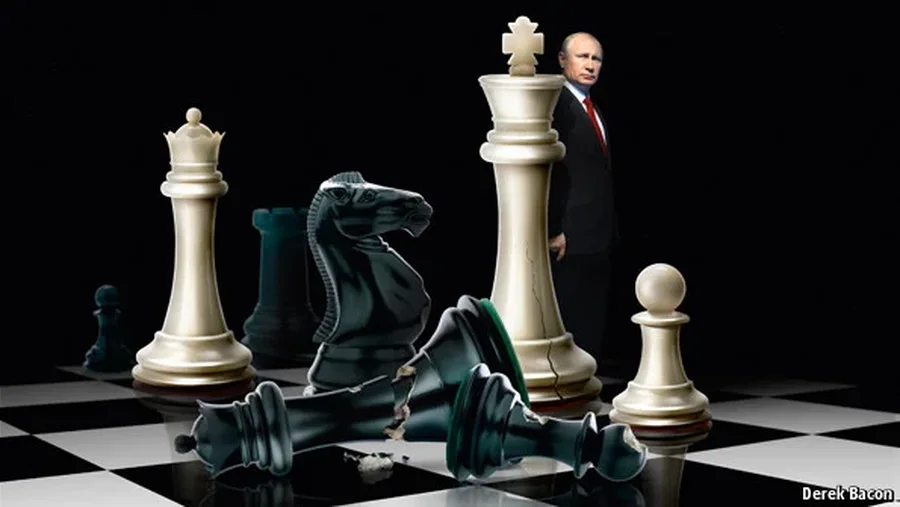
With a divided West and a maneuverable American president, he sees no reason to abandon his main goal: the conquest of all of Ukraine.
Vladimir Putin was in a good mood. On March 18, he was an hour into an annual meeting of Russian industrialists and entrepreneurs in Moscow when the panel's chairman, Alexander Shokhin, announced that it was time to end the meeting. Putin's press secretary, Dmitry Peskov, reminded him that his boss would be on the phone with Donald Trump at that very moment.
Shokhin said this while nervously looking at his watch. “It doesn't matter,” Putin said, ignoring Shokhin's concern. “That's his job!” The audience burst into laughter.
Putin clarified that he was referring to Peskov, but everyone understood that the joke was on Trump. The message was clear: there was no rush to go talk to the US president. When the two leaders began talking an hour later, Putin’s calm proved to be justified. While Ukrainian President Volodymyr Zelensky was attacked and then kicked out of the White House after raising the issue of security guarantees, Putin was showered with praise from Trump.
Describing their conversation as “very good and productive,” Trump announced on social media that they had agreed to “an immediate ceasefire on all energy and infrastructure facilities.” In fact, this was not an act of charity from Putin, given Ukraine’s recent successes in striking Russian oil refineries.
Moreover, the Russian president said that the only way to prevent the war from escalating was to end foreign military aid and intelligence sharing with Kiev. So, unless Ukraine is abandoned by its allies and forced to surrender, he intends to continue the war. And that's because the Russian military is making rapid progress on the battlefield. Supported by North Korean troops, they have made significant progress in recent weeks in retaking most of the territory that Ukraine had occupied in the Kursk region of southern Russia since the summer of last year,
The offensive in eastern Ukraine appears to have stalled. But now the geopolitical dividing lines have shifted. With Trump at the helm of the US, Putin sees an opportunity to tear Ukraine apart and divide Europe. He hopes to at least secure sovereignty over the four regions of Ukraine that he claims to have annexed but does not yet fully control: Luhansk, Donetsk, Zaporizhzhia and Kherson, along with Crimea, which he annexed in 2014.
He is also likely to demand permanent neutrality for Ukraine. That is, in a truncated EU, and never in NATO. Meanwhile, he wants new elections to be held, which he hopes will
They will remove Zelensky, and bring a softer leader to power.
On the other hand, it will not accept the presence of European troops as part of a peace agreement, as this would make it more difficult to resume the war if necessary. According to Putin, either Ukraine regains its place in the Russian orbit or it must be destroyed. Even just 6 months ago, these demands would have been unthinkable.
Russia risked losing the war for most of the first year. But America, which pledged to stand by Ukraine “for as long as it takes” during the Biden administration, is no longer there. Past experience has taught Putin that Trump is too susceptible to flattery and the lure of a lucrative deal.
At the same time, Trump barely hides his contempt for Zelensky, whom he has called a “dictator,” but also for the European Union, which he insists was “formed to sabotage the United States.” It would be a big blunder if Putin did not seize this advantage.
Of course, there are also reasons why Putin might welcome a temporary cessation of hostilities in the form of a ceasefire, as a chance to rebuild his weakened military. Over the past three years, British intelligence estimates that around 900,000 Russian soldiers have been killed or wounded.
Russia has lost nearly 12,000 tanks and armored fighting vehicles, hundreds of aircraft, and more than 20 of the ships of its famed Black Sea fleet. Although the Russian economy has withstood Western sanctions much better than many international analysts once predicted, there are signs of great pressure.
Last year, interest rates rose to 21 percent, inflation by 10 percent, and prices for basic foods like butter by 30 percent. There is a persistent shortage of workers due to the number of Russian citizens who have fled the country and men who have been mobilized for war.
But that doesn't mean Putin is desperate to end the war. Recent moves to shift the country's economy to a war footing appear sustainable, at least in the short to medium term. The Russian soldiers fighting in Ukraine come from the country's poorest regions.
And good pay and compensation for the families of the fallen have brought an economic revival to those areas. The same has happened to the ruined factories and industrial cities that once fueled the mighty Soviet army, producing tanks and artillery shells.
Russia's revamped military-industrial complex, a sector long synonymous with corruption, offers new opportunities for enrichment for the wealthy elite around Putin. Meanwhile, the latter knows that Trump's time in office is limited. Barring a change to the US constitution, he will be in power for another 4 years.
He could lose control of Congress by the end of next year. So the Russian leader will take any concessions Trump is willing to offer, while he has so far shown no sign of accepting anything worth exchanging./ Adapted from “Newstatesman”, Pamphlet


Lini një Përgjigje