


 Shkruar nga Patrick Jenkins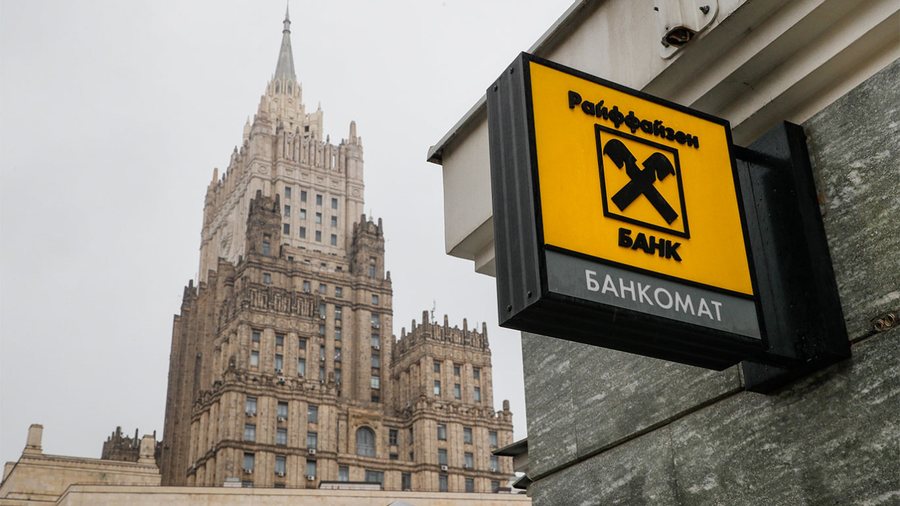
Austrian bank continues to make huge profits after Putin's invasion of Ukraine...
There is a simple and remarkable fact about the business of Raiffeisen Bank International - a fact that illustrates why the West has failed to hamper the Russian economy, despite the sanctions imposed since the full invasion of Ukraine in February 2022.
For the past three years, profits generated by the Russian arm of the Austrian bank have exceeded the entirety of the group's other operations.
Given that all of Russia's major banks have been sanctioned – and Western banks have been under pressure to reduce their activity in Russia – it's surprising that Raiffeisen, unlike its rivals, has actually increased its profit margin.
According to estimates by Citigroup analysts, this year the bank will have a net profit from its units in Russia and Belarus, of about 1.2 billion euros, compared to almost 500 million euros from all its branches around the world.
This looks bad and it is bad. For a Western bank to thrive shows a disdain for Western governments that have tried to shut down Russia's global nexus. It is also a very real boon to the country's economy, and therefore its war machine. Western banks still in Russia are the main channels for clients there to operate internationally, while generating significant tax revenue. (Foreign banks last year paid more than 800 million euros in taxes to the Russian government. Raiffeisen paid almost half of this number.)
So it was no surprise that the US Treasury in January launched an investigation into Raiffeisen's Russian business. Or that last month, the European Central Bank, the group's main regulator, pressed to speed up its withdrawal from Russia.
Until recently, Raiffeisen had given the strong impression that it thought it could maintain its difficult balance of operating a large Russian business while keeping the authorities at bay. As the Financial Times revealed a few weeks ago, it even appeared to be in growth mode, posting thousands of job adverts which revealed plans for "active expansion". Then they tried to deny it.
In a sense, Raiffeisen is in a difficult situation. Even if it really wants to leave Russia, doing so is subject to Kremlin vetting of any buyer. Meanwhile, restrictions imposed by the Russian regime mean the bank cannot repatriate profits to Austria through dividends. Last week, apparently amid pressure from the US Treasury, the bank abandoned a high-risk plan to swap funds in the bank's Russian arm with Austrian construction business Strabag, which had been held by sanctioned oligarch Oleg Deripaska. before he transferred it to an unknown company.
This leaves Raiffeisen with nearly 5 billion euros of capital trapped in Russia. Most of the customer deposits and retained earnings are deposited with Russia's central bank, where it earns 16 percent interest.
Although it has reduced its lending activity in the country (and is selling its unit in Belarus), it, like other foreign banks, has become a channel for the movement of money out of Russia. Unlike sanctioned Russian banks, Raiffeisen remains part of the Swift network that connects banks around the world. The bank does not disclose a detailed breakdown of its money transfer operations and declined to comment on the extent to which this part of its Russian business had flourished.
Against this background, Raiffeisen shareholders have remained strangely sanguine. Although shares fell on news of Russia's invasion of Ukraine, they have recovered 26 percent over the past year. They are now trading at around 30 percent of book value. Given that more than half of the bank's business is under Russian influence and Western pressure, the financial situation itself is good. /Adapted "Pamphlet" from " Financial Times "



Lini një Përgjigje