


 Shkruar nga Pamfleti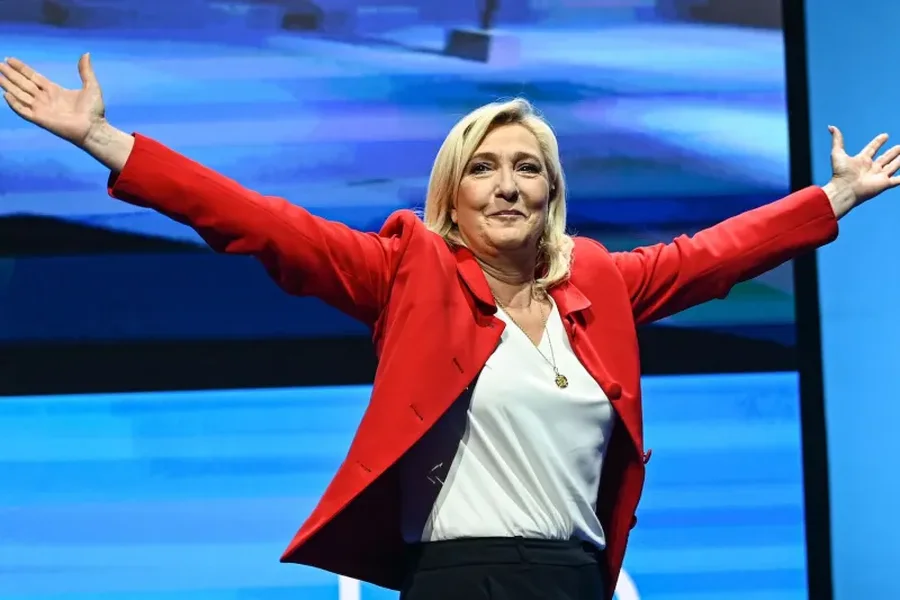
France's presidential election is still a long way off, but the eventual victory of Marine Le Pen is a challenge the French will have to face now, amid the rise of the far right in Europe, according to The Economist.
Marine Le Pen and her party have gained support according to the latest polls, signaling a turn the French political scene is not used to and as the British media point out, any complacency is misplaced.
But Marine Le Pen, unlike her father, Jean-Marie Le Pen, a historic figure of the French far-right, claims the presidency.
Le Pen is on the way to victory
Since Le Pen took over the National Front from her father in 2011, renaming it the National Rally, she has turned a pariah faction into a party capable of governing.
More than 60% of French people now see the National Rally as a political party like any other.
Almost two-thirds of voters believe he can consolidate power, up from 40% in 2018. Most French no longer see him as a "threat to democracy".
Macron's response
The country's next presidential election will be held in 2027. But many things could happen to prevent a Le Pen victory, particularly the emergence of a credible successor to Emmanuel Macron, who cannot seek a third consecutive term according to the French Constitution.
Macron has begun promoting a new generation of leaders, including 34-year-old Prime Minister Gabriel Attal. One of his former prime ministers, Edouard Philippe, is among those preparing for a candidacy. However, Le Pen will be a strong opponent.
In 2022, she won the support of almost 42% of the voters and the second time she will win even more.
What a victory means for the far right in France
France is not a country like any other. It is a nuclear power, with power highly centralized in the hands of a single person, the president, who has the ability to dissolve Parliament, appoint and dismiss the prime minister, and appoint the head of the armed forces, state enterprises, institutions.
In neighboring Italy, where Giorgia Meloni's relatively moderate rule has eased some observers' concerns about a Le Pen presidency, the prime minister is appointed by the country's president, who exercises some control over the executive.
Her closest political allies in Europe are strong, authoritarian men, including Hungary's Viktor Orban.
It is also worth noting that a Le Pen presidency would endanger the foundations of the European Union and call into question France's commitment to the Western alliance.
The far-right leader may have abandoned her calls for a 'Frexit' or France to leave the euro, but her plans to hold a referendum to enshrine in the Constitution the supremacy of French law over EU law well, they would bring it into conflict with the EU.
Unlike Meloni, Le Pen has said she wants to withdraw France from NATO's military wing and opposes Ukraine's membership in both the Alliance and the EU.
At best, a Le Pen presidency would paralyze the Franco-German foundation of the European Union. At worst, an alliance between the nationalist-populist leaders of France, Hungary, Slovakia and, possibly, the Netherlands could encourage Meloni to turn to them.
By voting together, these countries can muster the 35% needed to block decisions in the Council of the European Union. A divided EU would be very different from what exists today.
Although presidential elections will be held in three years, France and its partners should seriously consider Le Pen and her election victory.
A Le Pen presidency is no longer impossible. Nothing would be more reckless than to assume that if Le Pen wins, France, Europe or NATO will be as before./Taken from "The Economist"





Lini një Përgjigje