


 Shkruar nga Pamfleti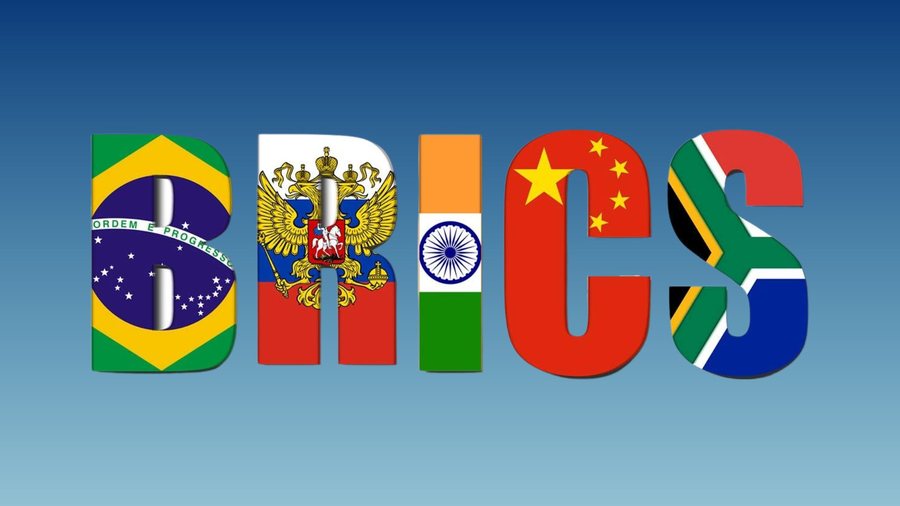
The "non-Western" world raises the level of challenge to the economic and financial hegemony of the United States. From January 1, 2024, six countries, Iran, Saudi Arabia, Egypt, Argentina, the United Arab Emirates and Ethiopia, will join the "Brics" group, which already includes Brazil, Russia, India, China and South Africa. It will be the first step in a kind of "big bang" that aspires to change the geo-economic balance of the world. At least 40 other countries have already applied to join the club, from Algeria to Indonesia, from Cuba to Kazakhstan to Gabon.
Thus, a coalition is being formed that unites the great powers, such as China, India and Russia, with the African, Asian and South African countries, which are still developing. This message was also conveyed at the summit on Wednesday 15 November between Chinese leader Xi Jinping and US President Joe Biden in San Francisco. "The world - said Xi - is big enough for both of us. China and the United States are fully capable of growth, despite their differences." In other words: open doors for Western capital, but all-out competition with Washington for global primacy.
The acronym Bric was coined in 2001 by Jim O'Neill, chief economist of the American investment bank Goldman Sachs, to indicate four realities on which to focus for high-potential investments, given their turbulent development. O'Neill's prediction, in reality, did not take into account that a political-diplomatic process was also starting. The governments of Brazil, Russia, India and China had already started a dialogue which reached maturity with the first summit, organized in the south of Russia, in Yekaterinburg, on June 16, 2009. In 2010, the four founders decided to open up to Africa. South. And so the Brics became the Brics.
The International Monetary Fund (IMF) notes that in 2022 the five BRICS countries produced 31.5% of the world's gross product. From next January, with the addition of 11 countries, the share of total wealth will continue to expand: 38.5% in 2028.
Just to have a point of comparison: in 2022 the European Union covered 14.5% of world GDP; while G7, 30.3%. And in 2028, their share of wealth will be further reduced: that of the EU (13.7%), that of the G7 (27.7%). 1.03 billion people live in the G7-EU block, 3.6 billion in "Brics plus".
G7 can count gold reserves of 17,527 tons, Brics has 5,493 tons. But those "new" countries already have 21% of the oil stock, and with the arrival of Saudi Arabia, the United Arab Emirates and Iran, they will reach the threshold of 41%.
On the western front, the only two producers, namely the United States and Canada, account for 20 and 6% respectively. But the issue is: what are the objectives, where do they want to go "Brics plus" and above all, can they go.
Their stated goal is to build an alternative economic, trade and financial order to that created by the United States at the end of World War II.
The first step has already been taken: the creation of the "New Development Bank" (Nbd). It began operating in 2016, from its headquarters in Shanghai, with the ambition to become the monetary fund for developing countries: lending to struggling governments without requiring drastic reforms. The Bank's shareholders are the five BRICS countries, to which Egypt, Bangladesh and the United Arab Emirates have been added.
In seven years of activity, the NDB has spent the equivalent of $30 billion to finance about 100 infrastructure-related projects, with the goal of reaching $350 billion by 2030, surpassing the IMF, which on November 15 2023 is managing approximately $110 billion in loans. The nbd mainly moves local currencies as part of a wider strategy: to get rid of the "dictatorship of the dollar".
An alternative currency to the dollar
This topic was at the center of the last Brics summit, on August 24, 2023, in Johannesburg, South Africa. Xi Jinping, Lula, Modi, Russian Minister Sergei Lavrov, South African President Cyril Ramaphosa started from the fact that the dollar is today the focal point. The US currency regulates 60% of international trade and 89% of transactions in the foreign exchange market, i.e. buying or selling currency. While international bond issues denominated in dollars have gone from 38.5% in 2003 to 48.5% in 2023. This means that in the last twenty years more and more states and more and more public companies or individuals have relied on the currency American, to seek resources in foreign financial markets.
But would "Brics plus" really be able to launch a single currency, perhaps on the model of the euro, conceived and tested from scratch? The widespread answer in global financial circles is “no”; and so it will be for a long time.
Meanwhile, the Beijing government is pushing to designate its own currency, the yuan, to become an alternative to the US currency. But it is far behind: today the yuan covers only 2.6% of world foreign exchange reserves, compared to 5.8% of the Japanese yen, 4.8% of the British pound, 20% of the euro and 59% of the dollar.
Since 2005, Beijing has entered into a series of agreements with the central banks of, among others, Malaysia, Argentina and Nigeria to provide the yuan as a currency for foreign reserves.
In addition, the Chinese have developed a banking platform, along with Thailand, Hong Kong and the United Arab Emirates, to be used as an alternative to Swift, the system most used by global credit institutions to settle payments financial and commercial. However, India and Indonesia have already made it known that they are not interested in replacing the dominance of the dollar with that of the yuan.
While Brazilian President Lula proposes: "When we trade with each other, we can easily do it using our currencies."
Lula's idea, however, may have limited impact. Starting with the giants, China and India. In 2022, the traffic between the two countries increased by 8.2%, reaching the threshold of 135.9 billion dollars.
Trade between the US and India reached $191.8 billion; that between the USA and China is up to 758.4 billion. Therefore, tested by the facts, the Brics are still not able to do without the United States and the West, its products, its technology and its reference currency. Then the political question remains: it is hard to imagine that these 11 countries and those to come can move in a compact way, and therefore influence the discussions in international bodies, or in the G20, the group that periodically gathers the leaders of The 20 best economies on the planet.
China has not explicitly condemned Putin's aggression in Kiev. India did. National border disputes between Beijing and New Delhi are ongoing.
Xi Jinping aims to reduce American influence in the Indo-Pacific region. On the other hand, Indian Prime Minister Modi is cultivating dialogue with Joe Biden.
For the Middle East: Iran wants to wipe Israel off the face of the earth; Saudi Arabia was willing to sign an economic cooperation agreement with Tel Aviv, in exchange for Washington's military protection, as well as American technology for civilian use. The Israeli response to the terror attack in Gaza, however, has united, at least for now, the Muslim world against Benjamin Netanyahu's government.
The challenges of "Brics plus", therefore, will be two. That towards the West and, in parallel, that of leveling internal political differences, to share the strategy for money, trade, investments to question the Western geo-economic center. / Corriere della Sera – Bota.al





Lini një Përgjigje