


 Shkruar nga Antonia Zimmermann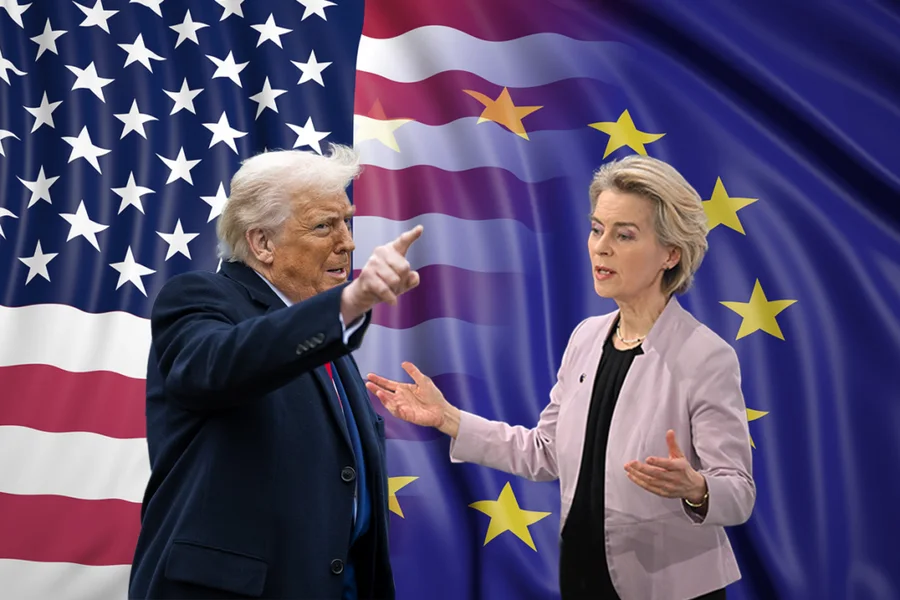
Donald Trump is using America's military and technological superiority to impose unilateral agreements on Europe.
After defeat by the British in the First Opium War, the Qing dynasty in China was forced to sign the Treaty of 1842, which paved the way for a century of foreign oppression and colonial control over trade policies. It was the first of the so-called “unequal treaties,” in which the military and technological powers of the time imposed unilateral terms to cover their trade deficits.
Today, almost two centuries later, it seems that the European Union is experiencing a similar situation to Donald Trump's United States. The trip of European Commission President Ursula von der Leyen last month to Trump's golf resort in Turnberry, Scotland, to sign an unbalanced trade deal has raised serious concerns that Europe is losing its former clout as a trading superpower.
Its critics called the acceptance of a 15% tariff on most European goods an act of “submission,” a “pure political defeat for the EU,” and an “ideological and moral capitulation.” But with the ink still fresh on the deal, Trump ratcheted up the pressure, threatening new tariffs on the EU over digital rules that affect American tech giants. If the EU did not comply, Trump warned that the US would halt exports of vital microchip technologies.
This came just days after Brussels believed it had received written assurances from Washington that its digital sovereignty was secure. Trump, like the British in the 19th century, knows that he holds the military and technological cards, and that Europe is far behind in these areas. He is aware that Europe does not want to face Vladimir Putin without American military support, nor can it survive without American chip technology.
The European Trade Commissioner, Maroš Šefčovič, acknowledged that the deal with the US is a reflection of Europe’s strategic weakness: “It’s not just about trade. It’s about security, about Ukraine, about the current geopolitical instability.” Experts like Thorsten Benner in Berlin go further, saying that this is a consequence of two decades of underinvestment in defense and technology, and the failure to deepen the common market.
Similar to the Qing leadership, Europe ignored the warning signs. Sabine Weyand, director-general for trade at the EC, recalled that the EU “ignored the warnings during Trump’s first term and fell asleep again,” and is now paying the price.
Meanwhile, Trump sees the agreement as the foundation of a "new world trade order," which he calls the "Turnberry system," comparing it to the Bretton Woods of 1944. But the text of the agreement, only four pages long and vague, gives him room to make new demands or threaten retaliation whenever he judges that Europe is not respecting its commitments.
Brussels sells this as the “lesser bad option,” but in practice it is proof that blackmail works. Beijing is watching closely, at a time when EU-China relations have deteriorated and China maintains dominance over critical minerals that the West needs for green and defense technologies.
To avoid a prolonged period of weakness, the EU must reduce its dependence on the US for defence, technology and finance. Ursula von der Leyen has outlined three pillars: preparing retaliatory measures, diversifying trading partners and strengthening the single market. Mario Draghi warned that without deep reforms and investment in European infrastructure, technology and companies, the EU risks falling into “geopolitical irrelevance”.
If it doesn't wake up, Europe could remain just a battlefield where the US and China clash. The question is: will the EU succeed in strengthening its role as a center of free trade, or will it turn into an inevitable territory of rivalry between superpowers? /Adapted from "Pamphlet" by "Politico"





Lini një Përgjigje