


 Shkruar nga Ivana Stradner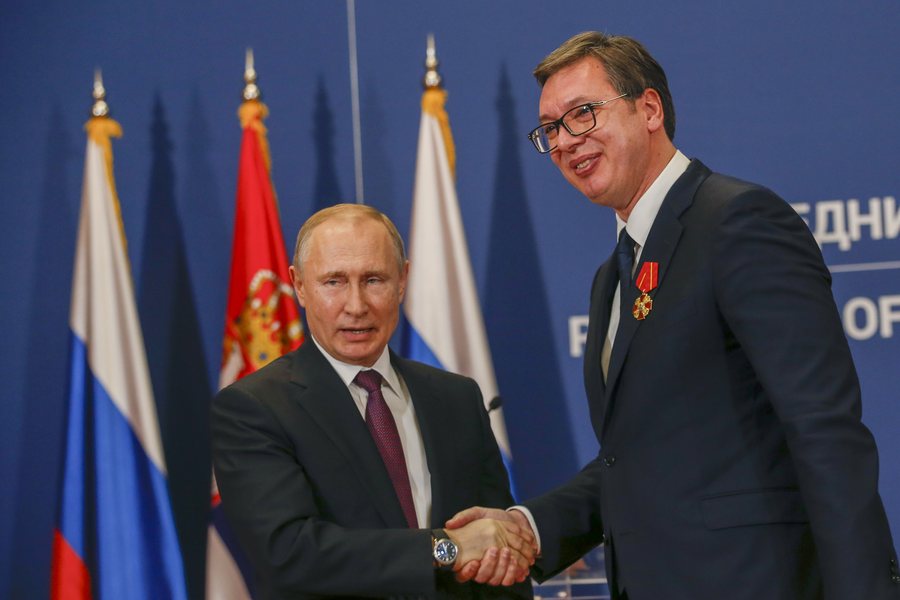
Two of them, Serbia's Aleksandar Vučić and Slovakia's Robert Fiko, represent Russia's success in resisting Western diplomatic isolation, legitimizing its global influence, and defying EU pressure.
Aleksandar Vučić does not want Serbia to be closer to the West and the European Union. His ultimate goal is to stay in power by playing both sides: maintaining close ties with Russia and China, while receiving economic benefits from the EU.
Last week marked “Victory Day” in Russia, the celebration of the victory that defeated the Nazis, ending World War II in Europe. Victory Day in Russia did not disappoint, symbolizing an event of pride, patriotism and propaganda.
Vladimir Putin acknowledges that global politics is heavily influenced by perception, and the advantage lies with the party that controls the information. To portray Russia as a major global power, 20 or so world leaders joined the Kremlin in the celebrations.
Two of them - Serbia's Aleksandar Vučić and Slovakia's Robert Fiko - represent Russia's success in resisting Western diplomatic isolation, legitimizing its global influence, and defying EU pressure.
Despite rumors that they would cancel their visit due to health problems, the Serbian president and Slovak prime minister arrived in Moscow ahead of the Victory Day celebrations on May 9. Vučić posted images from Moscow on his social media accounts, saying that he had “given his word” to Putin that he would attend and that “I did what I said.”
Meanwhile, Fiko criticized the EU for warning him not to participate in the parade. He stressed that he is the leader of a sovereign state, adding: "No one can tell me where to go and where not to go!"
Kremlin spokesman Dmitry Peskov praised the two leaders for their “heroic act” in the face of “open and unrestrained pressure” from the European Union. Europe again called for a cessation of hostilities in “Russia’s war of aggression,” while the British prime minister said Putin must “pay the price for avoiding peace.” The EU threatened Fiko and Vucic for their trip to Russia. Brussels had criticized Vucic’s plan to attend the celebrations, saying it would constitute a clear violation of the bloc’s set criteria for Serbia’s membership.
Brussels should understand that Vučić is not interested in joining the bloc. He keeps the door open for EU membership, if only to benefit from its funds. But he has no interest in bringing Serbia closer to the EU's strict rules on corruption, the rule of law and democratic governance.
In fact, one of the first things Vučić did upon coming to power was to undermine the pro-Western political opposition, while strengthening far-right groups to improve his political position. On the other hand, he is facing massive protests in the country after the collapse of a roof at a railway station in the city of Novi Sad killed 16 people.
Ultimately, Vučić needs Putin. To that end, Western leaders have tried to appease the Serbian president by offering incentives, including economic initiatives and investment, in the hope of making him a partner.
But this is a futile effort. Vučić does not want Serbia to be closer to the West and the European Union. His ultimate goal is to stay in power by playing both sides, maintaining close ties with Russia and China, while continuing to reap economic benefits from the EU.
Putin humiliated Brussels by hosting Vučić and Fiko in Moscow, and ensuring that the EU’s response remained weak and largely rhetorical, i.e. without concrete consequences. For despite the EU’s threats and Vučić’s visit to Moscow, the President of the European Council, Antonio Costa, visited Vučić on May 13 in Belgrade, stressing that Serbia is “fully committed to the EU accession process.”
Meanwhile, British MP Emma Lewell handed a letter to British Foreign Secretary David Lammy, co-signed by 25 other MPs, condemning Vučić’s visit to Moscow. She called on “the Starmer government to change course, starting with a series of major sanctions against the Serbian government and its collaborators….”
Now, Brussels must implement its threats against Serbia and Slovakia. First, the EU must cut off funding for Vučić, as EU accession funds strengthen his authoritarian regime. Brussels should not fear an escalation by Belgrade, as Vučić needs the EU more than the EU needs Vučić.
This strong punitive measure will also send a clear signal to Moscow and Belgrade that the EU is serious about upholding its values, which Vučić seems to think he can exploit.
Second, Brussels should treat Fiko as it treats Viktor Orban, and impose broader financial costs on him, legitimizing the EU's power and setting an example of credible threats followed by concrete measures.
Despite Fiko and Vučić's boasting, their political strategy is extremely fragile, and the EU should not fall prey to their games./ Adapted from "Pamphlet" by "Kyiv Post"



Lini një Përgjigje