


 Shkruar nga Pamfleti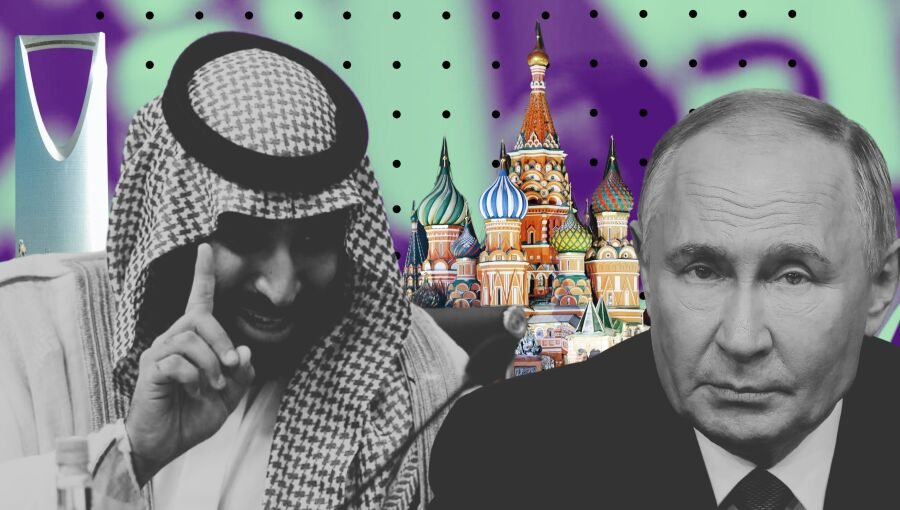
Economic ties between Russia and key Gulf Arab states have expanded since the outbreak of the war in Ukraine. Russian-UAE trade grew from $5.3 billion in 2021 to $11.2 billion in 2023, while Russian-Saudi trade increased by $1.1 billion over the same period.
The Gulf Cooperation Council (GCC) states – Saudi Arabia, Kuwait, Bahrain, Qatar, the United Arab Emirates and Oman – are increasingly supporting Russia in its geopolitical and economic standoff with the West, but they have failed to forge an alliance with the Kremlin, argues Nikolay Kozhanov, an associate research professor at Qatar University, in an article for Riddle.
The relationship between the Kremlin and the Gulf Arab monarchies is more than a marriage of convenience, but less of a full partnership. Since becoming competitors with the US in global oil markets, the GCC countries have been trying to establish themselves in the middle ground between East and West and become autonomous players on the international geopolitical stage, while also tapping into Russia’s broader Muslim culture.
The perceived closeness between the GCC and Russia stems from the obvious economic benefits the Gulf states derive from their relations with Moscow, including cooperation within the OPEC+ framework to stabilize oil prices, which the Kremlin carefully ignored for years until signing in December 2016 following the international sanctions regime following Russian President Vladimir Putin’s annexation of Crimea two years earlier. Putin has been doing his utmost to woo Arab states, particularly the Kingdom of Saudi Arabia (KSA), as he attempts to rebuild Russia’s international relations, focusing on the Global South. This has been welcomed by GCC countries seeking a counterweight to the US, as their relations with Washington have soured since the shale revolution in 2016.
However, while embracing Putin's vision of a "multipolar world" that he outlined in his recent Valdai speech, the GCC is also careful to keep the Kremlin at bay.
Economic pragmatism over alliance
Economic ties between Russia and key Gulf Arab states have expanded since the outbreak of the war in Ukraine. Russian-UAE trade grew from $5.3 billion in 2021 to $11.2 billion in 2023, while Russian-Saudi trade increased by $1.1 billion over the same period. Beyond trade, those countries have leveraged Russia’s economic pivot to Asia to boost their food and energy security. Russian hydrocarbons, agricultural products, and IT have found an open market in the region, underscoring a pragmatic rather than ideological partnership.
"Russia has been more involved in ensuring the food and energy security of the Gulf since 2022," it was noted in November.
The Gulf’s role in the International North-South Transport Corridor (INSTC), mainly through Iran’s Chabahar and the UAE’s Fujairah port, has also been critical for Russia’s access to Asian and African markets. Multilateral cooperation, such as the UAE’s joining BRICS in 2024 and strategic dialogue within OPEC+, underscores the alignment of economic interests but falls short of solidifying a formal alliance.
A calculated neutrality
On the geopolitical front, the Arab GCC countries have a delicate balance. While Saudi Arabia and the United Arab Emirates avoid open criticism of Moscow, Kuwait and Qatar have condemned Russia’s actions in Ukraine. Diplomatic circles in the Persian Gulf continue to prioritize their alliance with the United States, demonstrating restraint in avoiding sanctions when US pressure increases. As Kozhanov points out, “the GCC does not see Ukraine as ‘their’ conflict.” Instead, economic stability, energy security, and the reshaping of US regional influence dominate their calculations.
GCC policies toward Moscow have been shaped by the region’s changing relationship with Washington. Limited U.S. responses to regional security crises and threats like the NOPEC bill have prompted Gulf states to diversify their partnerships while maintaining strong ties with the United States.
This balancing act extends to Russia, with GCC countries willing to engage economically, provided it does not damage relations with the West.
Fears that sanctions mechanisms, such as the EU price cap on Russian oil, will be retaliated against them also bind the Gulf monarchies to Moscow’s positions. However, such alignment remains tactical, aimed at maximizing economic gain and minimizing exposure to global energy volatility.
Not allies, but strategic partners
Essentially, the GCC's interaction with Russia demonstrates strategic pragmatism rather than an attempt to create alliances and follows that of Iran, which has also moved closer to Moscow in recent years with observer status in the Eurasian Economic Union (EEU) and membership in BRICS, along with Saudi Arabia and the United Arab Emirates.
Economic and political cooperation is based on mutual advantages, not ideological similarities. It is impossible for this relationship to develop into a strong partnership or alliance, as both sides recognize their greater geopolitical limitations and their individual national interests.
Future changes will depend on developments in global energy patterns, the changing role of the US in the Gulf region, and the capacity of both sides to adapt to a more multipolar global landscape.
While the GCC may continue to act as a "fellow traveler" alongside Russia, the relationship is expected to remain pragmatic, transactional, and limited. / Adapted Pamphlet from Intellinews /



Lini një Përgjigje