


 Shkruar nga Pamfleti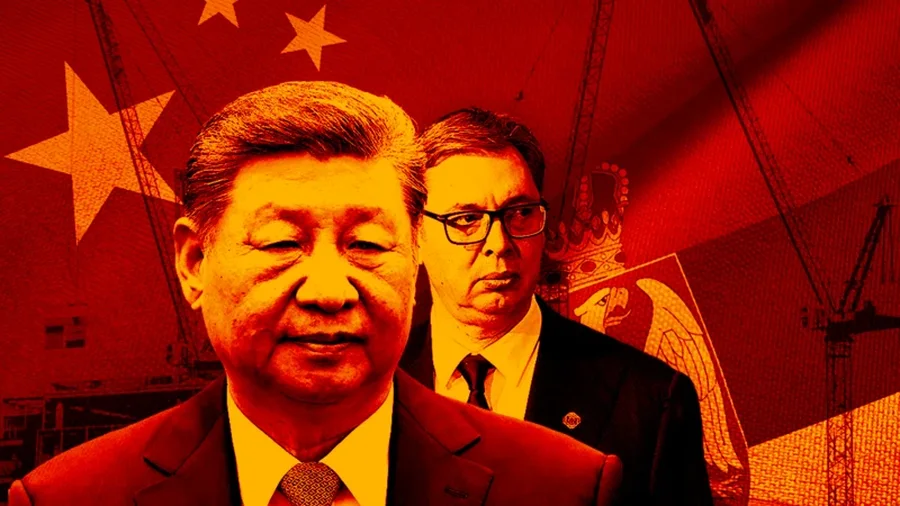
Serbia received 7.7 billion dollars from China...
From 2000 to 2022, Serbia received $7.7 billion from China, most of it in the form of loans, according to the international organization AidData. AidData, a research lab that tracks how governments spend money outside their borders, published a comprehensive report on Chinese investment around the world in October this year.
Chinese money in Serbia, analyzed in a separate report, is characterized by the fact that most of it consists of loans for infrastructure, mining and energy projects, many of which are granted on the condition that the projects use the services or goods of Chinese companies. The loans, worth millions of dollars, have also raised questions about whether Serbia will be able to repay its debts.
"Serbia is not overburdened with debts to China in terms of the overall level of debt, but the rate of debt growth and the issue of its concentration among creditors could be a sign of caution ," Nikola Stakić, a professor at Singidunum University, told the BBC.
The largest single creditor is the State Export-Import Bank of China, to which Serbia owes $2.8 billion according to the latest data for September 2025, which is $45 million more than a year ago.
Globally, China lent more than $2 trillion worldwide between 2000 and 2023, twice as much as previous estimates, according to a report by AidData. The money has flowed to both poor and rich countries, with $200 billion coming to America from Chinese state lenders.
A large portion of credit to rich countries has been directed toward key minerals and high-tech industries, raising fears in the West about Chinese dominance in key sectors and prompting some governments to tighten regulations to prevent Chinese money from flowing in.
"For many years, we assumed that almost all Chinese money was going to developing countries. So we were very surprised to find that hundreds of billions of dollars are going to countries like the US, the UK and Germany, and that this is happening right under our noses ," Brad Parks, executive director of AidData, told the BBC.
In a statement to the BBC, Brad Parks explained that Chinese loans to developing countries, a group that includes Serbia, are mainly intended for infrastructure projects and go towards the public debt of these countries.
“Chinese state-owned banks are the main financiers of public infrastructure in transport, energy and industrial development in low- and middle-income countries. In contrast, Chinese lending to high-income countries is less focused on public infrastructure. In richer EU member states, Chinese state-owned lenders provide loans to corporations, financing from commercial banks, credit lines for Chinese branches in Europe and loans that facilitate Chinese investment abroad ,” he says.
Another difference is that investments in Serbia are less regulated than in EU member states.
“This may explain why Serbia has become one of China’s most important economic partners in the Western Balkans. Serbia does not have the same restrictions and is therefore essential for Chinese companies that want to operate close to, but not within, the EU regulatory space ,” he added.
Specific characteristics of Chinese loans
Beijing considers the details of its overseas investments, how much money it spends and where, a state secret. In Serbia, loan agreements are approved by parliament and are publicly available. However, AidData’s analysis also shows that the Chinese state has directed money to companies operating in Serbia, such as Zijin, the main owner of the Bor mining and smelting basin.
"It was more difficult for us to obtain data and documentation on Chinese grants and loans to Serbian state institutions," Brad Parks told the BBC.
Regarding loans, the analysis claims that Serbia's borrowing conditions were more favorable than Chinese loans for other countries with similar incomes. In addition to lower interest rates, Chinese loans have other characteristics compared to loans from Europe. Loans from China are more flexible and accessible for Serbia, and there is no need to go through complicated procedures, project documentation and everything else that European banks require, says Stakić. However, the downside is that there is a lack of transparency, he emphasizes.
How did Chinese money come about?
Since 2010, the flow of Chinese funds to Serbia has increased. The peak was in 2019, when Serbia received $1.6 billion, including a $1.1 billion loan to modernize the railway from Novi Sad to the Hungarian border. As part of this project, the Novi Sad railway station was renovated, where in 2024 a canopy collapsed, killing 16 people, which triggered a wave of anti-government protests.
The main contractor for this work was a consortium of Chinese companies, China Railway International (CRIC) and China Communications Construction Company (CCCC), while the subcontractors were both Chinese and local.
The companies involved in this project received and performed work outside of internal regulations, based on friendly agreements that are a basis for corruption, according to one of the conclusions of an informal investigative commission that analyzed the reconstruction of the Novi Sad railway station.
However, the “friendly ties” between China and Serbia were confirmed much earlier by official documents. In 2009, Serbia signed an Intergovernmental Agreement on Economic and Technical Cooperation in the Field of Infrastructure with China, which became the basis for subsequent contracts for work on large projects. This agreement was signed during the reign of the coalition around the Democratic Party (now in opposition) and was later supplemented with annexes during the reign of the Progressive Party. The second annex, adopted in 2013, for example, stipulates that programs and projects “are not subject to the obligation to publish a public tender for the execution of investment works and the supply of goods and services, unless otherwise specified in the commercial contract.”
How much money has China given to Serbia?
After all, China was Serbia's second largest development partner in 2022. The European Union leads with 10.3 billion euros. Although the bulk of this ten billion EU dollars consists of grants, of which China accounts for 7.7 billion euros, total grant aid amounts to 304 million euros.
AidData also notes that in-kind donations are not easy to convert into cash, so their monetary value is “probably underestimated.” Among the donors, Zijin stands out, which has invested in education, health and sports, as well as $730,000 from the Chinese state for the University of Novi Sad, where the Confucius Institute is located.
Most of the loans, totaling $4.5 billion, are being repaid, while nine loans worth $250 million should have been repaid by now, according to AidData.
The value of loans being repaid may be higher because AidData was unable to find data on some loans, they say.
“ The international policy of Chinese creditors in developing countries (especially African and Asian countries) is accompanied by a high level of so-called 'hidden debt', i.e. various agreements that do not appear in official statistics. If even a part of this is present in Serbia, this means that the official public debt does not fully reflect the current situation ,” says Nikola Stakić. /Adapted from “Pamphlet” by “TheGeopost”





Lini një Përgjigje