


 Shkruar nga Pamfleti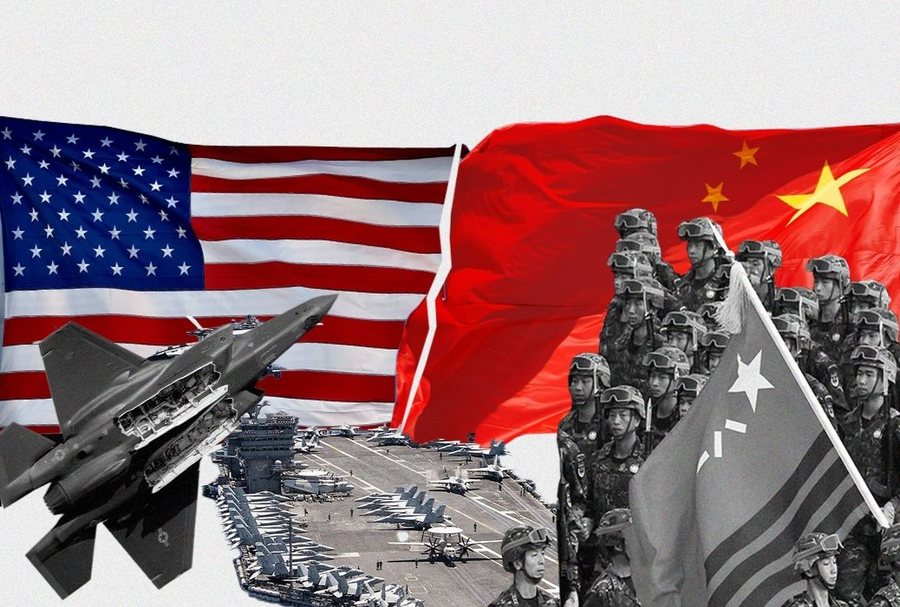
How would a US-China war play out?
In the event of an armed conflict between the United States and China, missile technology is expected to be one of the US military's greatest advantages, according to an analysis by " Army Times ."
A war in the Pacific, experts point out, would be fought primarily through air and naval forces, with ground forces playing a supporting role. However, even without a direct ground invasion of China, the US military has the capacity to strike targets deep inside Chinese territory through its arsenal of long-range weapons.
Currently, the Pentagon is developing several modern attack systems, including the Precision Strike Missile, the strategic medium-range Typhoon system, and the hypersonic Dark Eagle weapon, capable of hitting targets at distances ranging from 1,000 to 3,000 kilometers.
Chinese ports in the spotlight
The most likely targets of such an attack would be China's main ports, which play a vital role in supplying the Chinese naval fleet, for any possible operation against Taiwan, as well as for keeping the country's export economy alive.
However, some military experts warn that the total destruction of the ports would have serious global economic consequences and could turn into a naval victory for the United States. According to Captain Micah Neidorfler of the US Army National Guard, the destruction of Chinese naval infrastructure “would severely damage the international economy and post-war recovery.”
He argues that the US military should guard Chinese ports and naval infrastructure during the conflict so that they can be used again after the war ends, when international trade resumes.
Temporary setbacks, not total destruction
Instead of total destruction, Neidorfler proposes concentrated attacks on specific elements of ports, such as cranes, rail terminals or fuel depots, to render them temporarily unusable but easy to repair after the conflict ends.
“This strategy,” he says, “would achieve the military goal of temporarily paralyzing Chinese logistics without permanently destroying the economic base on which the American economy itself depends.”
The Army's Role in a Naval-Air War
Analysts note that the role of the US Army in a potential conflict in the Pacific is often overlooked, as the focus remains on the Navy and Air Force. However, over the past decade, the military has focused on five strategic areas, including joint command, air defense, and long-range forces, that could have a direct impact in such a conflict.
Another alternative: Chinese ports outside China
Another idea raised by Neidorfler is to take control of Chinese ports in third countries – where China has major investments through infrastructure projects. These ports could be used as a tool for diplomatic pressure or to prevent China from using them for military purposes.
According to 2024 data, Chinese companies have invested in 129 ports abroad, giving China a vast network of maritime influence. But such an operation, warns Neidorfler, would create sovereignty problems for host countries and would require international cooperation, as unilateral American intervention would be viewed with distrust in many countries, especially in the “Global South.”
Skeptical experts
Not all experts agree with these ideas. Lonnie Henley, a fellow at the Foreign Policy Institute, says that authorizing attacks on Chinese ports would depend on very complex political decisions. He also questions the Army’s real need for more missiles, given that the Air Force and Navy already possess a vast arsenal. “The United States and its allies can disrupt Chinese maritime trade without having to occupy ports in third countries. Therefore, the additional benefit of such a strategy is questionable,” Henley says. /Adapted from “Pamphlet”





Lini një Përgjigje