


 Shkruar nga Pamfleti
When Trump appeared to be blocking the release of the Epstein files, and even denied that he had anything substantial to reveal, significant parts of the MAGA world turned against him.
President Donald Trump has spent two weeks trying to get out of the scandal that has become known as the “Epstein Files.” Allegations of a conspiracy involving top government officials, Democrats and wealthy financiers to cover up how Jeffrey Epstein died have been a major topic in MAGA circles for years.
When Trump appeared to block the release of the Epstein files, and even denied that he had anything substantial to reveal, significant parts of the MAGA world turned against him. Tensions have escalated to the point where Trump has called his supporters "stupid."
The story continues to unfold. For now, it appears that Trump can survive the fallout through a series of political maneuvers and by pressuring enough Republicans on Capitol Hill to support him. House Speaker Mike Johnson went so far as to start the August recess early, in July, to ensure that Democrats would not be able to propose legislation that would require the Justice Department to release all of its information.
Whatever the outcome, the Epstein controversy remains one of the most difficult domestic political challenges Trump has faced and a stark reminder of the strength of right-wing conspiracy politics within the Republican Party. While many commentators attribute the rise of conspiracy rhetoric within the Republican Party to Trump, the political style actually has deep roots in right-wing history.
To understand how deeply ingrained this style of politics is in the veins of right-wing politics, we must start with one of its most astute chroniclers, historian Richard Hofstadter.
In November 1964, the same month that Republican Senator Barry Goldwater faced President Lyndon Johnson in the election, Hofstadter published a seminal article in Harper's magazine titled "The Paranoid Style in American Politics." In it, he argued that there was a particular political style that had found strong support throughout U.S. history, one that "evokes a sense of heated exaggeration, suspicion, and conspiratorial fantasy..."
Defining the paranoid style, Hofstadter explained that in it, “ The enemy is clearly defined: he is a perfect model of evil, a kind of amoral, evil, omnipresent, powerful, cruel, sensual, luxury-loving superman. The paranoid spokesman traffics in the birth and death of entire worlds, entire political orders, entire systems of human values. He always holds the barricades of civilization. He lives constantly at a turning point .”
Negotiation was impossible in this worldview because everything was a battle between good and evil. The enemy, in the paranoid mind, “controls the press” while having unlimited funds. In a revised version of Harper’s essay published in a book, Hofstadter added that conspiracists claimed that the conspirator was “gaining a firm grip on the education system.” Equally important, this form of political thinking began with “broad, defensible judgments” before evolving into something much broader and less defensible.
So when Trump tapped into this style after entering the national scene with the birther movement, he was building his political foundation on a tradition with very deep roots in Republican politics. What made Trump different, however, was that he became president.
Conservatism certainly does not have a monopoly on conspiratorial thinking. At many points in U.S. history since World War II, weakly based arguments about right-wing cabals have surfaced among activists and even some elected officials.
In his book, “The Age of Reform,” Hofstadter pointed out how conspiracies were common among populists in the 1890s fighting for small farmers. But what has been noticeable in recent decades is how this kind of rhetoric has moved to the forefront of Republican politics. Unlike previous periods, when Republican presidents like Dwight Eisenhower opposed extremist right-wing forces, realizing that making them mainstream would harm the conservative cause, Trump has moved in a very different direction.
He embraced conspiracy rhetoric rather than toned it down, warning of a “rigged” media that manipulated the news and liberals funded by George Soros who supported the far left. He promised to “drain the swamp” of corrupt actors who he claimed controlled national politics. Trump has sent signals supporting QAnon conspiracy theories and welcomed social media figures from those circles. During the height of the COVID pandemic, he amplified unsubstantiated claims about causes, treatments, and death tolls without worrying about their impact.
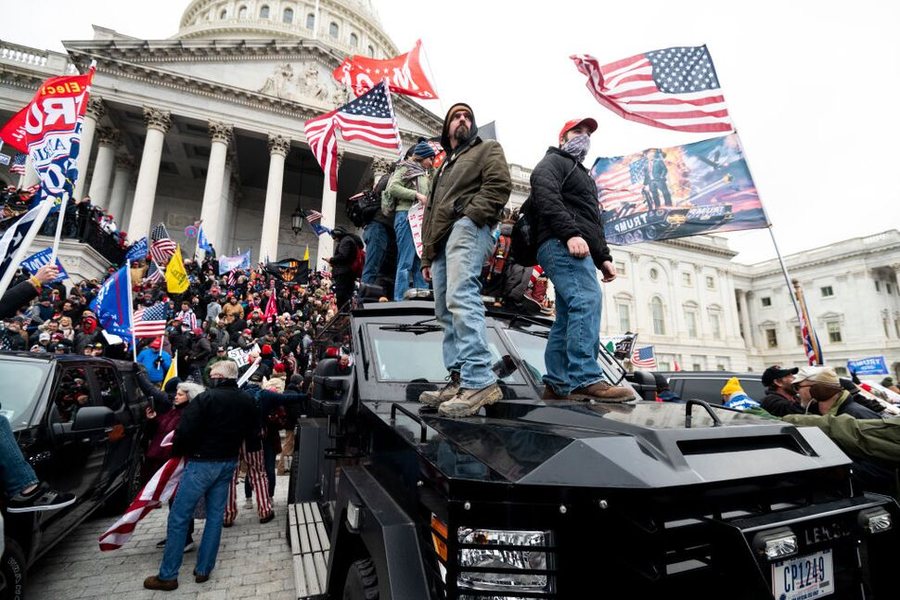
His comfort with conspiracy became central to his attacks on the 2020 presidential election, where he charged, without evidence, that the vote was “rigged.” At Mar-a-Lago in 2022, he hosted a supporter of Pizzagate, the conspiracy theory about a Democratic-run child sex trafficking ring that used a Washington pizzeria as its base.
In fact, understanding the power of conspiracy politics within the Right does not mean that there cannot be truth to their claims, including the possibility that President Trump is trying to hide information about his relationship with Epstein.
But the specific ways in which the issue has been discussed within much of the MAGA world have taken on a paranoid style. They have insisted on a concerted and coordinated operation across various institutions and pockets of elites (ranging from the Justice Department to prison guards, all with a clear political agenda), which fits the tropes of the essentially conspiratorial. They have made assumptions about why the information was kept secret and have implied that because a person had contact with Epstein, that person inevitably participated in his sex crimes. In this worldview, anyone who questions the conspiracy immediately becomes part of the conspiracy.
Trump, who has thrived on capitalizing on this political tradition at the highest levels of power, has learned that he cannot easily control it. If he does not use this style to strengthen his position, he too may fall victim to its influence, becoming the focus of, rather than the fighter against, the conspiracies that many of his followers believe could end civilization.
It’s no wonder that Trump has responded to his conspiracy attack by trying to turn the public’s attention to other conspiracy theories, including his unfounded accusation that President Obama acted treasonously in 2016. As Democrats jump into this issue, they should be careful to do so in a cautious manner and be judicious in how they handle this temporary alliance with the MAGA coalition.
In the world of conspiracy politics, even a key supporter can quickly become an indictee. Trump may very well survive this round, but now he sees that he could become a victim rather than a hero if he is not careful./ Adapted from "Pamphlet" by "ForeignPolicy"






Lini një Përgjigje