


 Shkruar nga Pamfleti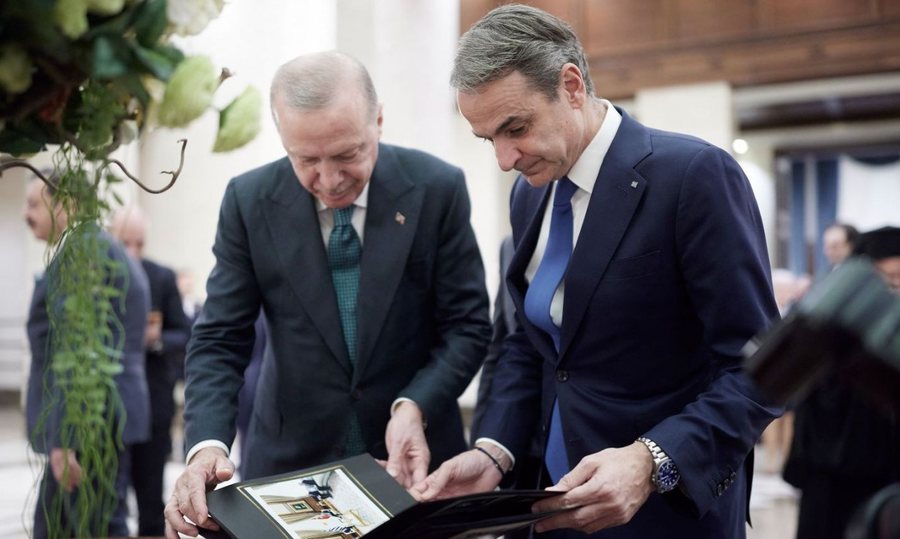
The meeting between Kyriakos Mitsotakis and Recep Tayyip Erdogan took place in a positive climate and maintained the channels of dialogue between Greece and Turkey. However, the parties did not reach concrete solutions to the fundamental issues that divide them, while their positions remain unchanged. For this reason, although the dialogue is assessed as a constructive step, there is no basis for enthusiasm or premature celebrations.
Many analysts believe that there is a prevailing perception in Greek society that the passage of time without resolving major problems is not necessarily a concern, as long as the status quo does not produce harmful consequences. According to this view, difficult issues are often postponed until later.
This approach, according to assessments made in the Greek media, was also reflected in Greek-Turkish issues. The meeting between Greek Prime Minister Kyriakos Mitsotakis and Turkish President Recep Tayyip Erdogan in Ankara did not result in any fundamental change in the basic model of relations between the two countries. Both sides reiterated their positions and chose to put aside the most complicated issues in order to maintain a calm climate in relations.
The Turkish side did not change any of its claims and did not withdraw the agenda that Athens considers revisionist towards Greek sovereignty. President Erdogan did not refer to the Turkish interpretation of the Treaty of Lausanne and the Italo-Turkish agreement on the Dodecanese, from which the theory of "gray zones" was born, according to which some islands, islets or rocks in the Aegean are considered to have questionable sovereignty. According to published assessments, Ankara's position remains unchanged.
Erdogan also made no statement about withdrawing from claims to maritime areas that Greece considers part of its sovereign rights, including the "Blue Homeland" concept and the Turkish-Libyan memorandum. The Turkish strategy in this regard has not changed.
The Turkish president stated that there are complex, but not unsolvable, issues in the Aegean and the Eastern Mediterranean, if there is will and if international law is respected. However, according to Greek analyses, this statement does not constitute a change in Ankara's position and does not imply alignment with the Greek interpretation of international law.
At the same time, the perception that international rules are being challenged and that the logic of force is prevailing in some regions has strengthened in public discourse.
The Turkish position on the division of responsibilities in the Aegean, with reference to the 25th meridian for search and rescue issues, remains the same. Ankara has not even withdrawn the NAVTEXs that reserve areas in the central Aegean for long periods.
In this context, the question has been raised in Greece whether Mitsotakis' visit to Ankara was necessary. According to the published analysis, the dialogue does not bring losses, as long as it is conducted with sincerity and national self-confidence. The Greek Prime Minister openly acknowledged the existence of disagreements and reiterated that the only issue that can be addressed to an international judicial body is the delimitation of the continental shelf and the Exclusive Economic Zone in the Aegean and the Eastern Mediterranean, based on international law and in particular the Convention on the Law of the Sea.
According to the published interpretation, a “frank” discussion means that each side reiterated its positions without hiding its differences. However, neither Athens nor Ankara are stopping trying to maintain communication channels and a positive climate.
In the internal Greek debate, some political figures had requested prior information on the agenda of the talks, hinting that a possible failure could have political consequences. However, according to the analysis, the meeting did not result in any territorial concessions or waivers of Greece's sovereign rights.
The article emphasizes that both Mitsotakis and Erdogan act in function of balances and circumstances. Examples include Greece's reaction at the Evros border, when Turkey attempted to push migrants towards Greek territory, as well as the crisis with the research vessel "Oruc Reis" near Kastelorizo, following the Greece-Egypt agreement on the partial delimitation of the EEZ. According to the author's assessment, Athens defended its sovereignty and rights through the mobilization of the armed forces and security forces, while continuing to strengthen its defense capacities with new naval and air assets.
During the meeting in Ankara, Mitsotakis called for the removal of any formal and substantive threat in bilateral relations, also referring to the “casus belli” adopted by Turkey in the event of the expansion of Greek territorial waters to 12 nautical miles. According to the analysis, it is impossible for Ankara to withdraw this threat at this stage, but the Greek Prime Minister’s message aims to emphasize that the war rhetoric hinders the objectives that Turkey seeks to achieve in relations with the European Union. / Adapted from Newsbomb.gr




Lini një Përgjigje