


 Shkruar nga Leonardo Cecchi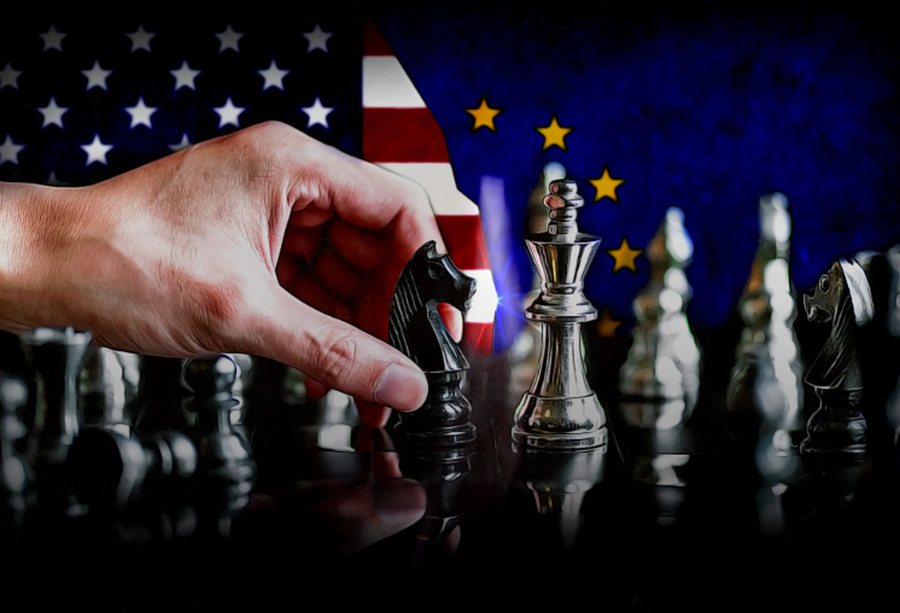
The looming crisis is not a distant possibility. She is sure it will happen. And while the world is preparing to face it, we Europeans still remain hostage to an outdated vision, and to a monetary policy incapable of responding to the challenges of the present...
Europe is preparing to experience an economic carnage the likes of which has not been seen since the severe financial crisis of 2007-2008, and Donald Trump's return to the White House risks being the main trigger.
The risk is not so much about the trade tariffs on Europe itself - which will also hurt a lot - but about the devastating domino effect they will produce. Because it is true, that in an economy like ours, currently in crisis, the great drop in exports to the USA would be a very strong blow.
But the real problem is not here. The real problem is China, and the domino effect that Washington's protectionist approach could cause. In fact, Trump has openly stated that he intends to impose tariffs of up to 100 percent on Chinese products.
This high level brings us directly back to the practices of the 19th century. Now, if he kept his word even partially, there would be an economic earthquake that would bring us Europeans to our knees. Let's consider some context.
China, a producer of goods in series, has exports with the United States at the level of about 500 billion dollars. And to combat the stagnation it is experiencing after the real estate crisis, it has recently revealed its intention to increase the rate of economic growth through increased production and therefore the supply of products.
Now that due to new tariffs expected to be imposed, these products will no longer be able to be exported in whole or in part to the US, Beijing will have two options: keep its warehouses full - of which there are very few likely to happen - or lower prices further and send that amount of goods to the rest of the world, and mainly here in Europe, given the strength of our purchasing power.
And this is where the disaster begins. Because we are talking about a flood, a real tsunami of low-cost products that will pour into our market, bringing local businesses to their knees and worsening the economic crisis that has already begun.
Meanwhile, it is certain that in line with his warnings, Trump will pressure the Federal Reserve to deliberately weaken the dollar, replacing its head Powell or convinced to submit to his game, to make American exports more competitive and their products more attractive in international markets.
Meanwhile, the euro will continue to strengthen, because here in Europe we are in the hands of a Central Bank, which considers any expansionist measure as an absolute evil. Thus, with a strong euro, it will be increasingly convenient to import and increasingly difficult to export.
So we will open our doors to the "avalanche" of Chinese goods. To save ourselves, we have 3 possible ways out. The first is to start devaluing the euro now, making our products more competitive. This would allow us not only to increase exports, but also to absorb the shock to the economy, injecting money and restarting the growth of jobs and production.
The second step concerns interventions in the prices of goods that cause inflation, ultimately changing the paradigm of monetary policy, an operation that starts from the recognition that the inflation we are experiencing is not an inflation of money, but of costs (first of all of energetic ones).
Therefore, we must stop fighting inflation with napalm, that is, setting fire to everything in the hope of lowering prices, but directly (and forcefully) controlling the prices of sensitive goods.
The third step we need to take is to abandon keeping inflation at 2 percent and aim for a more realistic target, given the global geopolitical and geo-economic scenario (a single oil tanker explodes in the Red Sea and immediately increases the price of bread in Wyoming, USA).
A more realistic scenario would be a rate between 3 and 4 percent. Meanwhile, continuing on this path, with a strong euro and moving towards an unattainable goal, will surely lead us straight to disaster. Because the crisis that is appearing on the horizon is not a distant possibility.
She is sure it will happen. And while the world is preparing to face it, we Europeans still remain hostage to an outdated vision, and to a monetary policy incapable of responding to the challenges of the present./ Adapted Pamphlet from "Huffington Post Italia"


Lini një Përgjigje