


 Shkruar nga Mario Ricciardi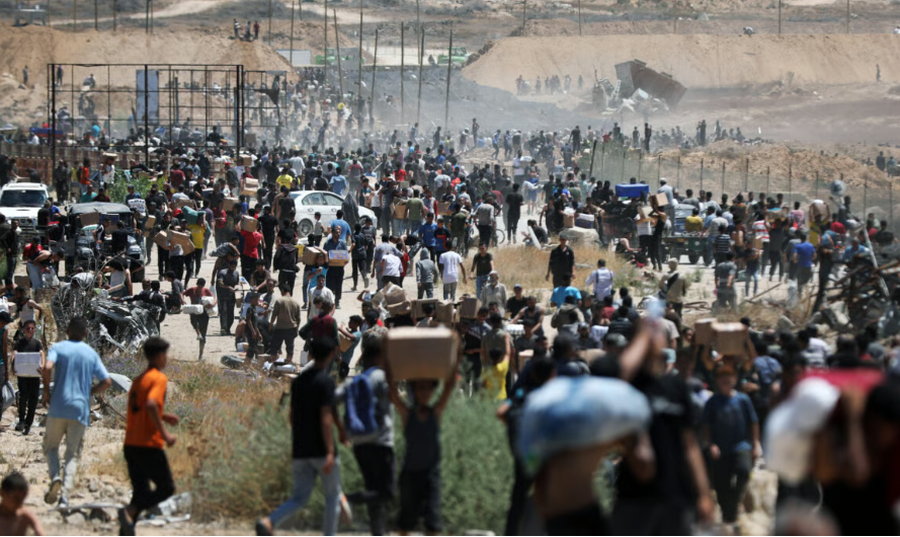
Civilization or barbarism? The very idea of law is incompatible with that of double standards. If an act is contrary to international criminal law, it is always contrary, regardless of who is responsible for it…
What is happening in Gaza is a moral test in two different but related ways. On a personal level, it is an opportunity for self-examination because it forces us to confront something that challenges our certainties.
We know well that this is not the first time that systematic and brutal violence has affected a population to the point of endangering its integrity and even its survival. However, this is the first time that these acts have occurred "under the eyes" of the entire international community.
Within minutes of a bombing, we already know that a child has been killed along with his or her family, or that a boy who went out to beg for food never returned because he was shot. In many cases, we see the battered bodies of these victims in real time, or almost, or witness the excruciating agony that marks the final stage of their short lives. We see mothers and fathers mourning their sons and daughters, brothers and sisters saying goodbye, children who will carry the scars of relentless violence for the rest of their lives.
All of this is horrifying and, understandably, provokes a flight response in many people. However, avoidance does not assuage the conscience. In a way, we would be failing the respect we owe ourselves as rational people if we chose to ignore those bodies, look away from their faces, or ignore those voices.
Even if we are unable to save the people of Gaza because we individually lack the means, we can bear witness to what happened to these victims to the extent that we are aware of it, resisting the temptation to suppress our frustration and anger by trying to think about something else.
Evidence is essential, as it was for the Armenian genocide and the Holocaust, but it is not enough. We must also answer the question of “why” all this is happening. Can one atrocity justify another? Can the blood of one innocent person compensate for the violent death of another innocent person?
Even those who accept that there are cases in which the use of force is justifiable, for example, to repel a potentially deadly act of aggression, cannot answer these questions in the affirmative. They cannot, because they would be stepping outside the bounds of the supreme principle of morality: the equal respect we owe all people.
This brings us to the second sense in which what is happening in Gaza is a moral test: the public one, which concerns the sphere of relations between people within a political community and between political communities at the international level. In this dimension, it is not individual conscience that is being tested, but collective conscience, which is expressed in the ability to reason together about right and wrong (which is why those who want the massacre to continue to its final consequences are so determined to prevent free discussion about the atrocities committed by the Israeli army).
The questions here are, first and foremost, about the rules. The very idea of law is incompatible with double standards. If an act violates international criminal law, it always violates it, regardless of who is responsible. The attack on these rules by the Israeli government, with the cooperation of those of many European countries and the United States, is changing the normative environment in which our sons and daughters will live.
The news of the last few hours, and in particular the conversation between Trump and Netanyahu, suggest that we are approaching the final phase of the destruction of Gaza, which could lead to the displacement of what is left of the local population elsewhere.
What was once considered “unthinkable” is becoming relevant again. By asserting double standards with their statements and actions, the governments that have supported Israel’s war against the civilian population of Gaza are also raising a public moral issue that we cannot ignore.
Are we willing to accept a return to a mentality like that of 19th-century jurists, who reserved the protection of international law only for "civilized nations"?
Are we willing to watch helplessly as the privilege of a "Western civilization" is restored, hiding an increasingly aggressive supremacism to which even "moderates" bow their heads?
Israel "does our dirty work for us," said Friedrich Merz. Do we want this phrase to hand over to history who we were and our moral character? / Adapted from Il Manifesto Pamphlet/








Lini një Përgjigje