


 Shkruar nga Roger Boyes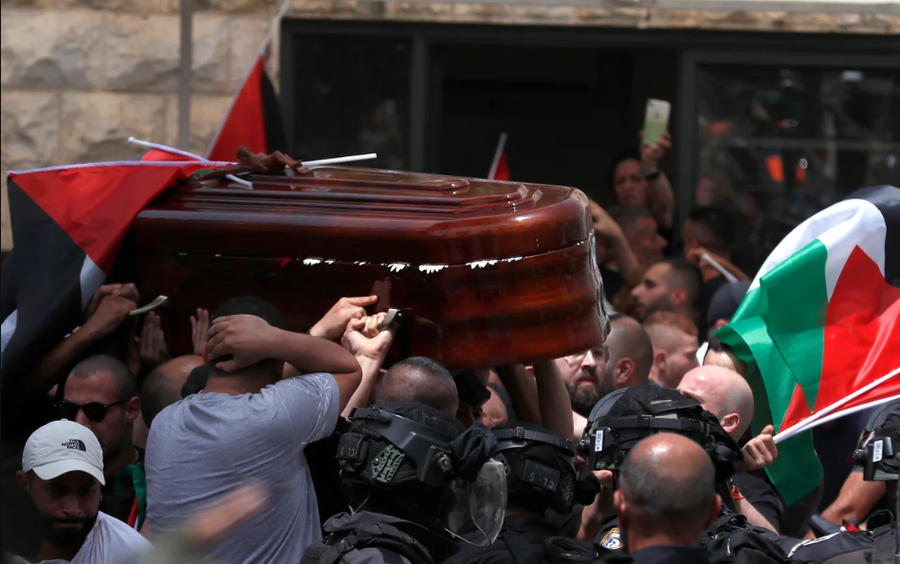
If he dies in the coming year, his funeral could be one of three funerals that will change the landscape of the Middle East.
The funeral of the founder of the Iranian Revolution, Ayatollah Ruhollah Khomeini, was more of a farce than a tragedy. However, he instilled in the Tehran regime the fear of mobs. It was June 1989, a period when the communist regimes in Central and Eastern Europe were in their last throes.
In northern Tehran, more than 1 million people had gathered to honor the memory of the 89-year-old Ayatollah, wrapped in a white shroud and placed in an air-conditioned glass case. A chaos of maddened wailing ensued.
As the crowd of people beating their chests hysterically swelled to over 7 million, the regime decided to delay the burial, and to parade the coffin through the streets in a helicopter, which it then took to the "Paradise of Zahra" cemetery in the south of the city. At one point, the body accidentally dislodged from the coffin as mourners in search of relics tore off pieces of his shroud.
No wonder there is nervousness over another expected death: that of Ali Khamenei, Khomeini's successor as Supreme Leader of Iran. Khamenei is 85 years old and is said to be battling cancer.
If he dies in the coming year, his funeral could be one of three funerals that will change the landscape of the Middle East. It may perhaps be out of place to consider change driven by natural causes, at a time when much of the region seems to have been bloodied by wars which, once begun, seem never to have ceased. : Gaza, Lebanon, Syria.
However, even under the most oppressive regimes, we see young people yearning for a break from the past, a renewal of society that does not completely abandon tradition. Their disappointment is with the old and the untouchables, with the corruption of the power structures, which over many decades made only symbolic changes.
So not only the wisdom of the Supreme Leader of Iran is being called into question - the whole idea of a series of private militias, protecting Iran from future attacks, has collapsed before his eyes - but also of King Salman of Saudi Arabia, today 88 years old. While in the Palestinian territories, it is Mahmoud Abbas, 89 years old.
All of them have one foot in the grave. And all three are blocking the road to modernization. Everything that happens around them at this moment is a response to their growing disability, and reflects the lack of an orderly inheritance.
Of course, the next funeral in Iran is unlikely to be as crazy as the one in 1989. First, its planning will be partly in the hands of Khamenei's son and right-hand man, Mojtaba. He has close ties to Revolutionary Guard commanders and played an important role in organizing the Basij militias, which crushed the 2009 attempt at a popular uprising.
He will play a key role in any potential crisis over the successor. Mojtaba Khamenei is a senior academic at the Qom seminary, but is not yet an Ayatollah. So there is no evidence of a high level theological expertise. Therefore, it is doubtful whether the Assembly of Experts will agree to elect him as the Supreme Leader.
The dilemma will be about who can preserve Iran as a theocratic regime. Much will depend on whether Mojtaba succeeds in convincing the elite that Iran is facing an existential crisis that must be deftly managed if the country is to stay true to its ambitions to be a central power and leader of Shiism in the region.
If Mojtaba wins this debate, his counterpart in Saudi Arabia will be Crown Prince Mohammed bin Salman, who has been given (or has taken on) unprecedented powers. He is behaving more and more like a regent.
His father appears to have accepted him as the driving force behind the Saudi kingdom and a major social transformation, giving young people a greater role in the kingdom's future. Therefore, it is now up to Mohammed how far the Saudis should go in containing Iran.
With Israel, within the framework of the Abraham Accords, or independently within a special extended relationship with the Trump administration? In this respect, Israel is still dependent on the king, who insists on the creation of an independent Palestinian state.
As for Iran, it is up to the Saudi Crown Prince to judge whether a new Supreme Leader in Tehran poses an immediate threat to Riyadh, or whether co-existence is possible. The fate of a potential nuclear arms race between Iran and Saudi Arabia will be decided only after two funerals.
The third politically important change is likely to be that of Abbas, head of the Palestinian Authority, leader of Fatah, in power since 2005, a corrupt, election-manipulating leader who, despite his great age, wants to have a role in post-war Gaza governance.
Unlike Saudi Arabia, where there is a succession process - although Prince Mohammed may have to fight off rivals - but also Iran, the Palestinian leader believes he can rule forever. One potential successor stands out: Marwan Barghouti, 65, who has spent the last 22 years in an Israeli prison accused of 5 murders.
He has taken a defiant stance there, leading Palestinian prisoners on a hunger strike. But he has learned Hebrew, and his supporters say he would ensure a less corrupt government and keep Hamas at bay. Can the Saudis get along with him?
This issue is not just about the exit of a few ambitious elders. Even young leaders often fail to understand conflicts properly. The president of Syria, Bashar Al Assad is still only 59 years old, and for almost a quarter of a century he has made life hell for the citizens of his country.
Perhaps his forced retirement could contribute to a good reformation of the Middle East, precisely in the year of the 3 funerals./ Adapted "Pamphlet" from "Sunday Times"




Lini një Përgjigje