


 Shkruar nga Pamfleti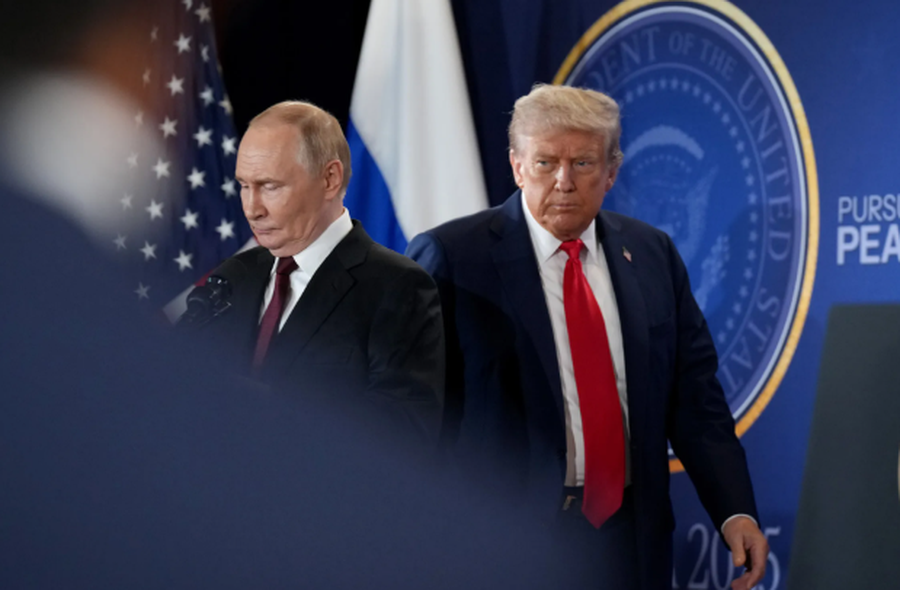
Liberal democracies see Putin's Russia as a bully, and Trump's USA as an angry drunk with a bazooka in his hands. The answer is pure poison...
There are those who say that Vladimir Putin's war on Ukraine is motivated not by fear or imperial ambitions, but by a lack of respect from other countries. Russia once had authority as one of the world's two superpowers, but has since lost that status.
It knows it has lost the respect of other countries (for example, Barack Obama called Russia a “regional power”), and the war in Ukraine is its way of regaining it. But perhaps surprisingly, Donald Trump’s turn against Europe is driven by similar motives.
Putin knows that his aggressive revanchism will not bring Russia any love among the countries whose respect he desires. But if he cannot be loved, he hopes at least to be feared. If you find yourself in a social order that considers you inferior, then you have every incentive to become the destroyer of that reality.
Likewise, Trump wants to disrupt a social order that looks down on him and his worldview. The US president and his officials are well respected by dictators and kings (though perhaps not by those whose respect they most desire, Putin and Xi Jinping), but they know that the leaders of many other democratic countries look down on them.
Now it is America that wants to act as a disruptor, destroying the existing hierarchy of respect, to replace it with a world where Trump will receive unconditional honors. Europe, with its emphasis on the rule of law and multilateralism, is the strongest remaining example of an entire system of prestige and values that the Trump administration wants to destroy.
The irony is that it was the United States that once built the world that Trump is now seeking to destroy. After World War II, Washington developed a new global ambition. Republicans and Democrats alike shared the belief that a world built on American values would be better for America.
The US proclaimed that democracy and the rule of law were the ideals by which countries should be judged. Despite the obvious hypocrisy (Washington itself regularly acted in illiberal and undemocratic ways and preferred to judge rather than be judged), this was the cornerstone of American “soft power”; its ability to influence the world indirectly through culture and values.
Other countries looked to the United States as a model to emulate. Modern Europe was the grand project of the old order. After World War II, the United States helped rebuild the economies of Western Europe, fostering the success of liberal parties and often quietly sabotaging those it considered too left or too right.
The European Union has historical roots in an agreement created to coordinate American aid distributed through the Marshall Plan. As it expanded, it built a new regime for Europe, based on cooperation between nations, the importance of law, and liberal democracy.
After the end of Soviet domination of Eastern Europe, the EU expanded to include countries to its south and east, on the condition that they adopt democratic principles. In many ways, the EU embodied the values of the liberal order created by America more than America itself.
Now the Trump administration wants to destroy the old order, replacing it with a new one based on power and national interest. Its new National Security Strategy declares that it wants to “preserve the United States’ unparalleled ‘soft power’,” but that the way to do so is by recognizing “America’s inherent greatness and benevolence.”
Trump boasts in the preface to the strategy that finally, “America is strong and respected again.” The problem is that this is undoubtedly untrue. Countries that still adhere to liberal values absolutely do not respect Trump’s USA.
They treat him like a drunk, angry, unstable man with a bazooka in his hands. In these conditions, you say whatever you hope will calm him down, but of course you don't really respect him. American soft power and indirect influence over other democracies is fading more and more.
This also explains why Trump's national security strategy spends so much energy and venom denouncing Europe. Although the US is clearly abandoning its ambition to change the world, it emphasizes that it will intervene in Europe to transform it.
“MAGA” wants to help the European parties it favors, but this time they are on the far right. Instead of promoting European cooperation, as the US did after World War II, the Trump administration hopes to turn discontent in the new EU member states into a wedge against the EU’s liberal democratic values, transforming Europe into a collection of sovereign, highly nationalistic, and culturally “white” nations.
In this world, Europe would no longer be an obstacle to MAGA ideology. The challenge facing the Trump administration is that it lacks the capacity or global ambition to achieve this transformation.
Like Russia, the current administration wants respect, but it doesn't have the power to do much more than act as a disruptor of the current status quo. It wants to shape Europe more, at the same time as it wants to engage less in the old continent, withdrawing from its role as a guarantor of NATO.
Trump’s strategy denounces the “massive military, diplomatic, intelligence and foreign aid complex” that has supported US global ambitions and is doing everything it can to dismantle it. But without this complex, it will not be able to reshape Europe in its own image.
Of course, the Trump administration could use scattered interventions to punish the European Union as it tries to help far-right parties rise to power. It is already denying visas to people who have acted as fact-checkers and social media moderators, whom it accuses of censoring right-wing views, and is threatening the EU for its boldness in regulating services such as the X platform.
But, as the example of Brazil shows - where efforts to punish officials and help Jair Bolsonaro have failed miserably - even this approach is likely to hurt more than help its ideological allies.
The Trump administration wants the benefits of global respect and soft power, which is why it is engaging with Europe. But in doing so, it wants to retreat, reducing its global capabilities and returning the US to a regional power like Russia, which uses its forces to pressure neighboring countries. But it cannot have both. / Adapted from The Guardian Pamphlet




Lini një Përgjigje