


 Shkruar nga Ezio Mauro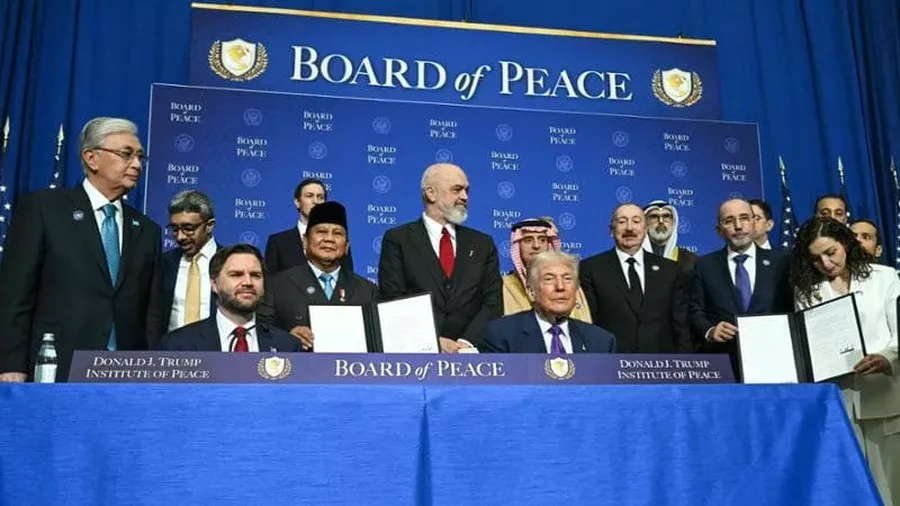
The citadel of the new kingdom of chaos has already been erected. It is the Peace Board established by the American president...
Amid the ruins of the old world order, while the Supreme Court reminds America that the awareness of the limits set by the law still exists, the citadel of the new kingdom of chaos has already risen, naturally named after the holder of the hegemonic power of disorder, Donald Trump. It is the Peace Council established by the American president, which has gathered around it the leaders of 20 countries, excluding China and Russia, plus other "observers" such as Italy, to discuss the reconstruction of Gaza, to announce to the world that thanks to the strength of this new institution, wars will end and to prepare events so that the winner of the Nobel Peace Prize can finally be handed over to the head of the White House, who now demands it in every speech not as a prize, but as a duty.
A mix of business, friendship, compliments and self-celebration, with real estate dominating and absorbing the concept of peace, and FIFA, the world governing body of football, listed among the major political and diplomatic powers tasked with freeing the future from the nightmare of conflict. But behind the group photo, the smiles and the promises, “The Peace Board will be something the world has never seen before,” lies something foreign to history and invisible to the news, something that it would be a mistake to underestimate: Trump is capturing the universal political imagination, with a veritable re-creation of the world.
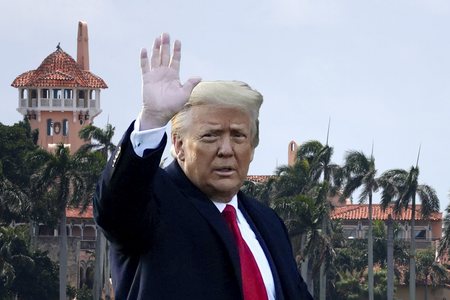
The image that best summarizes and explains the emphasis on the Peace Board, in fact, is that of the American president who builds a domestic UN, ready to serve his purposes, outside the procedures, roles, and limitations of the United Nations organization.
It is a subcontracting of peace, if Trump's announcements are to be believed, a privatization of diplomacy, an authorization to manage the course of contemporary history in the interests of a world made up of former friends, subjects, and spectators. But this operation, part papier-mâché and part supremacy, is achievable precisely because the president personally occupies the center of modern political radiation, the place where the narrative is born that now accompanies reality every day, surpasses it, obscures it, and replaces it.
Although it is difficult to say, given the results, that the factory of new today is on the right, working tirelessly to translate the neo-reactionary ideology of Trumpism not so much into concrete measures as into emblematic images, symbolic figures and evocative narratives, thus blocking the political imagination and dominating it with an exaggerated production of sensations, emotions and suggestions. It is not important that citizens think; what is important is that they feel, perceive and participate in the emotional impulse with which the new world distances itself from the old, made up of cold and now obsolete rules.
It is a “new”, disorganized, dominant, chaotic, even subversive, yet confusedly turbulent, fiery and revolutionary. A continuous stream of situationism, which produces a permanent turmoil in what remains of public opinion, inflating, disturbing and igniting sound logic.
The left follows, corrects, denounces and criticizes, cushions and counters, but inevitably tries to catch up, at the risk of appearing conservative of the existing order, in a reversal of roles and roles. The right hardly worries about the concrete translation of these revolutionary impulses; the announcement is enough to ensure that the tension towards unrest continues. The development, the process and the result do not matter, because everything is summarized and concentrated in the initial moment of announcement: on the right, the "new" is not reform, it is disruption, different destinies, a rejection of the past and an evocation of the future.
Along this path, almost naturally, politics becomes performance, the political act is translated into gesture, the image matters more than its meaning. With all the embellishments and echoes that this ideology of raw action brings with it, as if it had taken them from Marinetti's Manifesto: permanent aggression, the constant presence of danger, recklessness, rebellion, somersaults, the energy that supports and justifies every correction, every rethink, every change of direction.
It is as if the decisive part of today's political game is being played out in a parallel dimension, where the hegemony of the imagination is at stake, and symbolic domination precedes and guarantees material conquest. In short: to rule over the real world, one must first recreate that world, reinvent it until it becomes desirable for citizens, and then command it. Power thus rediscovers the eternal temptation of authoritarian simplification: it is unnecessary to impose on reality, when it is possible to change the perception of what is possible in the narrative.
And it is clear, at this point, why the Peace Board is a decisive turning point: it is not simply a theater in which the American president is simultaneously author, director and protagonist, but it is a narrative device that automatically becomes political, transporting this abusive legitimacy built in the sphere of storytelling to the concrete, everyday dimension, to the point of making the new body the UN's controller and its supreme judge.
As politics becomes propaganda and, instead of living in the world, prefers to find refuge in its representation, the distinction between the real and the imaginary, between the truth and the possible, between disruption and change, fades. It is precisely this territory, without borders and boundaries, that has attracted the champions of techno-innovation to Trump's court: here, the redistribution of parts of power takes place, but above all, here, the final transformation of technology into ideology takes place. Technology and politics come together, mutually reinforcing each other. Here, the entrepreneurs of the innovation that has transformed our lives can realize the supreme Faustian temptation, participating in the creation of the new political form that will replace democracy.
The answer can only be to restore a sense of purpose for change, a capacity for liberation for innovation, an emancipatory purpose for the new we produce and a sense of responsibility for the factory of tomorrow. This requires restoring politics to the ability to distinguish and citizens to the ability to choose between the allure of the new and the promise of progress./ Adapted from “Pamphlet” by “La Repubblica”


Lini një Përgjigje