


 Shkruar nga Rana Foroohar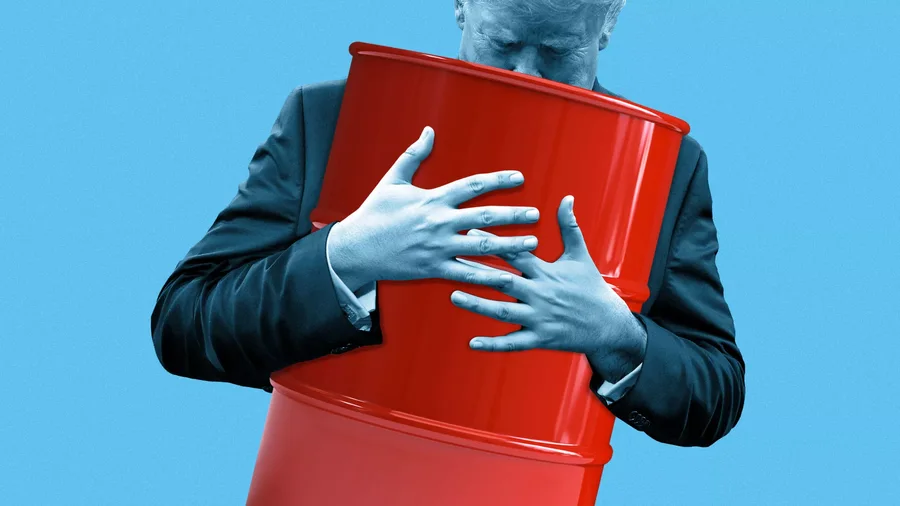
The Trump administration's energy policy will make the country sicker and poorer...
The US is once again going where no rich country has gone before. Earlier this month, the White House capped a year of regulatory restrictions on climate change by repealing the “risk finding,” which is the rule that allows the Environmental Protection Agency to curb carbon emissions because of their health consequences.
President Donald Trump is touting this as great news for the American economy, energy security, the fossil fuel industry and the people who work in it, like the coal miners he welcomed to the White House earlier this month after signing an executive order directing the War Department to use more coal-fired power. The truth is, it’s none of those things. Trump’s war on clean energy will make America sicker and poorer.
Let’s start with the fact that the administration’s sabotage of existing federal tax credits for electric vehicles, the clawback of grants and loans already funded for clean energy projects, and cuts to federal fuel efficiency mandates are costing Detroit $50 billion. That’s the amount of rebates the Big Three automakers, GM, Ford, and Stellantis, are getting now that they’re being stripped of incentives to switch to electric vehicles.
But this number, as large as it is, does not include all the costs to the federal budget on both the demand and investment sides of the transportation business, which is the largest source of greenhouse gases in the US.
The BlueGreen Alliance, an association of labor unions and environmental groups, released a study last year estimating that repealing the clean energy tax credit alone would put more than 2 million jobs at risk in states like Arizona, Kentucky, Michigan, South Carolina, Tennessee and West Virginia, which were beginning to benefit from a boom in clean energy-related manufacturing investment.
That boom is now turning into a bust. Manufacturing jobs have plummeted under Trump, who promised to bring industrial work back to the U.S. Research firm Rhodium Group estimates that $22 billion in planned investments in electric vehicles, batteries and critical minerals have dried up.
Meanwhile, workers in fossil-fuel-dependent states who had successfully and with difficulty transitioned to clean-tech jobs are being laid off. Last December, for example, Ford closed a large battery plant in Kentucky, a coal-rich state, laying off 1,600 workers in a place where state and local governments had spent $250 million to attract new business.
Some workers may be forced back into coal mining. If they do, they won’t be protected by the tougher silica standard passed by the Biden administration. It was an effort to eradicate the black lung disease that a fifth of veteran coal miners now suffer from from using the more powerful machinery needed to reach the coal in mature mines as it becomes harder to extract, kicking up more silica dust.
The Trump administration halted implementation of the standard due to a restructuring of multiple federal agencies that resulted in the loss of jobs for thousands of labor and health care workers. "Anyone who says they support coal miners literally doesn't care if they live or die," said Jason Walsh, executive director of the BlueGreen Alliance.
I could go on, but you get the idea. While the White House touts the money saved by regulatory cuts, public health and environmental advocates are worried about hundreds of thousands of premature deaths linked to climate change in the pre-regulatory era to which we seem to be returning. People in Mississippi, worried about pollution from a Venezuelan oil spill expected to hit a Chevron refinery in their community, are asking the oil company to buy their homes. As China ships cheap solar panels to emerging markets, America is becoming one.
The immediate costs I have outlined are just the beginning. For the US auto industry, stagnation is now the best possible outcome. Even if we get a waiver from Trump’s measures after 2028, that would leave America years behind China, which clearly owns the future of clean energy.
Legal battles over all of this have begun (the first lawsuit over the jeopardy rule was filed last week, adding to many others). The lack of certainty resulting from ongoing legal action is in itself a major deterrent to foreign investment, not only in the transportation sector, but also in the supply chain that serves it.
One wonders what risk premium might be imposed on a nation with less interest in high-growth industries, as well as more polluted water and air, especially at a time when the insurance industry wants to pass on more of the costs of climate-related disasters to companies, banks, and governments themselves. Premiums, which have already risen by double digits in some countries, are likely to rise further. Overall borrowing costs for those investing in the U.S. could also rise.
Beyond that, I have to wonder whether America’s complete abdication of any responsibility for global warming will one day be retaliated against in the form of retaliatory tariffs or financial sanctions imposed on the US by other countries. What is to stop a group of nations with record climate-related economic losses from eventually penalizing the US, just as America has penalized nations that support terrorism? The costs, both human and economic, of the former are already much higher. / Adapted from “Pamphlet” from “Financial Times”



Lini një Përgjigje