


 Shkruar nga Paolo Valentino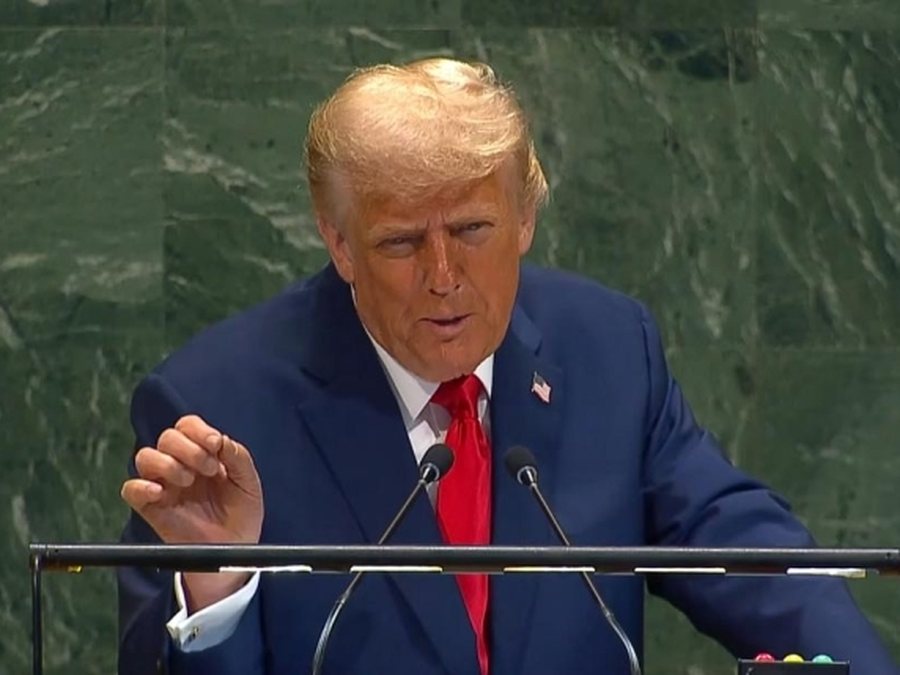
He is perhaps the first American president who has managed, with a rhetoric of localities devoid of substance, logic, and nobility, to strip the spoken or written words of the most powerful person in the world of any value, reducing them to simple situationist conversations...
Two things will be remembered from Donald Trump's recent speech to the United Nations. The first is the sentence with which he condemned European and other governments for embracing climate change and for not following his example of closing borders and mass deportations to combat illegal immigration: " Your countries are going to hell."
Next, more practical but no less significant, was his lament over the incident with the escalator at the UN headquarters, which stopped, forcing him and Melania, in a harrowing way, to walk up. This was followed by the faulty teleprompter, which forced him to read the speech while looking at papers: " Those are the two things I took from the UN: a bad escalator and a bad teleprompter. "
The next day, he called his experience in New York a “triple sabotage,” adding that the audio in the General Assembly chamber had been muted while he was speaking. He then ordered his ambassador to the United Nations, Mike Waltz, to demand a formal investigation: a confirmation that Trump’s personal grievances are now official U.S. foreign policy.
Two days before speaking at the UN, the White House chief of staff attended the memorial service for Charlie Kirk at Phoenix Stadium in Arizona, where his widow had previously said she had forgiven her husband's killer. The president's key phrase, however, was: "I hate my opponents; I don't wish them well ."
On November 19, 1863, President Abraham Lincoln marched into Gettysburg, four months after the bloody battle that decided the fate of the American Civil War. In his famous speech, Lincoln argued that no Union or Confederate soldier had died in vain and that the fratricidal conflict should be followed by a "renaissance of liberty" so that "government of the people, by the people, and for the people, shall not perish from the earth . "
Of course, we don’t want to compare the current president to Lincoln. But we are still talking about the most powerful man in the world, which, incidentally, was not yet true in Lincoln’s time. Therefore, one would expect that the words of the President of the White House, the man who commands the most powerful military and nuclear arsenal in the world and controls the world economy with his tariffs and sanctions, would have value when spoken, value, meaning, and great political weight.
Instead, Donald Trump is subverting, or, more precisely, has already subverted and degraded, the rhetorical code that has accompanied American democracy since its origins, making the United States the leading country of the West, the defender and guarantor of its values, albeit with dark and unmentionable chapters. Here, we want to focus on the topic of public speech, which has always been an undoubted hallmark of American presidents.
When Franklin D. Roosevelt wanted to shake up the country ravaged by the Great Depression in March 1933 by launching his New Deal, he explained to Americans that " the only thing we have to fear is fear itself . "
"Ask not what your country can do for you, but what you can do for your country ," said John F. Kennedy in his inaugural address, a phrase that has become part of American political iconography.
Two years later, in Berlin divided by the Wall, speaking from the balcony of the Schöneberg Town Hall, he uttered the words that would inspire an entire generation: "Ich bin ein Berliner". (I am a Berliner). This meant a lot, because Kennedy was president of the United States.
On March 15, 1965, a week after Bloody Sunday, when the Alabama National Guard brutally beat 600 unarmed civil rights marchers, Lyndon Johnson appeared before Congress to introduce the Voting Rights Act, the federal law that allowed African Americans to exercise their right to vote in all states.
"We shall overcome" was the famous phrase, taken from a gospel song also sung by Joan Baez, with which the president ended his speech, which was interrupted by 40 rounds of applause.
Reagan's call from the Brandenburg Gate on June 12, 1987 remains immortal: "Mr. Gorbachev, tear down this Wall!" It was a masterstroke in the final phase of the Cold War, with which the leader of the White House demonstrated the quality of the US's moral and political leadership in the Western camp.
Anything can be said about Barack Obama, who was awarded the Nobel Peace Prize prematurely and certainly undeservedly. But his cry, " There are no red states and no blue states, there is only the United States of America ," remains the country's strongest call for unity.
Which, however, is precisely what Donald Trump, a man who seems to be driven by resentment, the need for revenge and the demonization of any opponent, does not want. More surprising and serious is that he is perhaps the first American president who has managed, with a rhetoric of localities devoid of substance, logic and nobility, to strip the spoken or written words of the most powerful person in the world of any value, reducing them to simple situationist chatter./ Adapted from “Pamphlet” by “Corriere Della Sera”



Skandaloz