


 Shkruar nga Pamfleti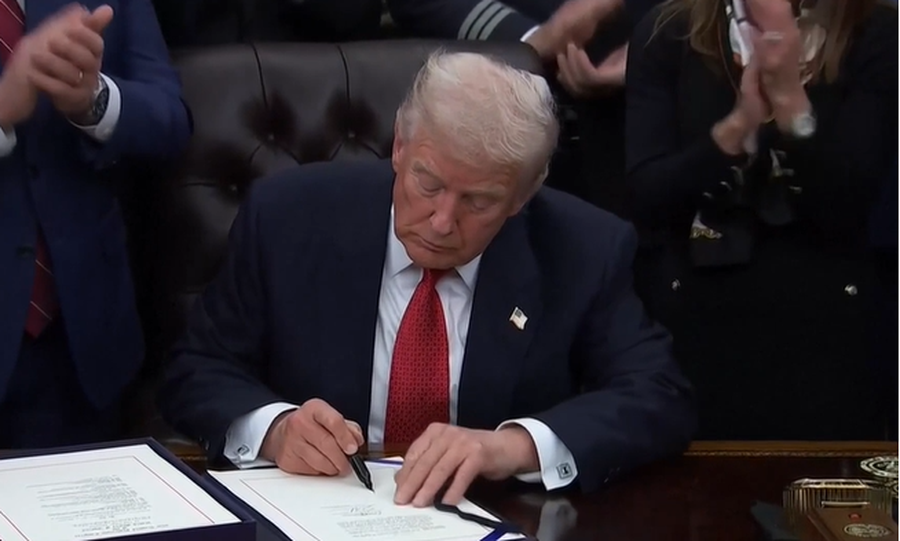
President Donald Trump has signed a spending bill to reopen the government and end the longest shutdown in US history.
He signed the short-term bill into law just hours after the House of Representatives voted 222-209 to pass it on Wednesday evening, and two days after the Senate narrowly passed the same bill.
Speaking in the Oval Office, Trump said the government would now "resume normal operations" after "people were hurt so badly" by the 43-day shutdown.
Many government services have been suspended since October, and about 1.4 million federal employees have been furloughed or working without pay. Food aid has also been put on hold and air travel has been halted across the country.
Government services are expected to reopen in the coming days, while disruptions to air travel are likely to ease before the upcoming Thanksgiving holiday. The Federal Aviation Administration (FAA) had reduced air traffic due to staff shortages due to the shutdown.
This had direct impacts on members of Congress trying to reach the nation's capital on Wednesday for a vote in the House of Representatives.
Derrick Van Orden, a Republican from Wisconsin, rode his motorcycle about 1,000 miles (1,609 km) to cast his vote in the House of Representatives before it was sent to the president's desk.
The bill only provides funding to keep the government open until January 30, when lawmakers will have to find a way to fund the government again.
Before signing the bill, Trump repeatedly blamed the Democratic Party for the government shutdown. "They did it purely for political reasons," he said.
"When we get to the midterm elections and other things, don't forget what they've done to our country," he added.
Senate Democrats managed to cause a shutdown despite being in the minority in the chamber because Republicans needed several Democratic votes to pass a temporary funding bill.
They initially refused to support the bill, demanding that Republicans agree to extend health insurance subsidies for low-income Americans, which are set to expire at the end of the year.
Republicans claimed that a discussion on health care could take place once the government reopens.
But on Sunday, a group of eight Senate Democrats broke away from the party and helped pass the spending package. They voted for it in exchange for a promise to hold a vote on those health care subsidies in December.
This led to anger within the Democratic Party and public criticism from figures such as House Minority Leader Hakeem Jeffries and California Governor Gavin Newsom.
Senator Chuck Schumer, the minority leader in the chamber, said the package "fails to do anything substantive to solve America's health care crisis."
Virginia Senator Tim Kaine was among the group of Democrats who voted in favor of the compromise. He pushed back against the criticism and said the federal workers he represents were "saying thank you" for agreeing to the deal.
Hours before the House of Representatives voted to reopen the government, Democrats in Congress saw the swearing-in of their newest lawmaker.
The addition didn't offer enough clout to influence whether health care subsidies would be included in the government funding bill, but Democrats welcomed Adelita Grijalva to their ranks with applause in the chamber.
The Democratic representative for Arizona was elected on September 23, but the House of Representatives has not held a session since September 19, delaying her swearing-in. She is taking the seat once held by her father, Raul Grijalva, who died earlier this year.
What is included in the expense agreement?
The deal negotiated over the weekend extends funding for the federal government through January 30.
It also includes full annual funding for the Department of Agriculture, as well as funding for military construction and legislative agencies.
Guarantees that all federal employees will be paid for time during the shutdown and funding for the Supplemental Nutrition Assistance Program (SNAP), which provides food assistance to one in eight Americans - through next September are also included in the bill.
The package includes an agreement for a vote in December on extending health care subsidies, for which Democrats had sought concessions.




Lini një Përgjigje