


 Shkruar nga Giorgio Cafiero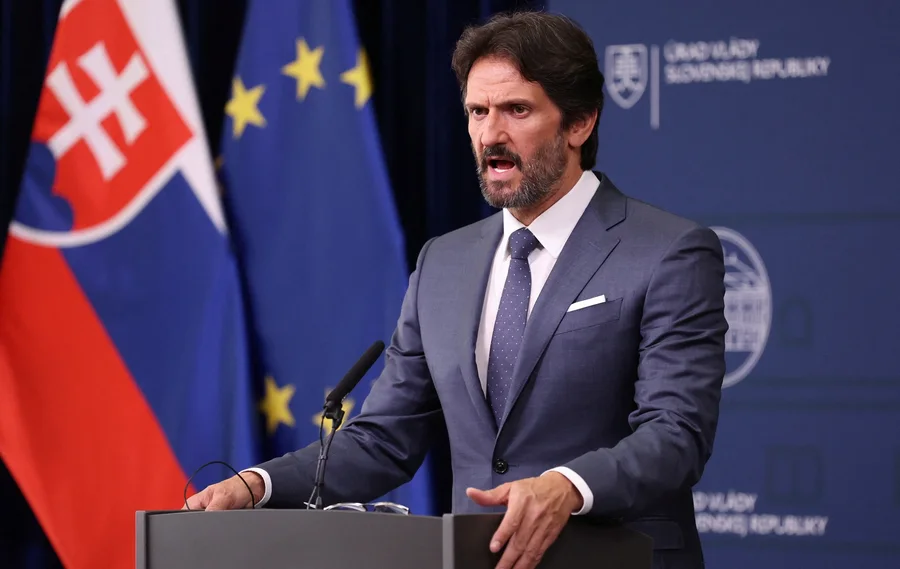
Fico campaigned last year on the promise that he would not give Kiev "any more bullets". Often labeled as a "pro-Kremlin" politician, he has not hesitated to criticize Western sanctions against Moscow.
Robert Fico has long been a dominant figure in Slovakia. He was prime minister in the years 2006-2010, 2012-2018 and from 2023 onwards. But he has upset many who believe in transatlantic unity. And this is because of his opposition to the Western arming of Ukraine, which shares a 96 km border with Slovakia.
Describing the war there as a "US-Russia conflict", Fico campaigned last year on the promise that he would not give Kiev "any more bullets". Often labeled as a "pro-Kremlin" politician, he has not hesitated to criticize Western sanctions against Moscow. On May 15, Fico was the target of an assassination attempt.
A gunman shot him 5 times at close range in Handlová, a small town in central Slovakia. Fico survived, although he remains in serious condition. The attack marked the first assassination attempt on a European prime minister in 21 years. According to the Minister of the Interior, Matush Šutaj Eštok, the author Juraj Cintula was politically motivated and probably did not act alone.
The assassination happened immediately after the presidential elections, won the second round by one of Fico's allies, Peter Pellegrini. Politics in Slovakia is very polarized. Many Slovaks support Fico, but there are also many who hate him.
There are also those who embrace Western-style liberalism, and believe that Bratislava's foreign policy should align more closely with its Western allies in NATO and the EU, which Slovakia joined in 2004. At the more conservative end of the spectrum politically, most Slovak voters support Fico's government as a defender of Slovak traditions, for example rejecting "gender ideology".
"Each group not only has different visions on the future of Slovakia, but perceives the other party's agenda as a direct threat to its way of life and the values it defends. And this is exaggerated and used as a tool to create political capital" - says Zuzana Palovic, co-author of the book "Czechoslovakia: Behind the Iron Curtain".
The murder of journalist Ján Kuciak and his fiancee in 2018, the government's response to the Covid-19 pandemic and the Russian invasion of Ukraine in 2022 deepened polarization in Slovakia. Fico's government repeatedly criticizes the opposition for serving the liberal Western order, while his opponents attack him for being too friendly to Moscow and for suppressing media freedoms.
Many people cite Russian propaganda as an important driver of polarization in this former satellite country of the Soviet Union, which is also happening in other EU member states. During 2020-2023, a number of Fico's political allies were indicted for corruption and subsequently convicted.
"While some of the cases we had procedural flaws, Fico's defense has always been that everything is just a 'witch hunt', like Trump. By harming the work of the police, prosecutors and judges, he created another part of polarization" - says Andrej Matišák, journalist of the Slovak daily "Pravda".
The assassination deepened tensions within Slovak society. Outgoing President Zuzana Čaputová has stressed the need to prevent further escalation. But so far, her appeal seems to have been ignored by both sides of the political spectrum.
"The current political landscape, in which politicians and their family members are receiving threatening letters, is very complex. Slovak politics is full of conspiracy theories and misinformation. All this is reflected in social media platforms" - says Lívia Benko, researcher at the Austrian Institute for European and Security Policy.
After the assassination, Eštok warned that the country is "on the brink of a civil war" because of the rhetoric on social media. But Palovic says that such language of the minister "reflects concerns for the stability and unity of Slovakia". Even Matišák thinks that this statement was understandable given the great emotions that the event provoked.
But according to him, only the government has the means to start a civil war, and in that case, it wouldn't even be such a war. "It would be a kind of coup against the democratic regime in Slovakia. I don't believe that will happen. Therefore, I read the minister's words as an attempt to communicate with his electorate to suggest that first of all the 'other side' is responsible for what happened," he adds.
"The behavior of the Minister of the Interior is the same as that of firefighters who start their work by throwing a gas cylinder on a fire. It is an irresponsible and dangerous statement. Slovakia is not close to any civil war. Unfortunately, Eštok is speaking as if he is a candidate running in the elections and not as the Minister of the Interior", says Matej Kandrík, co-founder of the Adapt Institute, an institute based in Bratislava.
In the 1990s, when autocratic leader Vladimir Mečiar was the first prime minister of independent Slovakia, he ran the country like a mafia state. In the mid-1990s, NATO delayed Slovakia's application for membership due to internal problems, and in 1998, then-Secretary of State Madeleine Albright called Slovakia a "black hole at the center of Europe".
So only 6 years before it joined NATO and the EU. Today, Washington is very worried about the future of Slovakia, which is located on the dividing line of a divided Europe. As Hungary's Fico and Viktor Orbán are increasingly tying their countries to Moscow, Washington and Brussels must try to influence these "rebel EU leaders".
Western pressure on these Russia-friendly NATO and EU members could backfire in ways that could further weaken Western unity against Moscow. The assassination of Fico risks deepening internal tensions in Slovakia, but also between Bratislava and Brussels. Especially if Fico's government promotes initiatives that further weaken the rule of law. Although the immediate consequences of the attempt on Washington's interests are currently difficult to assess, instability in Slovakia could have major consequences for US foreign policy interests in this part of Europe, especially in the context of architecture of security in progress. /Taken from "Responsible Statecraft", adapted from 'Pamphlet'
Note: Giorgio Cafiero, founder and head of Gulf State Analytics, a geopolitical risk consulting firm based in Washington.


Lini një Përgjigje