


 Shkruar nga Pamfleti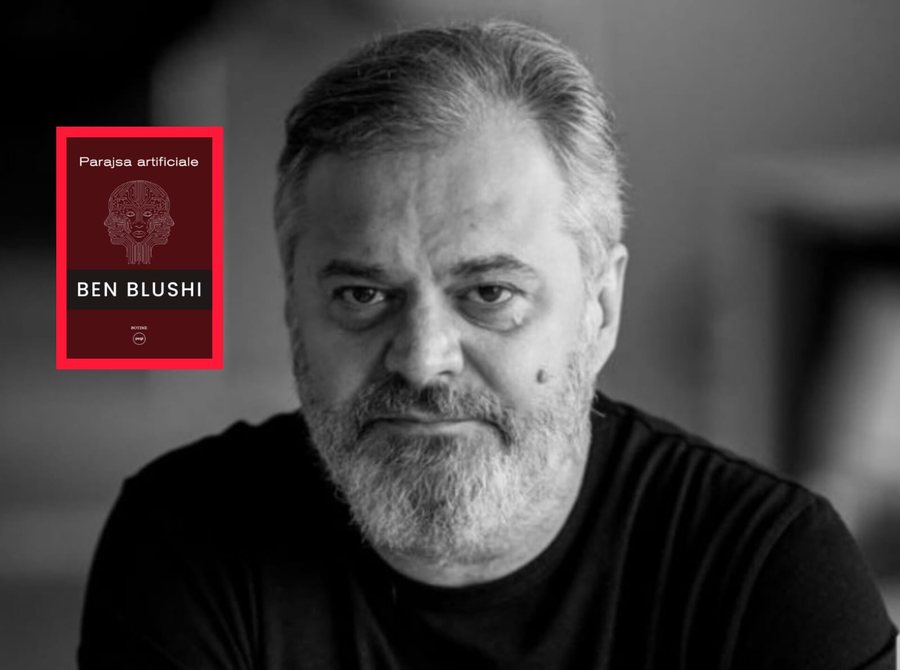
Of course, times have changed and the battle between God and technology has become increasingly fierce. This topic is also touched upon by Ben Blushi in his latest novel Artificial Paradise.
Although Ben Blushi says his latest novel is a love story, it doesn't seem to be just that. From some clarifications that Blushi himself has given in the media, it seems as if there is a tendency to hide some other topics under the sheets of love that this book describes.
One of the main themes of the novel is the battle between God and science. Ben Blushi with his character's mouth says on several occasions, that God is dead. He even goes further when he claims that Muhammad and Jesus Christ have weakened as prophets, that is, they no longer serve the humanity they once did, which is tending towards unbelief.
It is true that religions in general are losing their weight to the detriment of technology. Today, more people hang out on the Internet, in stadiums and screens than in churches and mosques. It was not like this 300 years ago when life was very limited and when cult objects were also schools and hospitals and bookstores and entertainment and meeting places.
Of course, times have changed and the battle between God and technology has become increasingly fierce. This topic is also touched upon by Ben Blushi in his latest novel Artificial Paradise.
In one case he writes: The ancient Greeks believed in many Gods, the main one being Zeus. But Moses, Jesus Christ and Muhammad killed Zeus and took his place. This will happen even after 1000 years. People will replace today's Gods with other Gods. Jesus Christ and Muhammad are dying.
In another case, the main character of the novel says: We are going to heaven without God's help. The difference is that when God was alive, we were each other's hell, now that God is dead we will be each other's heaven.
In the novel there are many dialogues during which the characters debate about the role of God and the prophets as well as many bold judgments about them. But the idea that runs through the book is that humanity tried for several thousand years to find heaven by following the divine method, that is, God's way. People believed that by doing good during their lives they would go to heaven after death. This means that the price of heaven is death. If you don't die, you can't go to heaven.
This is precisely what Blushi opposes in the last novel. According to him, humanity failed to know heaven in God's way because no one returned from there to prove that it exists. The world is a hell filled with injustice, war, conflict and enmity which God is unable to appease. Therefore, the other way to go to heaven is the way of science and specifically the way of artificial intelligence.
The main character of Ben Blush's book says that through Artificial Intelligence, humanity will gradually detach itself from money, from vices, from wars, from greed and from God himself. The world controlled by Artificial Intelligence will be a fairer, more peaceful world, in which people will not kill, steal and fight, and the man empowered by Artificial Intelligence will be God himself. Through the progress of Artificial Intelligence, people will live longer, overcoming body diseases, pains, tortures of aging as well as soul diseases such as greed, envy, betrayal, lies and hatred.
This is one of the endings of this strange novel which Ben Blush elegantly hides under the sheets of an inappropriate love between a man and a young girl.
Perhaps he greatly exaggerates the power of Artificial Intelligence while deliberately downplaying its dangers. Although Blushi says that it is not going to happen, there is no guarantee that Artificial Intelligence can turn into an enemy of humanity by getting out of control, which is the biggest fear of many philosophers today. Even those who work with artificial intelligence every day are afraid of its complete independence from humans.
And if this happens then Blush's enthusiasm is rash. Therefore, should we live with the fear that Artificial Intelligence will become our new God or even worse, our Owner? No one knows, so the reasons to be afraid are strong and Ben Blush's reasoning is not enough to calm the doubt./ Pamphlet





Lini një Përgjigje