


 Shkruar nga Pamfleti
Obituary for the passing of Archbishop Anastasios
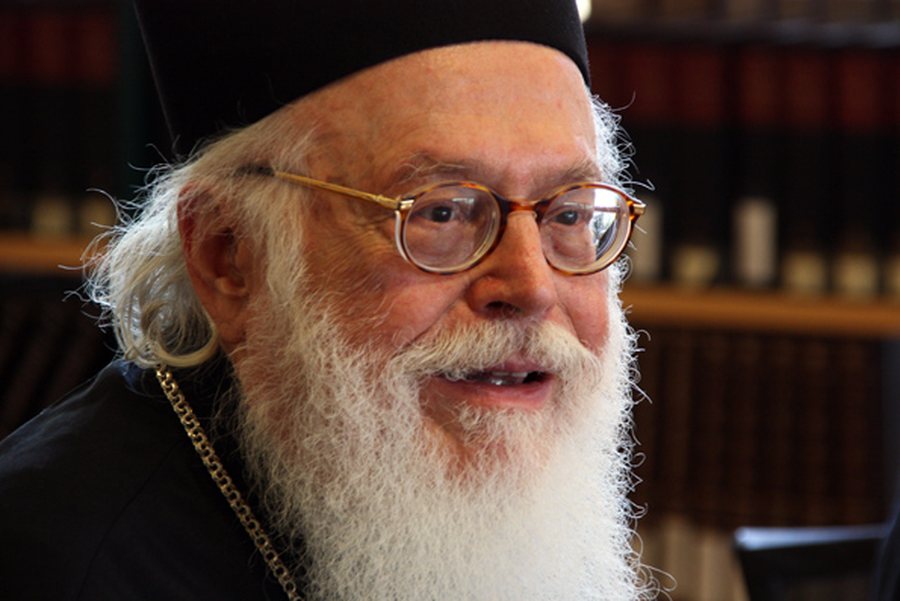
One of the most important and influential figures in Albania after 1990 has passed away, after a few weeks of health struggles.
One of the most important clerics not only in the region, but also beyond, as well as one of the most prominent thinkers and intellectuals of the Christian world in the Balkans.
The Archbishop of the Orthodox Church of Albania, who passed away at the age of 95, is one of the longest-serving senior clergy of religious communities in the country since the revival of faiths after the fall of communism.
The late Janullatos is a cleric ordained as a deacon, i.e. a simple priest, in 1960, who carried out his first mission in the Peloponnese area in Greece.
Janullatos was born in Piraeus on November 4, 1929, but his ancestors originated from Cephalonia, an Ionian island near Corfu and Albania.
Yanullatos, before being ordained a simple priest, studied theology and philosophy at the University of Athens. Meanwhile, after 4 years in the role of simple priest, he was appointed Bishop of Androusa. A rapid career climb, which he completed with additional studies in Germany on the History of Religion and Missions. During his study stay in Germany, the cleric stood out for excellent results, especially in scientific research on the philosophical and theoretical aspects of the relations between religions.
He returned to Greece in 1970, where he received the title of Professor Doctor of Theology with the highest possible results. During his military service, which Janullatos completed in 1954, he also studied at the Military Academy, where he received the diploma of a reserve officer. Janullatos' career took off in 1972, when he assumed the high position of Apostolic General Director of the Greek Orthodox Church, which means its administrative "prime minister".
After a few years, he was sent on a mission to several countries in Africa, where he managed to establish and strengthen Orthodox Christian missions in Kenya, Uganda, and Tanzania.
In 1991, the Patriarchate of Istanbul sent the now famous Greek priest, Anastas Janullatos, as Exarch to Albania. Exarch means ambassador, the same as the apostolic nuncio that the Pope sends to countries where the Vatican has diplomatic relations.
But in 1992, it became clear that he had not come simply to be Exarch. Janullatos was appointed by the Patriarchate with the title of Metropolitan of Andruza and commissioned archbishop of Tirana, Durrës, and Primate of Albania.
In 1992, he was elected head of the Orthodox Church in a very heated and controversial process, as some believers were seeking an Albanian to lead the church.
Sali Berisha, then President of the country, helped him a lot in taking on this role.
From that time until now, Anastasius managed to build up the Orthodox Church, securing funds and establishing new and important institutions. The most important are the Cathedral of Tirana and the Academy of Clergy in Shën Vlash in Durrës.
In these days of the agony of the late Janullatos, even today there are many kind words and tributes for him, which is humane and part of the Albanian tradition regarding the escort to eternity.
However, Anastasius, besides being the longest-serving high priest of a religion in Albania, was also an important personality connected to official Athens.
There has been no similar case of homologation of other religions, for example, evangelical Protestants with the USA or Britain and Germany; Muslims with Arabs and Turks; Italy with Catholics, just as Athens has considered Anastasius as a semi-official of its own.
This is not only a designation on the official agenda of every high-level meeting, but also in relation to the political activities of His Majesty.
The last was the political communication with Fredi Beleri, as the most serious was when the priests of the Orthodox Church were involved in the bones scandal in the Korça and Përmet area. Where the bones of residents were taken to be identified as Greek soldiers to be placed in cemeteries that are still empty today in Këlcyrë.
Fortlumturia never condemned this act, as it has had a bad relationship with the few Orthodox Albanians in Kosovo, Montenegro, or North Macedonia.
On the contrary, he has had close relations with the Serbian Church, to the extent that at an Orthodox assembly in Tirana, the infamous head of the Serbian Orthodox Church, Irinej, said in front of the cathedral that "Kosovo is Serbia."
A statement that caused the Archbishop many problems regarding relations with the Albanian government and Albanian politicians in the region.
There is much praise from analysts and politicians on the screens for his role in the return of the Orthodox Church as Albanian, but the fact is that the late Janullatos kept away those priests who belong to the nationalist cause, such as Foti Cici or Nikolla Marku, whom he crushed with his propaganda. Apparently, he failed to unite the Orthodox in Albania, and on the other hand, he failed to soften or bring closer Albanian-Greek relations. Even though he took Albanian citizenship, whenever these relations have been tense, his Beatitude sided with the country of his birth. However, to see the content of his work, how he has led the Albanian Orthodox Church, it will take more time and patience. To see the mission complete. / Pamphlet


Lini një Përgjigje