


 Shkruar nga Diplomatico | Pamfleti.net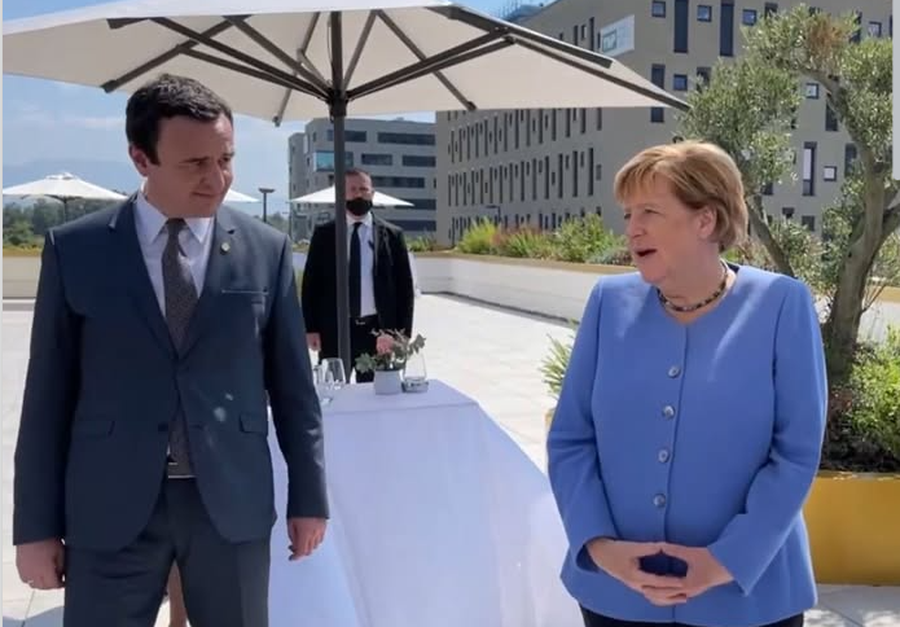
Berlin brought him to power, but after five years without results, Albin Kurti has lost value as a German political project in Kosovo...
There has been a lot of noise for days about the strong clash between the US government and Albin Kurti in Kosovo. A serious political fact, but not new.
Kurti, the Americans; both Democrats and Republicans, have never liked him. Especially with Donald Trump, he has been unwanted.
Albin Kurti was brought to power by Germany, and especially Angela Merkel. In 2020, she carried out a political “blitzkrieg” that was even more powerful in effect than her fearsome predecessors. Merkel stopped Hashim Thaçi at the airport, disrupting his trip to Washington, and he then ended up in The Hague. A perfect political act, without casualties and without collateral costs, that put Kurti, Vjosa Osmani, and Donika Gërvalla at the center of the scene.
Since 2014, German diplomats have been uncompromisingly attacking people associated with Thaçi. We recall here the episode in Tirana, when German ambassador Helmut Hoffmann publicly attacked Enver Hoxhaj, so strongly that the latter left not only the activity, but also Tirana. Merkel's Germany set up the "Berlin Process", a project that aimed to build a new geopolitical axis in Europe. A process that the Italians, French and British did not like, and that the Americans viewed with suspicion, although they did not openly oppose it.
Donald Trump chose to directly challenge Merkel with Ambassador Richard Grenell. Merkel declared him 'Non Grata' and expelled him from Berlin, while also punishing Hashim Thaçi who followed his adventures, leaving him in prison since 2020 and bringing Kurti to power. The latter was spoiled by German support, but never managed to justify it. He behaved like Xhafer Deva of the '40s: power from Berlin, but without results.
Germany has kept Kurti, but no longer sees him as a valuable card. Berlin has shown strength not only with Kosovo, but also in other cases. The Greek crisis of 2008 clearly showed that Wolfgang Schäuble dictated every move in Athens. The same power was seen in the forceful installation of Ursula von der Leyen at the head of the European Commission, in the management of the Covid-19 pandemic and in the distribution of billions of European funds. After the war in Ukraine, Germany is no longer just the “bank” of Europe, but is turning into a military superpower, multiplying its influence in the Balkans.
In the region, Germany is openly playing against Aleksandar Vučić, just as it helped topple Slobodan Milošević in the 1990s. Zoran Đinđić was a product of Berlin, and his assassination is still an open wound for the Germans. They have not forgotten who executed him, nor the double games that the Americans are thought to have played.
In Kosovo, Berlin has invested a lot, but Kurti has squandered this golden opportunity. His rigid ideology, hesitation about strong decisions and fear of consumption have made him survive without achieving anything. Five years have passed in vain. Such an opportunity will not come again for him or Donika.
Germany is not a peripheral actor, but a power that acts calmly and decisively. It already seems to be looking for the new figure for Kosovo and Albania. And when it finds it, there will be no more "bam", but "bam-bam"./ Pamphlet





Lini një Përgjigje