


 Shkruar nga Gaetano Quagliariello
But the problem remains the same: the responsibility of the ruling classes and their ability to lead. If one is intimidated by the idea that the opponent should not be defeated but destroyed, politics inevitably degenerates into civil war.
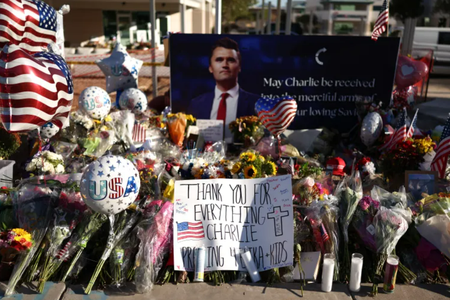
The execution of Charlie Kirk, shot by a sniper while giving a speech at the University of Utah, connects the conditions of political struggle in America with the future of democracy, understood as a universal political regime.
America is the oldest political democracy of all. And it is certainly not the first time it has been shaken by a bloody act.
However, never before has an attack raised fears about whether the institutional framework is strong enough to contain and overcome such an event.
The suspicion is growing that long-simmering social, cultural, and identity-based trends have reached their extremes. In the span of just a few years, former House Speaker Pelosi’s husband was hammered, the CEO of United Healthcare was murdered, the Pennsylvania governor’s house was burned down, a Democratic congresswoman from Minnesota and her husband were murdered, and the attempt to assassinate Donald Trump narrowly failed, until the assassination of Charlie Kirk.
Faced with this trail of blood, it is impossible not to wonder if this is also due to an abdication of institutions and their inability to manage the conflict. But the answer is no.
In America, for now, judges are the real opposition to Trump. The courts are exercising sharp scrutiny over several executive branch initiatives: from tariffs to immigration to the deployment of the National Guard.
Their decisions have repeatedly held back government action. When Trump declares a state of emergency, the justice system tightens its grip to the point of denying that an exception exists.
Thus, communities, cities, and states can assert their autonomy against the President’s decisions. The goal of some judges is political: to portray Trump as a “serial loser.” But history and jurisprudence remind us that, in exceptional circumstances, federal law has permitted (and does permit) the use of force under federal auspices.
Eisenhower sent troops to Little Rock to enforce desegregation. Bush the Elder sent them to Los Angeles in 1992 to save a burning city. And so it’s understandable why the recent district court ruling stripping Trump of control of the National Guard was stayed by federal appeals courts.
This confirms that the constitutional system of checks and balances still works: it curbs excesses but also protects the prerogatives of the executive branch. What is faltering, however, is the political discourse.
The Democratic Party is either absent or incomprehensible. In the face of Kirk's murder, the front lines of Democrats, Clinton, Obama, Biden, immediately condemned it. But the hesitation of the liberal world and the party's second lines has revealed a leaderless opposition.
When Republicans in the House of Representatives pointed the finger at Democratic benches, the response was a resounding call for gun legislation.
Meanwhile, the perception of tragedy is changing. In the age of social media, collective mourning has lost its function as a civil ritual. Everything is destroyed in memes, likes and harsh irony. Death is trivialized, transformed into a weapon used by one faction against another. And violence ends up being legitimized.
They say the polemicist Kirk “looked for it.” Some write of the era of “violent populism.” Others evoke the end of the Founding Fathers’ experiment, overwhelmed by a kind of mass psychotic collapse.
But the problem remains the same: the responsibility of the ruling classes and their ability to lead. If one is intimidated by the idea that the opponent should not be defeated but destroyed, politics inevitably degrades into civil war.
A poll shows that 40% of Democrats believe that using force to remove Trump is acceptable, while 25% of Republicans believe that military intervention against protests is legitimate.
If these views are allowed to prevail, even a functioning democracy like the American one is at risk.
Because institutions last only as long as garrisons of real men and women stand ready to defend them.
When "deviance" ceases to be opposed and even violent murders are tolerated, then the value of democratic institutions also disappears, no matter how efficient they may be: today in America, tomorrow at home. /Adapted from Il Giornale/





Lini një Përgjigje