


 Shkruar nga Pamfleti
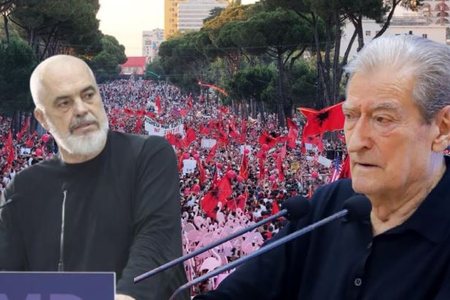
For 23 days, citizens have been protesting and demanding change. Instead of a political response to their demands, the government is choosing labeling, division, and fabricating new enemies to divert attention from the essence of the protest.
For more than 3 weeks, thousands of citizens have been protesting. In the squares, on the streets and on social networks, political demands are being articulated that cannot be ignored: the resignation of the prime minister, a caretaker government, term limits and the restoration of trust in elections. These are political demands, not criminal ones. They are demands that in any serious democracy would deserve debate, response and reflection.
But what is happening in Albania?
Instead of listening to the protesters, the government is looking for enemies. Instead of dealing with the demands, it is dealing with the people who articulate them. Instead of providing explanations, it is producing labels.
And the target of recent days has become Dritan Goxhaj.
The man who read the protest demands has suddenly become the main subject of public debate. Not the demands. Not the protests. Not the civic anger. Not the country's problems. But Dritan Goxhaj.
This is no coincidence.
It's an old political technique. When you can't defeat the message, attack the messenger. When you don't have an answer for the protest, create an enemy. When you can't convince the citizens, try to divide them.
This is exactly what we are seeing today.
There is an attempt to create the idea that anyone who has a different opinion on international conflicts, anyone who has criticized certain American or Israeli actions in the Middle East, is automatically on Iran's side. This is an absurd standard.
Because if this standard were true, then some of the world's largest newspapers, the most renowned Western analysts, retired American diplomats, and experts who have criticized the Trump administration's strategies or military operations in the region would also have to be declared "pro-Iranian."
Criticism is not betrayal.
Analysis is not propaganda.
And thinking differently is not a crime.
Dritan Goxhaj may have been wrong in certain analyses. He may have positions that many people do not agree with. But that does not make him an enemy of the US, nor an enemy of Albania.
On the contrary.
His biography is well-known. He left his military career and went to the Kosovo war. He served alongside the KLA in the most difficult days of the nation. He has spent years amidst sacrifices, persecution, unemployment and clashes with various powers. He has never been part of the privileged elites. He has never been a man of favors. You can accuse him of many things, but it is difficult to accuse him of living for interest.
Therefore, attacking him seems more like a political necessity than a real debate.
And here the most important question arises:
Why is there so much talk about Dritan Goxhaj and so little about the protest?
Why are we talking about labels and not requirements?
Why are you talking about Iran and not Albania?
Why are you talking about analysts and not citizens?
The answer is simple.
Because the protest is becoming difficult to ignore.
When hundreds or thousands of people take to the streets for days on end, the government is forced to react. And when there are no convincing arguments to quash the protest, it seeks to delegitimize it.
This is why artificial divisions are being built. This is why new enemies are being produced. This is why individuals are being attacked.
Albanians have seen this film before.
Whenever power has felt threatened, it has sought out "enemies." Once they were called class enemies. Later they were called traitors. Then agents. Today the label changes according to the needs of the day, but the logic remains the same: create a figure to demonize and divert attention from the real problem.
But the real problem is not Dritan Goxhaj.
The real problem is that after 12 years in power, a large portion of citizens do not feel heard.
The real problem is that people continue to leave the country.
The real problem is that trust in politics is at an all-time low.
The real problem is that every critical voice is treated as an enemy.
No Facebook post solves this. No hashtag solves this. No attack on an individual solves this.
Dritan Goxhaj may be the next target today. Tomorrow it may be someone else. But history has always shown the same thing: when the government starts to deal more with the people who speak than with the reasons why they speak, then the problem is no longer with the critics.
The problem lies with the government itself.
And citizens understand this much better than those who are trying to distract them today think.
Because ultimately, protest doesn't need imaginary enemies.
Real answers are needed. /Pamphlet


Lini një Përgjigje