


 Shkruar nga Ben Andoni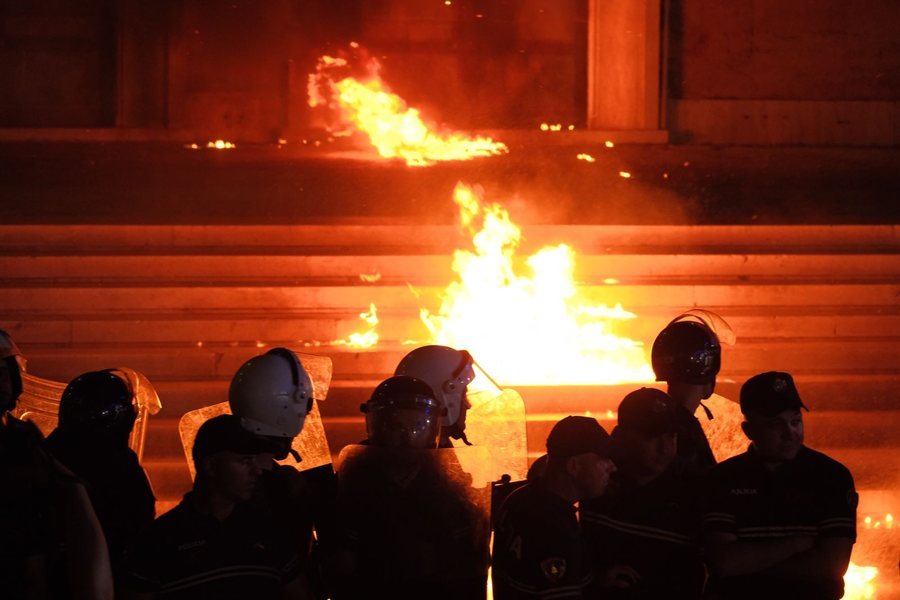
Independent institutions, those that could set balances between them, were and remain mostly under pressure and silent. It often seems that Albania is a party.
The last sentence of the democratic deputy Salianji has served as fuel for the big opposition machine to arouse the revolt of its militants and to say that it will not stop until the government falls and gives way to a technical government. The most active voices have continued to say that: the protest is no longer closed and so on. On the other hand, the government has had enough to remind them of "January 21" and for the last few hours to repeat that this is a scenario that can only arise from the DP. Power and violence go hand in hand and are opposites. If you will have a good government, which means that you respect the Independent Institutions and let them work; gives continuous account to the public and makes life more peaceful for post-democratic Albanians; preserves economic balances, not to burden the prices of the basket; respects pensioners; or bears responsibility for mistakes, then the confrontation of such a government with violence becomes hypothetical. The case of the Rama government, currently, is not like that. Their predecessors, who were led by Berisha and who today are thinking of a protest that will not stop, were no different.
Independent institutions, those that could set balances between them, were and remain mostly under pressure and silent. It often seems that Albania is a party. Political mentality and behavior fuel this argument. The majority's respect for the Constitutional Court in the case of the "Xhaçka" mandate; the collision of the parliamentarians with the head of the SSC during accountability, etc., are indicators that the past inertia continues, where the conflict between politics and the institution is inevitable.
The heads of the Independent Institutions are elected by the parliament and only a few of them with a qualified majority. From the latter, the election of the People's Advocate is being prolonged without end, without being able to find the right replacement. The current President Begaj, like other predecessors Meta and Nishani, simply decrees, since the constitutional changes of 2008 turned the President into an extension of the political force, which has the majority of cards. Except for Meta, who left the line, after 2008 only one was signed. The decree as well as consent are in the hands of the political force, which has more parliamentarians and gives the presidential throne. Therefore, President Topi (he clashed with his own people, when he showed him the Constitution), then the opposition Nishani and that Meta had so many problems with the majority.
The strength of the winner of the general elections is immeasurable, as it ensures the power of the government through the election of the heads of other independent institutions, that is, the entire architecture of the state. Independent institutions have the duty to inform and work for good governance, as they should focus on governance problems. In extremely protective conditions (where violence "must" appear), the opposition remains to oppose these institutions, when they give decisions outside their interests and to accuse their colleagues of usurping independent powers. It is understood until they come into force and the rotation transforms the same problems. If someone succeeds in postponing the mandate, as happened with Xhuka of the ILDKP, dismissal from a commission will definitely happen, where the majority decides and the minority in the opposition is absent. The law on the president has made his institutional independence fragile, while his morals are difficult because it comes from the pocket of the current prime minister. Independent institutions really specify a mandate for the head of the institution, as in the case of the head of the Supreme Court, ILDK, the General Prosecutor, or even a detailed legal protection in case the majority in power will strike them, but even this is insufficient , but again the integrity of the holders and the necessary legal space to exercise the duty is possible.
With what we see, the President, who is the proposal of the majority, is usually not able to get out of the moral conditioning of the election debt. Albanians are eager to see people in high positions publicly resign for the sake of the sense of statehood, in case their rights are violated. Unfortunately, our conformism is extended to the highest segments, while homo albanicus, whether in constitutional functions, meritorious remains more in the service of power and not the state, towards a different behavior towards independent institutions by the majority regardless which wing it belongs to, they seem to be very few.
This makes today's DP opposition forget what it used to be and surrender to violence, as the only means to be heard. Violence is the biggest element, which is made and articulated by it, which leaves a mark on the commitment of the individual (a part of the DP must be on the lists) and which can mobilize and at the same time distract ordinary militants from developments real and in causes, often urgent. The DP's case is genuine, that for the sake of Salianj's imprisonment and the problems of Sali Berisha, they are trying to distract public attention on things that do not belong to them, while discussions on the budget and so on are approaching.
The disrespect of the institutions already continues due to inertia even in the opposition. At another time, the well-known political scientist Hannah Arendt looked at it somewhat differently, understandably under conditions where institutions must function: "Power and violence are opposites; when one rules absolutely, then the other is absent. Violence appears where power is in danger, but left to its own devices, it (violence) ends up under the influence of power". Power gives you such sensations in the country, but suddenly returns to its cynical face. Rama does this by criticizing the SP, when it seems that he will lose his power. In the case of the Berisha administration, this made little sense, as the deliberate escalation of state violence was used as a desperate attempt to retain power, however the consequences would be catastrophic, as they claimed the lives of four unfortunates.
Violence is not only indicative of a leader's loss of power and waning influence, but actually contributes to the erosion of their power. Berisha suffered from this and it served as a precipitating factor for his loss of power that he used state violence. Will Rama's government escape the violence from above against the opposition? Most likely yes, while he will leave the weight to the opposition, underlining it with the darkest and most inappropriate colors, reminiscent of 1997 and especially "January 21". Aman, Rama is fading from his own cynical and tiresome power, many times without rules and completely spontaneous. The Prime Minister has long learned the lesson, while the goal is to, through the opposition and its behavior, reduce or remove from the agenda the power of the Independent Institutions that monitor it, as in the case of the "Xhaçka" mandate. they showed him the border.
Protection of Institutions and Power in the face of Violence are now the main topics in Albania in a democracy that is leaking water everywhere. Historian Snyder in his corpus of 20 essays, referring to the American case, criticized that it is the people who must protect the institutions and in this case the state. If these politicians who tear us apart with violence, do not do this, their primary duty is what they expect from us, that we delegate power to them. "Don't talk about 'our institutions', as long as you don't make them yours, acting in their defense, because institutions cannot defend themselves," Timothy Snyder elaborates in his essay on institutions. History has given endless cases, but our history speaks for itself, that by not respecting the Institutions, we willingly bow down to Power and Violence. Pick an institution and defend (!), is Snyder's motto that has nothing to do with our parliamentarians, whether Left or Right. Mostly, to those who are hiding under the shadow of Berisha and can't wait to take their place under the shadow of Rama. (Homo Albanicus)


Lini një Përgjigje