


 Shkruar nga Pamfleti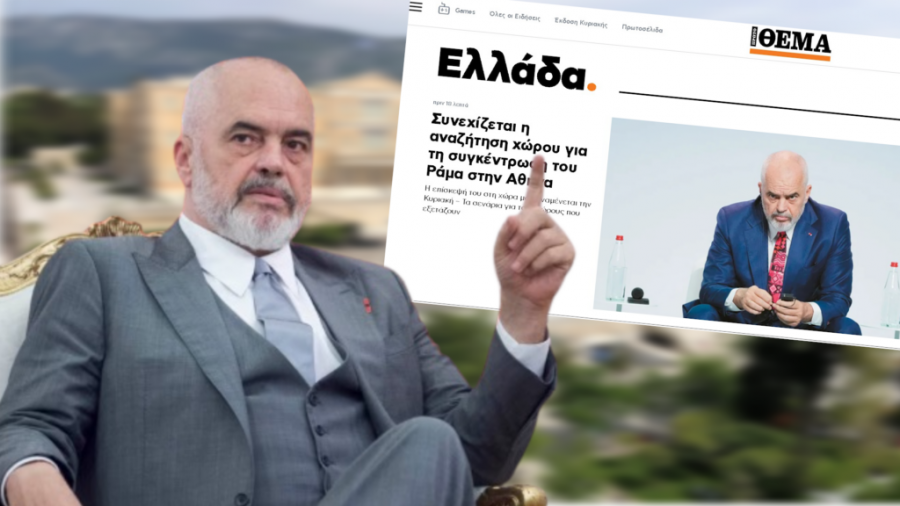
It is not known whether the Greek government is more irritated by the eventual posting of votes that Rama can do with his meeting, or the stubbornness of the Albanian prime minister, who after "leaving us Beleri in prison, is coming to make a mess of us in the middle of Athens"?!
The approach of Sunday, when Edi Rama will hold a rally in Athens with our immigrants there, has thrown new fuel on the diplomatic fire that has been burning for a year between Albania and Greece. While representatives of the Albanian government and our embassy in Athens continue to look for a hall or stadium to hold Rama's meeting with his compatriots, the head of the Greek opposition was the next senior Greek politician to come to Dropull without being stopped or provoked by no one. He visited the municipality of Dropulli, the schools where Greek is taught and laid flowers at the memorial of Bularati. No problem, no pressure, no blockage from the central government in Tirana.
If Albania is used to experiencing with calmness and restraint these repeated diplomatic incursions of the Greek neighbors on its land (and very well that is the case), it seems quite the opposite with the other side. The tension that Rama's visit has caused in the Greek politics and media, sums up both anger and surprise. It has not been customary for the poor northern neighbor to show such courage and defiance on the diplomatic level. In Athens, they are used to the parades of politicians and journalists happening only in the opposite direction. They are used to the word that Himara will turn into a parade of Greek parliamentarians and reporters at election time here in our country, but it has never been seen that an Albanian prime minister insists on meeting the Albanians in Greece (tens of thousands of whom have the right to vote in the Greek elections), in the middle of the election campaign there.
It is not known whether the Greek government is more irritated by the eventual posting of votes that Rama can do with his meeting, or the stubbornness of the Albanian prime minister, who after "leaving us Beleri in prison, is coming to make a mess of us in the middle of Athens"?!
This new inverted agenda in bilateral relations is a very worrying circumstance for Greek politics, as it outweighs the electoral damage of the moment. Rama's defiant trip to Greece is a historical contradiction, a drastic change of diplomatic relations, a crisis in the middle of a concert for the ears of official politics in Athens.
For decades, Greece has used a clear political line towards Albania, which has been fundamentally unbalanced and biased towards Greek interests. The Greek governments have advertised and gradually received all the rights for which they regularly shut their mouths to the Albanian governments. Greek-language schools for the minority, World War II memorials, paradoxical maintenance of Martial Law, unconstitutional maritime border agreements and above all a total silence on anything related to the Cham file. This has been the Albanian-Greek relationship in the last 30 years, where one side has achieved everything and the other side almost nothing.
The Beleri case marked a major turning point in this one-way relationship. What seemed like a small electoral tussle for Himara (how many conflicts has a shami-country like Himara produced), gradually turned into the prelude to a completely unknown season in the historical relations between the two countries. As Athens, in the wake of many years of tradition, took its means of pressure on the official Tirana after the arrest of Fredi Beleri, for the first time Europe slams the door in Greece's face by taking the side of the Albanian state. This was the alarm signal for Mitsotakis and the circumstance that gave Rama the impetus to stand firm on the Beleri issue. But today, one year after the arrest of the elected mayor of the Himarë municipality, we assist more in a confrontation between countries and diplomatic traditions, than in a judicial conflict for a local unit where only old men and women are left.
Edi Rama's initiative for an open challenge in Athens has the dimensions of an unprecedented event, but it is also material proof of a new era in the role and weight of Albania in the region. The message is as simple as it is unique: you did what you wanted during the campaigns in the South of Albania, why don't we do this for once during the campaigns in your country?! Moreover, Rama is going to meet Albanians who work and live in Greece as economic immigrants, and not to demand any property, religious or linguistic rights towards the Greek state.
The Greek side is in a very delicate situation in relation to the May 12 rally in Athens, since if Rama holds this meeting with the Albanians, then he will have triumphed this time in relation to the force that Mitsotakis tried against him last year. .
On the other hand, if Rama is prevented from going to Greece, he will be the prime minister of a NATO member country and of a neighboring country, which will be denied what the Greek governments have done for decades in Albania. By analogy, it would be difficult for Greek politicians from now on to land in Himara and Dropull whenever they wanted to.
The visit of the "uninvited" Rama disrupts both cases, whether it happens or not, since the effects on official Athens will be equally complicated. For these reasons, the messages and news coming these hours from Athens about the meeting are contradictory, as once it is said that the meeting place was found, and after a few hours the owner of the hall or stadium suddenly says that the roof is leaking.
Greece is unaccustomed to following the official Tirana in its movements in bilateral relations. He has only learned to lead the dance and rhythm he wanted, imposing it on the Albanian state. He found himself unprepared for Rama's outburst against Beler in last year's elections, he did not expect the Albanian government to resist so strongly the pressure to release him from prison, and even less did he expect Albania to achieve it to turn the United Europe, first Germany, against Prime Minister Mitsotakis in this matter.
Athens has done these thirty years as it wanted in relation to the Albanian political elite. It has managed, with its repeated threats, to have a clear influence on certain decision-making in Tirana, it has raised its voice even when it was wrong about the Greek minority in our country, it has tried to forcefully expand the area of the Greek minority to the feet of Karaburuni and everything she has done by connecting her pressure with the fate of our economic immigrants in Greece and with the perspective of European integration.
These pressure cards have fallen because we live in a different time. Apparently, it is up to Mitsotakis to prove this historical turn on his back, which today comes from a small and poor state, but which has a different role and dimension in the European region than it used to. The broom has been put on a broom!





Lini një Përgjigje