


 Shkruar nga Eduard Zaloshnja
The decline in turnout here had a dramatic effect on the constituent parties of the Alliance for a Greater Albania (PD+LSI+etc.).
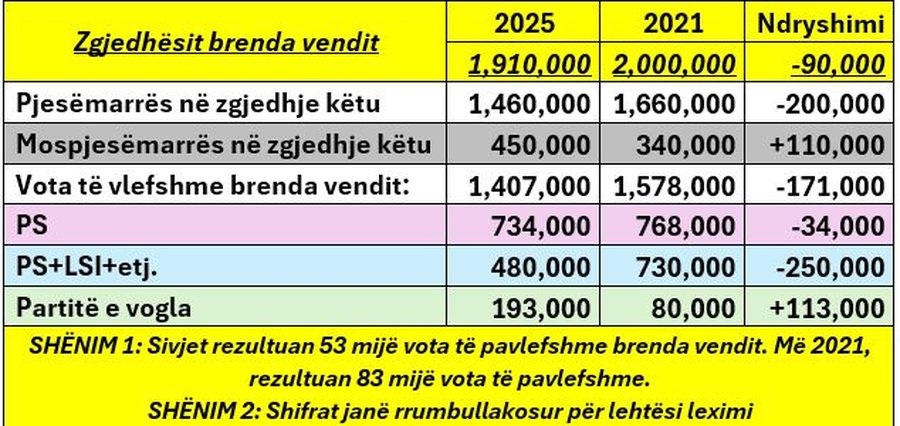
From a rigorous survey that I conducted throughout the country after May 11, it resulted that only 76.4% of the local voters voted, while 23.6% of them did not vote at all. And since the CEC officially certified that only 1.46 million local voters voted, it can be roughly extrapolated that about 450 thousand local voters did not vote at all.
I conducted an identical survey four years ago (after the 2021 elections), which showed that 83% of local voters voted, while 17% of them did not vote then. Which translates into 1.66 million participants and 340 thousand non-participants here (at that time, immigrants could neither vote by mail, nor come to vote here – due to the pandemic).
The decrease in local participants by 200 thousand is partly explained by the decrease in voters within the country (90 thousand) and mainly by the unwillingness to vote for any of the existing parties (110 thousand).
The decline in turnout here had a dramatic effect on the constituent parties of the Alliance for a Greater Albania (PD+LSI+etc.). They created a large electoral hole of 250 thousand votes here, compared to 2021. Meanwhile, a small hole of 34 thousand votes was also created by the SP. And the two electoral holes of the large parties were partially filled by the small parties, which received a full 113 thousand votes more here than in 2021 (see the table below).
Since there were a total of 3.71 million citizens on the voter list, and since about 1.91 million voted within the country in these elections, it can be calculated that about 1.8 million were abroad. Of the latter, only 11.1% (202 thousand) cast their votes by mail…







Lini një Përgjigje