


 Shkruar nga Ylli Pata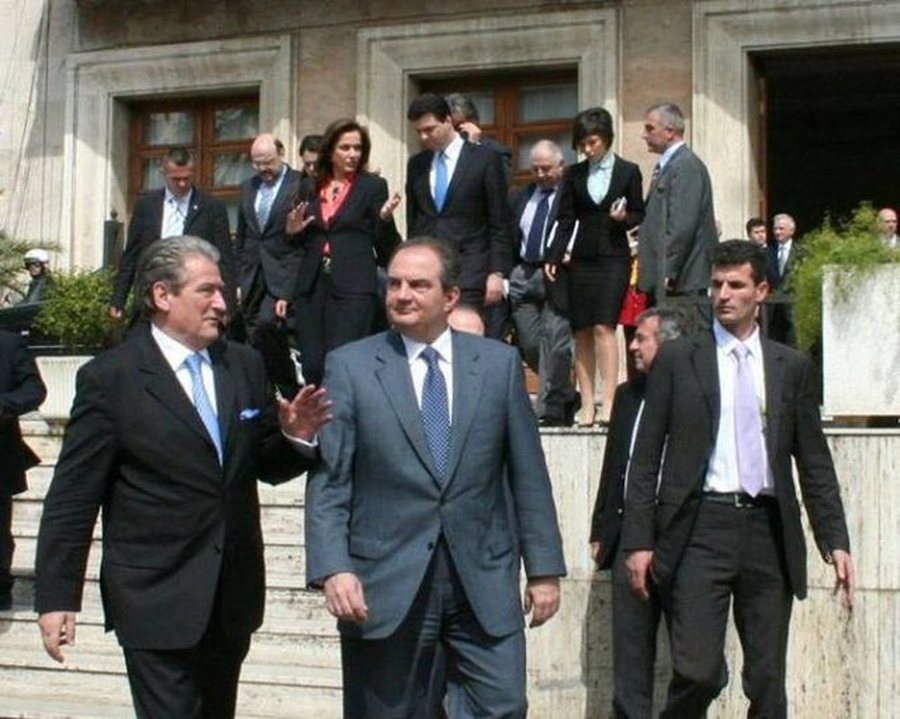
In 2005, Sali Berisha came to power, also thanks to an agreement with important Greek circles. Where is the meeting with Nicholas Gage, the head of the Greek lobby in the US, remembered? And when PD came to government, the issue of expanding the cemetery of Greek soldiers in Këlcyra was opened.
In Athens, both the government and the opposition consider Fredi Beleri a political prisoner. Although in recent days, the Greek left opposition has not liked the placement of Fredi Beleri as a candidate for the Eurodeputy of Nea Dimokratia, it has not waged a battle on this issue. The head of Syriza, Stefanos Kasselaqis, who made a perfect political move in Albania, visiting the real areas of the Greek minority, such as Dropulli, made it a little difficult in the discourse, which needlessly destroyed the care he had shown in logic diplomatic protocol.
In general, there is no doubt that in Athens there are many differences between the parties regarding the issues of relations with Albania. However, when there is a government position against Tirana, there is never an accusation or a political war. This opposite opinion is given in the mildest possible way in parliamentary committees or other institutional tables. However, we have never seen a rift like it happens here between the government and the opposition.
And not for nothing, when there is a stance against Albania, the Greek Prime Minister always consults with the opposition. Where he is asked at least not to attack the official position of the country, in political meetings.
After the overthrow of the dictatorship of the Greek colonels, the government of Kostandinos Karamanlis, a conservative of New Dimokratia, did not take any decision against Tirana. The big change was made by Andreas Papandreu, the founding father of PASOK, who without any compunction opened the reconciliation process with Enver Hoxha's communists. Action that the Greek socialists did not escape without political cost. But we are dealing with heavy weights, which are not affected by side effects.
The "colonel" of PASOK in the north of Greece was a high-level politician: Karolos Papoulias. who was elected in Ioannina every time he ran, maintaining the profile of an anti-fascist and sworn leftist. Papoulias, not Golden Dawn, nor the significant influence of other right-wing extremists, were able to overthrow him politically, until he was elected President of Greece.
Papandreou's government did not lift martial law, but declared that it had frozen it, yet opened a new policy that resulted in a melting of the ice. In a way, removal of warlike rhetoric. Papandreou did not have any losses politically from this step, on the contrary, he stayed for two mandates, until 1989, when the New Democracy of Kostandin Micotaqis won. who followed a policy with a strong hand towards Tirana, and who was known more for his alliance with Milosevic. Which was not really contested by PASOK in the opposition.
Meanwhile, on our side, until 2009, it was the same behavior. Fatos Nano's Socialists had close relations with Papandreou's PASOK in 1992. It printed SP posters, told you a fleet of new ice Land Rovers, and when Nano was jailed they relentlessly demanded his release. . However, the SP did not have positions against the Albanian government in relation to Greece.
Not even Sali Berisha, when Nano was in the government in 1997, had wild attitudes against relations with Athens, even the statements of the opposition were almost always in line with that of official diplomacy, even though when he was overthrown from power he blamed Eastern Epirote Greek regions. Obviously for internal political needs.
In 2005, Sali Berisha came to power, also thanks to an agreement with important Greek circles. Where is the meeting with Nicholas Gage, the head of the Greek lobby in the US, remembered? And when PD came to government, the issue of expanding the cemetery of Greek soldiers in Këlcyra was opened. The opposition of Edi Rama, however, did not have a great antagonism. At that time, Rama had good relations with the new head of PASOK, Jorgos Papandreu, son of Adreas.
But everything turned upside down in 2009. When one day in September, a material was released by the SP that was given to the media, where the agreement between Sali Berisha and Kostas Karamanlis on the limitation of the maritime border is called national treason.
Edi Rama takes the sea pact to the Constitutional Court, where, as we know, the result is history.
Many supporters of the DP and supporters of Berisha, all these years, have tried to defend the thesis that their idol has made a pact with Athens, because he himself intervened in the Constitutional Court to overturn it.
But no one believed this thesis, also because Sali Berisha has always defended his agreement on the sea with the Greek government. Which he called successful and fair, and even in the Albanian Parliament he accused Erdogan of directly influencing the overthrow of the pact by the Constitutional Court. As Neo Demokratia has done in Athens.
This is where the political thread in Tirana is really broken, as we are dealing with a development that not only divided the Albanian society, but also brought a political stain to the Albanian right, alias the Democratic Party, and especially to Sali Berisha.
That pact will always be remembered by the DP, which as a "nationalist right", would be left with a bullet in its leg as collaborationism.
Of course, the story is more colorful than that and everyone who dealt with that pact should speak in detail, but in reality, Sali Berisha defended it. He defended it strongly, hoping that exactly from that collaborationist agreement, Athens will bring him back to power, overthrowing Edi Rama. It was precisely this hope that made Sali Berisha commit a suicidal act: the candidacy of Fredi Beleri as mayor of Himara. In the area of Himara, PD has always received at least one deputy since 2009, when it is voted with the regional system. In the next elections, that deputy was lost forever, as was also seen in the voting of the municipal council, where he replaced Fredi Beleri with a woman from Vunoi. With an Albanian name and surname: Blerina Bala!


Lini një Përgjigje