


 Shkruar nga Ben Andoni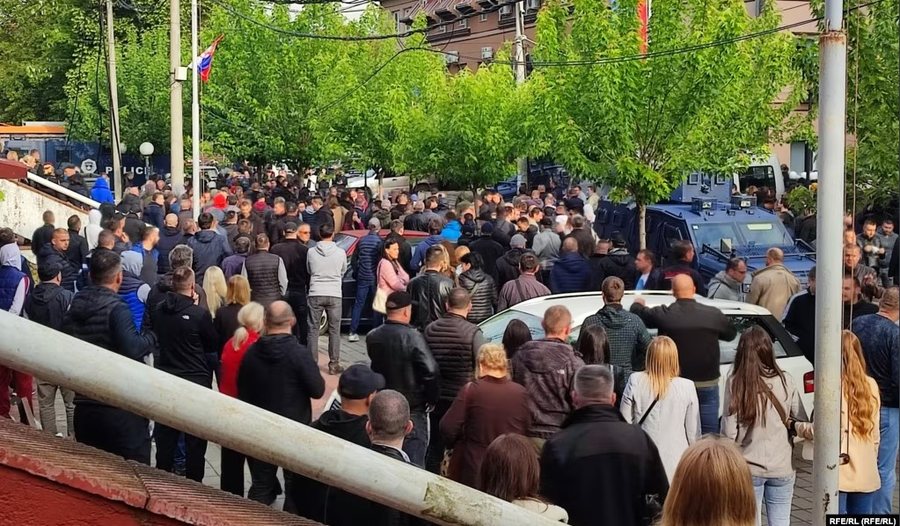
In another sense, the government of Kosovo has avoided the entire discourse of the country towards the problems of the North, which rightly are appearing very disturbing with the continuous Serbian provocations.
The "North" is "serving" almost simultaneously, but in a different direction, official Kosovo and Serbia. Shifting attention from internal economic and social issues. For months, the ministers of Kosovo and Serbia are more concerned with the dialogue than with the conditions of their citizens and the economic level of the respective countries. Although much criticized by the opposition media, the head of Serbian Statistics Kovacevic, would show the position of Serbia in relation to the countries of the European Union, regarding the risk of poverty. "According to the latest data, obtained on the basis of the Survey of Income and Living Conditions (SILC), the poverty risk rate in 2021 was 21.2 percent. This means that about a fifth of the population of Serbia was at risk of poverty!"
Despite a relative improvement, the Serbian economy will continue to slow in 2023 due to persistently high inflation, lower demand from its main European trading partners and rising borrowing costs that will weigh on consumption, exports and private investments. And, these are easily read in Serbia in the purchasing power of the public, but also social concerns. Paradoxically, the Russia-Ukraine war has a modest direct impact on the Serbian economy, as Russia accounts for about 4% of the country's merchandise trade exports and 5.3% of its imports. Serbia has condemned the violation of Ukraine's territorial sovereignty and voted in favor of a UN resolution calling for the withdrawal of Russian forces, but remains the only country in Europe to refrain from imposing sanctions on Russia.
However, the indirect effect of the war, which has materialized in higher global energy prices in the European market, has spread in Serbia to the prices of food and other goods due to increased production and transportation costs. This pushed the annual inflation rate in Serbia to an average of around 12% in 2022, ie the highest inflation rate since 2008-2009, when the financial crisis hit Serbia. Price tensions are greatly eroding the purchasing power of households and their consumption is predicted to slow down further during the winter and spring months of 2022-2023, coface.com (Economic Studies and Country Risks/Serbia) reported.
However, this side is being covered up while the official power in Serbia has avoided attention to other "internal" problems, as they consider Kosovo and the turmoil in the North, which apparently are fueled by the many paradoxes of the West.
In another sense, the government of Kosovo has avoided the entire discourse of the country towards the problems of the North, which rightly are appearing very disturbing with the continuous Serbian provocations. Aman, now, the infantile part of the Kosovar leaders, who had avoided the dialogue and had it in the minor ranks of their priorities (Kurti emphasized it forcefully in his victory), while today they have forced it among the priorities of their main. What about internal problems? Former Prime Minister Hoti listed in a message on social networks the decline in spending on economy, education and health, referring to data from the Statistics Agency based on the report on government accounts 2015-2022: "The figures speak for themselves. Kosovo will suffer economic collapse with this government.
Is the "North" able to ease the economic and social situations in the respective countries?! Apparently so. Serbia is forgetting before its citizens, the main task, the mitigation of inflation, while the promises of the Kosovar ministers are already clearly on the calendar. Or, as my colleague Mushkolaj wrote: "Belgrade is not stopping Liburn Ali to finish the roads left in a deplorable state, nor Arbërie Nagavc to build the promised nurseries and increase the quality of education. Serbia is not preventing Hekuran Murat from increasing the minimum wage, nor Arben Vitina from improving conditions in hospitals. Now 27 months in power, Vetevendosja has done some good work". Well, this is an alarm bell, what is done with the power and its administration...in the Balkans.



Lini një Përgjigje