


 Shkruar nga Ardit Rada
His call for standards based on votes and electoral performance is a direct message that touches Bardhi more than any other figure.
The Democratic Party is involved in a new, but familiar dynamic. Only this time the 'war' of the pulpits has a different direction. Well-known figures in the DP who have openly come out on Ervin Salianj's side are confirming day by day that their entire movement, from cafes to ploy halls, has nothing to do with the aim of taking Sali Berisha's place, nor with creating an alternative to him. On the contrary, Salianj's movements follow a logic that makes sense for the situation in which the DP finds itself today: Strengthening his position in relation to Gazment Bardhi.
Salianji is one of the most exposed figures in the DP in the last decade. He has gone through a difficult judicial process, faced prison, and returned to political life while carrying the weight of a personal narrative that distinguishes him from many others within the party. Despite the challenges, he has continued to maintain an active profile in political debates and public communication.
Meanwhile, Gazment Bardhi, despite the embarrassing result in Fier on May 11, continues to hold important positions in the DP. The man who failed to even get the closed list into Parliament remains the Chairman of the Parliamentary Group and part of the decision-making of the party structures. This contrast between the electoral result and the institutional position naturally creates dissatisfaction and rivalry within the DP, especially from Salianji who a day earlier declared that career advancement within the blue headquarters should reflect the assessment of the voters.
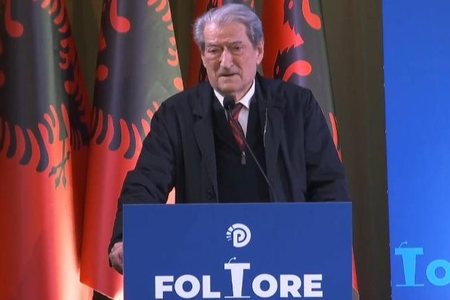
This is where the tension between Salianji and Bardhi arises. If the blue headquarters claims to apply a standard where the vote is the main indicator of legitimacy and advancement, then Salianji sees himself at a moral and political advantage in relation to Bardhi. Consequently, his engagement in a 'Poltore' with the Democrats is an appeal to Berisha to restructure the internal balances and hierarchy in the DP.
Ilir Alimehmet's statements that his and Salianji's meetings are not intended to challenge Berisha's authority are clear proof that 'Foltorja' is not about one person, but about those around him. Likewise, the statements of Edmond Spaho, who mentioned that Salianji was close to taking the post of Chairman of the Parliamentary Group, show that his ambition for that position was real. The fact that this opportunity did not materialize left open an internal issue that today seems to be returning to the scene.
In this sense, 'Foltorja' does not appear as a tool to challenge the historical leader of the DP, but as a platform to strengthen Salianji's personal position. And in fact, he is showing this by gathering more people than Gazment Bardhi received votes in Fier. Faced with such discrediting figures for the Democrats, Salianji aims to reposition himself as a figure who has a contribution, has a history and, finally, seeks to have space in the leadership structures of the DP.
His call for standards based on votes and electoral performance is a direct message that touches Bardhi more than any other figure. Therefore, today the Democratic Party is not experiencing a battle for chairman. It is experiencing a battle for hierarchy. And in this hierarchy, Gazment Bardhi's role is the most contested today. Both for his failures in politics, and for the mystery he carries, how the snail found itself on top of the mountain.




Lini një Përgjigje