


 Shkruar nga Frrok Çupi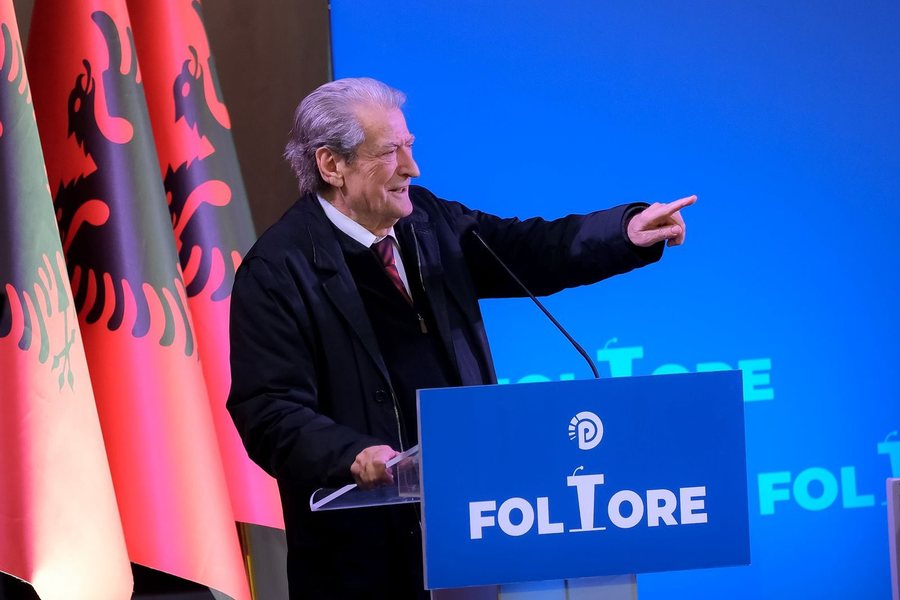
Mark Zefi called this passage a dead party, worthy of words...
Even though he is an engineer by profession, Mark Zefi has written like a linguist 'par excellence'. Because the dictionary is the altar of words, not verbs.
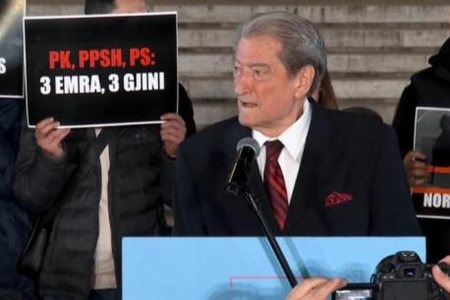
But the engineer did not use it in the sense of a true scholar. He writes: "Tonight for about 2 hours, the leader of the remaining DP, Sali Berisha, was in the hall of the "Gjok Beci" cultural palace in Rrëshen, with his dictionary no. 2."
Even at the end of the article, he says: 'In this way, Berisha's "NOTHING" in Mirdita got what was his. While Berisha, who had attacked Mirdita with the word number 2 to find fur, left shaved and sheared.'
In this sense, the variant of the word 'dictionary', brought by the engineer, becomes all-powerful.
'Vocabulary' is a typical linguistic femnomen in Mirdita. Vocabulary, in the regional dialect only in Mirdita, does not have the meaning of a wooden or metal stool or podium where someone comes out and speaks, whether a fraudulent politician or even the Pope himself. The word 'vocabulary' has an almost aerial, or vocal, or even celestial meaning due to the emotional weight it carries. The Kanun of Lekë Dukagjini used it more specifically.
In colloquial speech, even outside the canon, the herald is the one who has taken on the mission of spreading the word about what has happened. Most often, the herald sends and receives news of deaths. When someone dies in a village behind a mountain or behind several mountains, the herald travels for hours and days to bring the news to friends and acquaintances.
With this sarcasm, Mark Zefi used the word 'speech' instead of the word 'speech'. Mark, a bright professional and a fair and tough man, was one of the first activists for pluralism and democracy. But now, he sees the death of the Democratic Party as an object for the speechmakers.
During Berisha's speech in Rrëshen, he saw the DP with a pale face, lifeless, shaky, hills behind the coast, deceitful, with a leader who had come to Rrëshen to pray: 'Keep me, not Salijan'.
-Just as we expelled Basha, so we will expel Salijanjni!', said someone who was dripping with animalism and servility. How did he know that Basha and Berisha today have more things together than ever, especially the crime of murder and serving foreigners who accused our nation of 'organ trafficking' at the yellow house in Mat. That guy knew as much as he knew the class enemy.
Saliu, after taking notes on the 'stale pearls', begins to speak... At the same time, from Korça, the democratic activist Vrenozi counted:
"We've heard this..., forget it, doctor... We've heard this several times too..., forget it. Hey, Sali, nothing comes of these speeches!"
Mark Zefi called this passage a dead party, worthy of rhetoric.
Someone told Saliu that 'you have in your bosom those you threw into the canal. As soon as Basha's horse died, they came to you'. Again the dead horse, or the dead party, comes out. As for the canonical 'word' dictionary.
"Take the flag away, Sali!", one shouted among the clamor of admirers. Sali shook his head; no one knows that this meant 'you give it, give it..., I die if I take the flag away'. It was all a matter of meaning and misunderstanding.
The flag itself is a wax Sali. It has Sali's signature, it has Sali's deceit, it has Sali's movements and corruption. They did not understand that within the bronze of the Noka monument, Berisha is hidden alive.
How would they overthrow one and leave the other?
While for Edi Rama they decided that 'they cannot overthrow him with votes, words, or guns'. So leave it at that.
Marku probably saw it as a stage for the speech: "Go and tell them that the Democratic Party has arrived in Fushë-Lumthi."
Maybe it was the last word.


Lini një Përgjigje