


 Shkruar nga Blendi Kajsiu
The vote of the DP coalition was reduced by 141 thousand voters, almost four times that of the SP.
Immediately after the DP's electoral disaster on May 11, Berisha's propaganda began to excuse Berisha for this defeat. According to it, Rama's victory is not explained by the DP's deep defeat, for two reasons. First, the DP's defeat does not explain the unprecedented electoral growth of the SP, as a result of crime, state capture and the stupidity of the Albanian electorate that votes for such a corrupt government. Second, the fact that the small parties failed shows that Rama is invincible in the system he has set up.
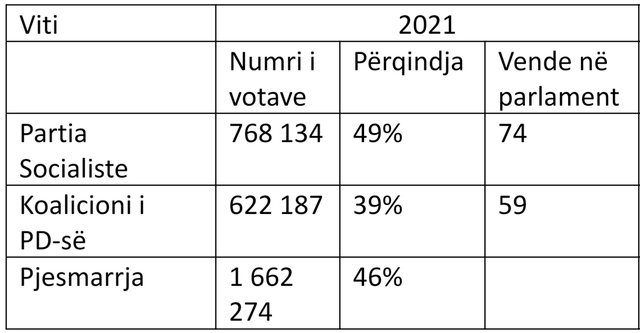
None of these arguments hold up. Rama's landslide victory, with 83 seats in Parliament, is not the result of the SP's electoral growth but of the DP's electoral contraction under Berisha's leadership. The SP has not only not grown electorally but has received fewer votes compared to the 2021 elections when it won 74 seats in Parliament. See Table 1 below
Table 1. Participation and votes of the SP and DP in the 2021 and 2025 parliamentary elections (without the diaspora)
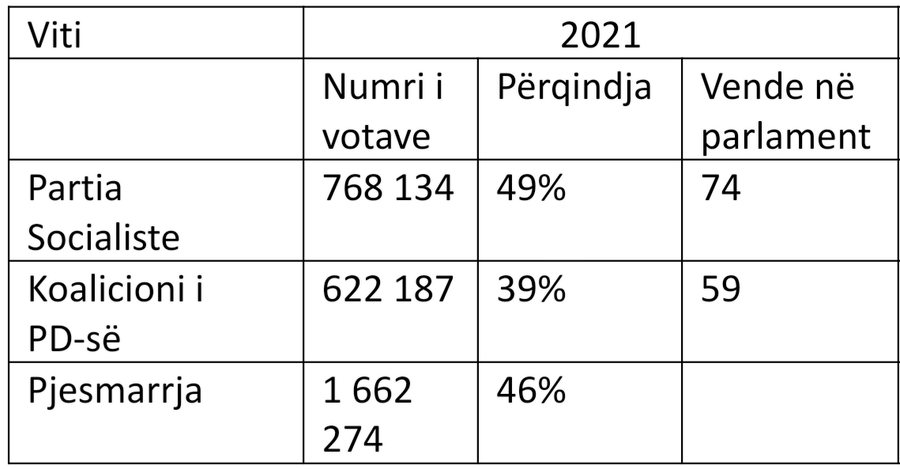
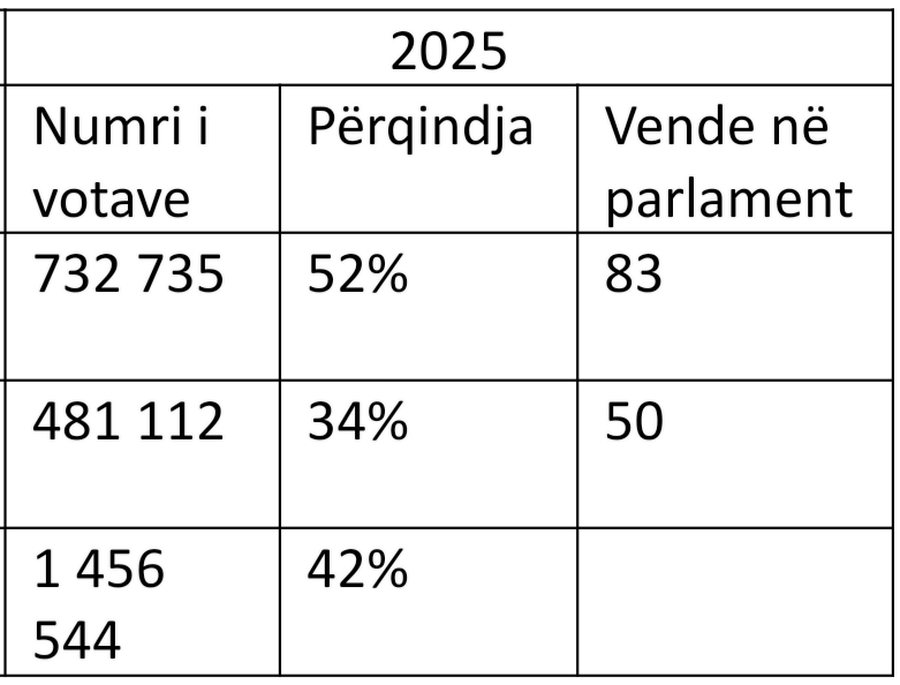
Source: Central Election Commission
As Table 1 clearly shows, the Socialist Party in 2025 has lost 35,400 voters within the country compared to 2021. So we do not have any electoral increase for the SP, on the contrary we have a reduction in the vote for Edi Rama's SP.
Then how is it possible that the SP went from 74 seats in 2021 to 83 in 2025? As a result of the double electoral failure of Berishism. First, if the SP vote shrank by 35 thousand voters, the DP coalition vote shrank by 141 thousand voters, almost four times. Second, in 2025, 205 thousand fewer voters voted in Albania than in 2021.
So even though the SP received fewer votes in 2025 than in 2021, it won more seats because the opposition vote was reduced. The SP expanded its seats in the Assembly, from 74 in 2021 to 83 in 2025, not because it increased the number of votes but because the reduction in the opposition vote increased the socialist vote as a percentage. Let us explain this dynamic with a simple example.
If the ruling party has 50 votes and the opposition has 50 votes, the percentage of votes is 50% ruling party and 50% opposition. If the ruling party falls to 45 votes and the opposition to 30 votes, then the percentages are 60% ruling party and 40% opposition. But in this case the increase in the ruling party is not a product of its electoral miracle, on the contrary it has lost 5 votes. The increase in the ruling party from 50% to 60% is entirely a product of the opposition's failure, of its decline from 50 to 30 votes.
This is what happened in the last elections. Edi Rama did not produce any electoral miracle in 2025. On the contrary, the votes he received in the last elections shrank despite the socialist electoral machinery, crime, the narco-state, fines or the use of public administration.
The Berishite idea that Rama performs electoral miracles and is unchallengeable is simply a fairy tale that hides the bitter reality that the key to Rama's deep electoral victory does not lie in the stupidity or manipulation of the Albanian electorate but in the electoral failure of Berishiteism. Rama's 83 mandates are the mathematical product of the electoral collapse of the Berishite opposition.
The election result clearly confirms the oft-repeated thesis that Rama wins due to the lack of an opposition alternative. The elections confirmed once again what almost all polls have shown, Albanians reject Berisha much more strongly than Rama. It is for this reason that Rama's entire electoral campaign focused on the short-eared owl.
The elections also showed that an increasing proportion of voters are seeking an alternative beyond the PD-SP binomial. The small number of mandates won by small parties hides the reality of a significant electorate whose vote is penalized.
Small parties received about 190 thousand votes (including Tom Doshi's party). So about 13% of the electorate voted outside the SP-PD binomial. Unfortunately, our electoral system penalizes small parties and favors the two big parties, because that's how Rama and Berisha built it. So it's no wonder that voters hesitate to vote for small parties.
But if we had a proportional system like in Kosovo, the SP's vote of 52% would translate into 73 seats in parliament and not 83. The DP's vote of 34% would translate into about 47 MPs and not 50. Meanwhile, the 13% vote of small parties would translate into approximately 18 mandates and not less than 10 with the current system.
Therefore, the alleged failure of small parties is not a product of Rama's stupidity of the electorate, but of the electoral system that Rama and Berisha have built together to preserve the PS-PD bipolarity that recycles both of them as long as they are alive.
It is this electoral system that will continue to keep the DP as the second force because not only Berisha but also Rama needs this. After all, Rama's electoral miracle has a name, Berishism./Lapsi







Lini një Përgjigje