


 Shkruar nga Pamfleti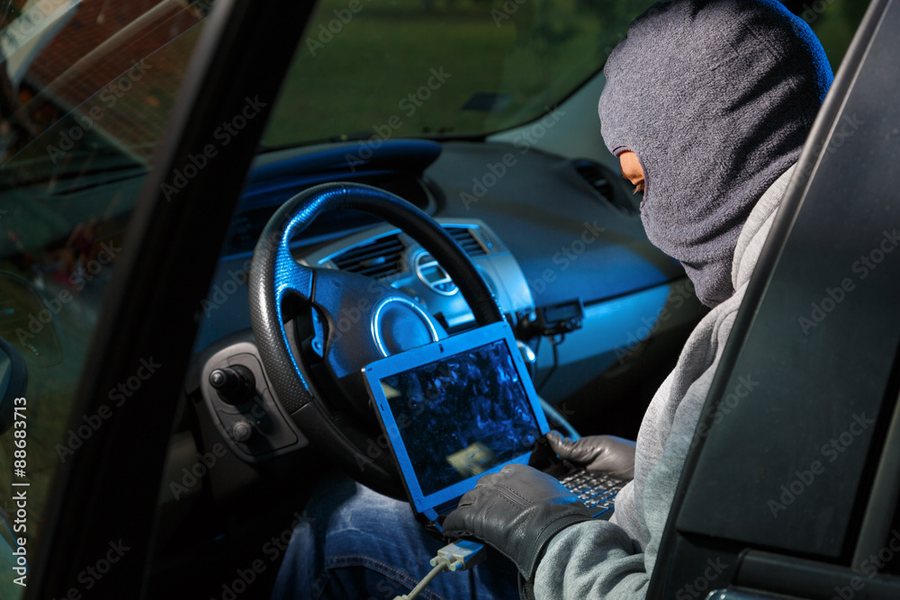
Why are thieves always one step ahead of car manufacturers?
Imagine meeting a car thief in 2013. His appearance would not have been impressive at all. Every year, his job had become more difficult. The classic tools of the trade, like coat hangers, slim jims, and ignition wires, were slowly becoming obsolete, thanks to new security technologies. The work was drying up.
But not anymore. The recent boom in car thefts has shown that this is a permanent battlefront. On one side are the manufacturers who create and sell products; on the other, the thieves who find ways to get them. As technology becomes more sophisticated, so too do ways to break it.
Today, modern cars are often called “computers on wheels.” This brought benefits, but also weaknesses that manufacturers realized too late. First came the “relay” attacks, which spread to Britain in 2016, after cars began to be equipped with keyless ignition. A thief stands outside the house, captures the electronic signal of the key inside and “transmits” it to the car, unlocking it.
Manufacturers have solved this in new models. Today, thieves break in by attaching devices to the car's electronic components, which trick the system into thinking it is communicating with the original key. A police officer at the port of Felixstowe shows off several recovered cars: one was opened through the taillight, another through the system near the bonnet.
This device is easily purchased online. There are even videos on YouTube showing its use. Organized crime groups spend up to 20,000 pounds on one. And when the police manage to seize it, the peace only lasts a few weeks.
The main problem for manufacturers is the pace of criminal innovation. While designing a car takes years, thieves can exploit a vulnerability for a long time. Another problem is cost. Luxury models are more protected because manufacturers fear for their brand image. In the mid-range segment, where competition is on price, owners are less likely to blame the company when their car is stolen.
The same story is happening with phones. When biometric locks and facial recognition were introduced, stolen phones lost value. Criminals turned to “snatch thefts” - grabbing the phone directly from the user's hand, while it's open, and disabling tracking before the victim can react.
Manufacturers have responded with new measures, such as automatic blocking after a violent movement or requiring a code when moving to an unknown location. But the system always has a weak link: the human. Many users do not activate these options. Meanwhile, criminals use phishing to obtain personal data and, if they fail, sell the phone for parts.
Some politicians in Britain have accused companies, such as Apple, of not consciously solving the problem, for example by introducing a mandatory “kill switch”. But the reality is more complex. Such a function would open up new problems, as it could also be misused by second-hand sellers.
The fair conclusion is that the cost of theft is distributed socially, through increased insurance premiums, and, consequently, no one has a strong interest in finally solving the problem. /Adapted from "Pamphlet" by "The Economist"








Lini një Përgjigje