


 Shkruar nga Pamfleti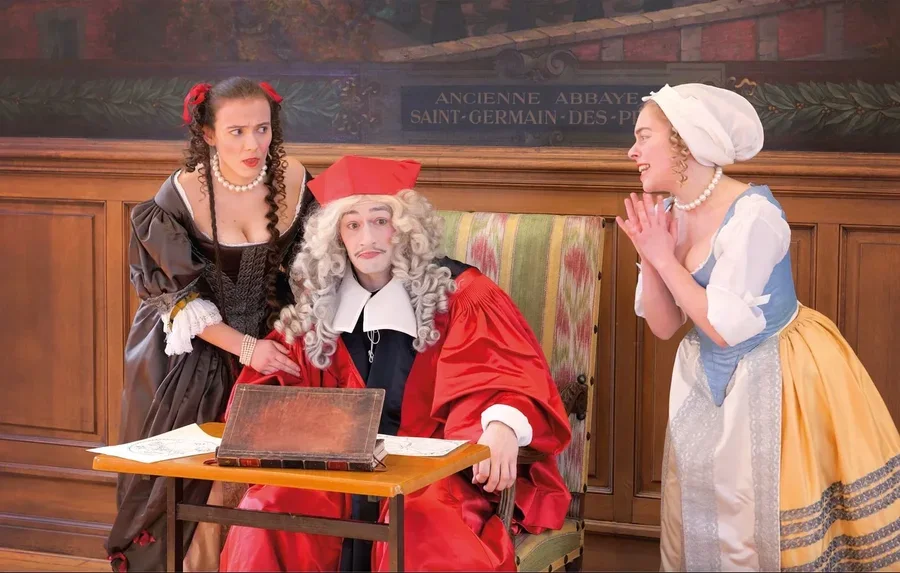
February 17, 1673. Molière died suddenly at the age of 51 after a performance of his play “Le Malade imaginaire” (The Imaginary Sick Man). But if the playwright had lived another year, what would he have written? This question was asked by the teams at the Sorbonne University. They asked the artistic trio “Obvious” and artificial intelligence to write together… Molière’s last play!
Project name: Molière Ex Machina. “20 Minutes” interviewed experts who are closely monitoring the project.
The “Molière Ex Machina” project team brings together researchers, scientists, artists, costume designers, and artisans.
“We knew it would cause reactions,” says Pierre-Marie Chauvin, Vice President of Université Sorbonne, who oversees the Molière Ex Machina project. But he justifies the initiative:
“We want to try to combine the best of 17th-century theater with the best of artificial intelligence, but without raising the dead.”
Asking ChatGPT to write a play in the style of Molière? Yes, that has been tried, but according to Pierre-Marie Chauvin, the result was “not satisfactory.”
For the Vice President of the Université Sorbonne, it was “impossible to start lightly, and it was essential to implement a serious, scientific and creative process by surrounding ourselves with the best specialists in each field.”
Not only is the artificial intelligence being asked to write a piece as Molière might have done, but the ten experts involved in its creation (including scientists, costume designers and artisans) will also think about the sets, costumes and composition of the music that will accompany the work.
Among the members of this small group is logically Mickaël Bouffard, director and stage manager of the Théâtre Molière Sorbonne. Founded in 2017 by literature professor Georges Forestier (1951–2024), this “school-studio” has the mission of reviving the old techniques of declamation and theatrical play of the 17th century. Yes, because back then Molière, Corneille or Racine were not necessarily performed as they can be today.
Artificial intelligence has already imagined the costume of Pseudoramus, the fraudulent astrologer from the theater play L'Astrologue ou les Faux Présages.
“For this project, we are forced to mobilize a lot of scientific knowledge, especially on Molière's creative process, which we now know well,” explains Mickaël Bouffard.
“The main challenge is to produce an original work that is both dramaturgically credible and faithful to the spirit of Molière, while arising from a close collaboration between man and artificial intelligence,” adds Hugo Caselles-Dupré, co-founder of the artistic collective Obvious.
Together with his colleagues, he stages the AI Mistral, trains it on existing knowledge of Molière, and through prompts, corrections, and collaboration with the project's artisans, creates a piece about... astrology. And all without a single line written directly by a human.
Astrology? “Molière criticized it in Dom Juan, but also in Les Amants magnifiques. He spoke of astrologers as ‘horoscope tellers,’” recalls Pierre-Marie Chauvin, Vice President of the Université Sorbonne. According to him, the theme of human credulity would have been an area that Molière would have continued to explore. Artificial intelligence has already found the name of the main character of the play, entitled L'Astrologue ou les Faux Présages: a fraudster named Pseudoramus!
In the nine months before the first performance scheduled for May 2026 at the Royal Opera of the Château de Versailles, the creative process is moving forward.
“Working with experts in classical theatre, literature and history allows you to move beyond a purely algorithmic logic and place the work within a real cultural heritage. This framework offers a creative constraint that forces you to be innovative with rigor, which is constantly applied throughout the project,” explains Hugo Caselles-Dupré, from Obvious.
Analyzing the first readings generated by artificial intelligence for the piece: “As philosopher Daniel Andler says, AI is amazing, but not intelligent. With this project, our goal is to create a profound work. We will see how it works in terms of length, depth, intensity, rhythm… and if the piece stands up to scrutiny,” notes Pierre-Marie Chauvin.
For his part, Mickaël Bouffard notes that:
“It is not equal to Molière, nor better than Molière, but often, almost immediately, we arrive at something that sounds like Molière.”
“AI takes us collectively higher and proposes unexpected things, much closer to Molière’s style than we, people of the 21st century, could have imagined.”
Care must be taken to ensure the full coherence of the work, such as not mentioning the names of planets that had not yet been discovered in Molière’s time.



Lini një Përgjigje