


 Shkruar nga Pamfleti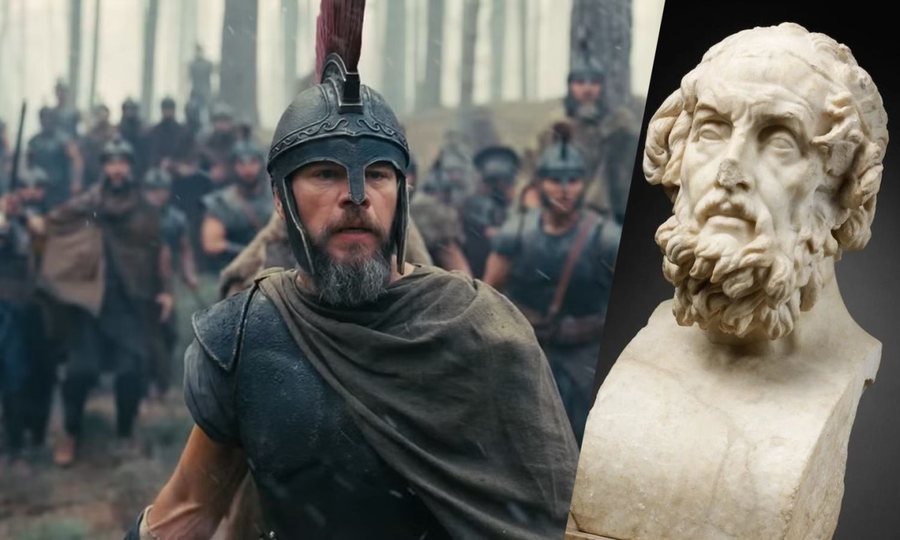
Christopher Nolan's film has revived the debate over the identity of the author of the "Iliad" and "Odyssey," as scholars continue to be divided between theories about a single poet, several authors, or even a woman.
The premiere of the film "The Odyssey" by Christopher Nolan is one of the most important cinematic events of this summer and has brought back into the spotlight not only the epic work, but also one of the greatest mysteries of world literature: who really was Homer?
In an analysis published by The Times, the newspaper examines the main theories and hypotheses on the identity of the author of the "Iliad" and "Odyssey", emphasizing that, despite his fame, very little is known about the man considered the founder of Western literature.
Was Homer a single person?
According to most scholars, Homer may not have been a single individual, but the symbol of a long oral tradition. For centuries, epic tales were memorized, recited, and enriched by generations of rhapsodists before being written down.
Scholars estimate that the "Iliad" and "Odyssey" were first written down in the late 8th or early 7th century BC, when writing began to spread in the Greek world. However, both poems retain much earlier elements, related to oral tradition.
If the Trojan War had a historical basis, it is believed to have occurred several centuries before it took the form we know today.
Where was Homer from?
In ancient Greece, several cities claimed Homer as their son. The most popular tradition describes him as a blind rhapsode from Chios, while other versions link him to Smyrna or Colophon in Ionia.
According to The Times, even the dialect used in Homeric poems has greater similarities to the dialects of Ionia than to those of continental Greece.
The figure of the blind rhapsode Demodocus in the Odyssey has been interpreted by some as an autobiographical reference, while others believe that the legend of blindness was created later to explain the oral tradition of the epic.
Did the "Iliad" and "Odyssey" have different authors?
Some philologists believe that the two poems were not written by the same author.
According to them, the "Iliad" has a more warlike and tragic character, while the "Odyssey" develops a more human, more intimate and more adventurous narrative. The differences in style, vocabulary and linguistic structure have long fueled this debate.
The theory that Homer was a woman
One of the most discussed theories was proposed in 1896 by British writer Samuel Butler, who argued that "The Odyssey" could have been written by a woman.
In his book The Authoress of the Odyssey, Butler claimed that female characters, such as Penelope, Athena, and Circe, are built with unusual depth and play a crucial role in the development of events.
He went even further, suggesting that the author may have projected herself onto the character of Nausicaa, the princess who helps Odysseus after the shipwreck.
However, Butler's arguments were not widely supported by the academic community and remain part of the historical debate.
A work created by many generations?
Another widespread theory is that the Homeric poems are the result of the work of many creators and different generations of rhapsodists, who enriched the narratives over the centuries.
According to The Times, Homer's true identity may never be revealed. It is this uncertainty that continues to fuel the magic of the work, which remains one of the cornerstones of world literature and continues to inspire contemporary artists, such as Christopher Nolan. /Pamphlet








Lini një Përgjigje