


 Shkruar nga Pamfleti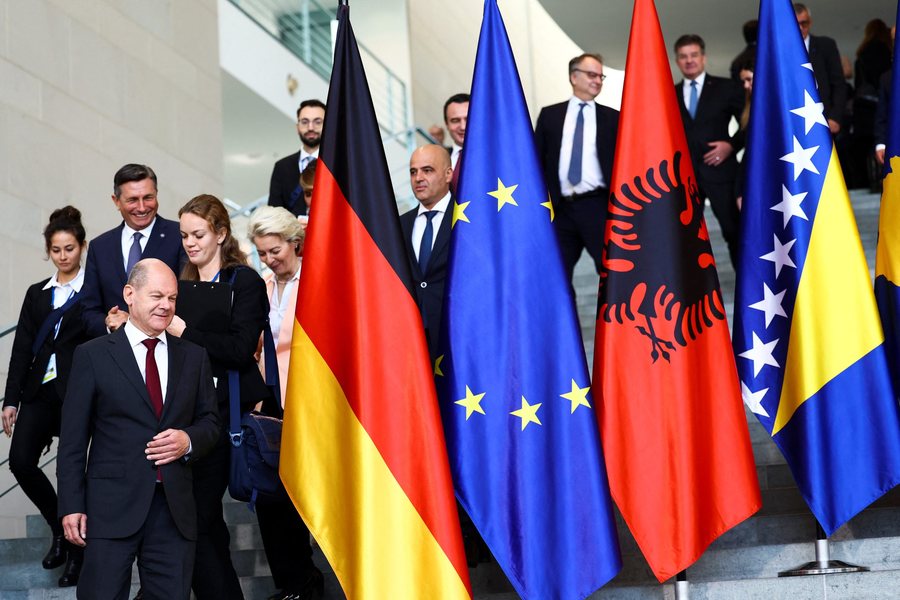
The Western Balkans still in the European Union's "waiting room"
In 2003, the European Union promised the Western Balkan countries that they would one day become part of the union.
More than two decades have passed and they still remain outside.
Why do they keep waiting? And will that day ever come?
Albania, Bosnia and Herzegovina, Serbia, Kosovo, North Macedonia and Montenegro, these are the so-called “Western Balkans Six.” All are candidate countries for EU membership.
However, since Croatia's accession in 2013, the "waiting room" has not been emptied.
And since 2022, the debate on enlargement has been largely dominated by the issue of Ukraine.
This is despite the fact that some Western Balkan countries have been much more advanced in the accession process than Ukraine.
So which countries are most likely to join first?
At the moment, Montenegro seems closest to membership, followed by Albania.
But even for these countries, which are considered the most advanced in the process, significant obstacles remain.
The most persistent problem in the region is democratic regression, including systemic corruption and lack of transparency.
Talks held in Montenegro in March showed that, although the country is in the "final phase" of the process, Brussels still expects acceleration of reforms and the building of strong institutions that can guarantee democracy.
The case of Albania illustrates this challenge even more clearly. Although Prime Minister Edi Rama is often seen as a natural fit at the table of European leaders, in reality his country has shifted towards a de facto one-party state since he came to power thirteen years ago.
According to Transparency International, Albania continues to record high levels of corruption.
Democratic regression is spreading across the region. At least that's what the 2025 Corruption Perceptions Index shows.
Does the EU bear some responsibility for this situation?
Some experts think so. They argue that some aspects of the EU's enlargement policy have long favored regime stability over democracy.
The process works like this: the EU offers candidate countries financial and technical assistance so that they can adapt the so-called acquis communautaire, that is, the legislation and rules of the European Union.
But for many scholars, this only results in superficial adoption of norms and fails to change the political reality of the region.
Second, the slow pace of integration is itself part of the problem. When ruling elites see that membership is unlikely to be achieved during their political careers, they have little motivation to push through difficult reforms.
However, for the European Union, there is a lot at stake.
The delay in enlargement also brings growing geopolitical risks for Europe as a whole, as external powers are trying to strengthen their influence in the region.
Just look at Serbia. Despite being a candidate country, support for EU membership there is the lowest in the region, at just 33 percent.
Under the leadership of President Aleksandar Vučić, the country continues to rely on Russian gas and deepen cooperation with China.
The same applies to Bosnia and Herzegovina, where the leader of Republika Srpska, Milorad Dodik, openly supports rapprochement with Moscow.
China has also established a significant presence in the region, investing 32 billion euros since 2014, mainly in infrastructure and energy projects.
To break the deadlock, alternative approaches are gaining ground.
The Kosovo Center for Security Studies promotes what it calls “operational integration,” the inclusion of Western Balkan institutions in certain EU processes and agencies without granting them full membership.
Just a few days ago, German Chancellor Friedrich Merz floated the idea of “associated countries” that could partially participate in EU negotiations. He was referring primarily to Ukraine.
But the idea of gradual membership has been discussed for a long time and could gain more support if there is political will within the union.
But returning to the original question: when can the Western Balkans join the European Union?
Montenegro had hoped to become a member in 2028, just two years from now. But this deadline may prove difficult to meet, for all the reasons we mentioned.
Therefore, the early 2030s seems more realistic, although there are absolutely no guarantees.
The European Union itself must also resolve some internal issues before accepting new members, including the issue of unanimous decision-making in certain areas. / Adapted from “Pamphlet” by “ EUobserver ”



Balkan people are the best and own the best land e resources in Europe. Why so late!? Aha, Europrosti... dreamed and still dreams those pretty lands to enjoy their summer.