


 Shkruar nga Pamfleti
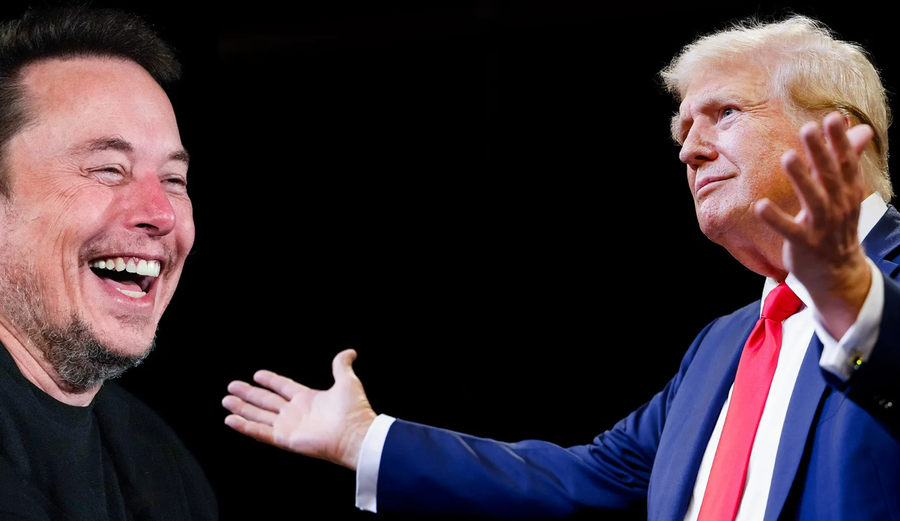
How the conflict between Trump's economic nationalism and Musk's technological globalism exposed the fragility of the new rulers...
Monarchy is defined as the absolute rule of one individual, who ascends to the throne by divine right or through election by someone else. Since the Declaration of Independence in 1776, when the Americans defeated the forces of King George III, the United States has maintained a strong anti-monarchical stance.
Yet President Donald Trump is increasingly presenting himself as an authoritarian ruler. More of a modern dictator than a traditional king, he has become a tyrant who attacks any opponent. Monarchs are usually surrounded by servile courtiers and family dynasties, doling out privileges and wealth at will.
Trump's most famous courtier was Elon Musk, the businessman who took on important roles in the Trump administration, appearing at public events and taking over the DOGE (Department of Government Efficiency), to reform the federal bureaucracy with extreme measures. Musk made the chainsaw his symbol of "cleansing", but recently its power seems to have faded.
It is unclear whether Musk left voluntarily or was theatrically fired by Trump, but he has stated that he will return to his private businesses. Their relationship began to deteriorate after several public conflicts, most notably after an incident in which Musk called Trump's trade adviser, Peter Navarro, "dumbest than a sack of bricks."
Experts in Washington had predicted Musk's departure as early as January, citing three main reasons. First, two narcissistic personalities like Trump and Musk were unable to coexist due to ego rivalries. Second, although stylistically similar, they come from different worlds of business and finance, which made their interests incompatible in the long run. Musk depends directly on Tesla's stock, while Trump depends on political polls and the real estate market.
But the deeper reason is ideological. Trump is an ethno-nationalist who aims to re-industrialize America and restore the glory of "white America." Musk, on the other hand, represents a techno-globalist vision, without national borders, that seeks the global dominance of private capital and technology.
Harvard economist Dani Rodrik had foreseen this conflict between economic nationalism and technoglobalism: one camp is populist, the other elitist; one is against immigration, the other supports it; one seeks to weaken Silicon Valley, the other to strengthen it.
In this clash, the losers are the ordinary citizens who believed in Trump's populist promises. As both factions vie for dominance, another figure is quietly preparing to take the lead: Vice President JD Vance. A cold and calculating politician, Vance is ready to take advantage of any weakness in Trump. In the end, history teaches us that every modern "monarch" must be wary of political betrayal that can come from those closest to him. / Pamphlet





Lini një Përgjigje