


 Shkruar nga Maya Krainc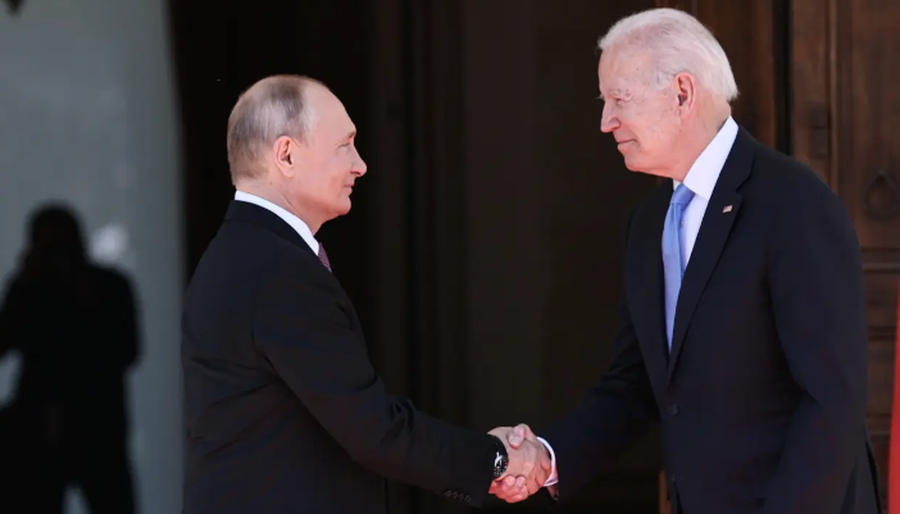
As two major global superpowers, the United States and Russia must again find a way to divide the world into their spheres of influence. Only real, long-term planning can ensure that Washington is able to shape the future in its best interest...
After a near-term election, Vladimir Putin was sworn in last week for another six-year term as Russia's president. Of course, Putin's victory has fueled accusations of rigging the process and political interference, factors that help explain his landslide victory with 87.3 percent of the vote.
If there's one thing that Putin's 24-year run in power makes clear, it's that he and his regime will be around for the foreseeable future. But as its war in Ukraine drags on, with no clear end in sight, it's less clear how Washington plans to deal with that reality.
Experts say Washington needs to begin crafting a long-term strategy toward Russia and its war in Ukraine, using its political leverage to pressure Putin as well as push for more diplomacy aimed at ending it. the conflict.
Only by looking beyond short-term solutions can Washington really change developments on the battlefield in Ukraine. Since the full-scale invasion of Russia, the US has focused on helping Ukraine regain all the territory it had before 2014.
This objective is hampered by Kiev's systematic shortages of ammunition and troops.
But that answer neglects a more strategic approach to war, says Andrew Weiss of the Carnegie Endowment for International Peace, who spoke at a recent panel organized by the think tank. "At the moment, emergency planning dominates. And this diminishes the possibility of the emergence of long-term strategies", he said.
Meanwhile, historian Stephen Kotkin underlined that it is vital to preserve the sovereignty of Ukraine. However, Kiev's apparent focus on liberating already occupied territory, also encouraged by the US, is misguided. "Wars are never about reclaiming territory
lost. But with the ability and will to fight. And if Russia has the capacity to fight and Ukraine regains the lost territories, Russia will not stop fighting," Kotkin said recently in an interview with a Wall Street Journal podcast.
And it seems that Russia has this capacity. The number of troops and weapons at its disposal far exceeds that of Ukraine, and Russian leaders spend twice as much on defense as their Ukrainian counterparts. To continue resisting the Russian onslaught, Ukraine will need continued military aid from the West.
While helping Ukraine is important, Kotkin says, so is having a clear plan for determining the preferred outcome of the war. US interests may be better served by using the significant political leverage it has over Russia to dictate a long-term outcome in its favor.
George Beebe of the Quincy Institute, which also runs the Responsible Statecraft think tank, says Russia's main concerns and interests do not end with Ukraine. Moscow is very concerned about the NATO alliance and the threat it could pose to Russia's internal stability.
Therefore, negotiations and dialogue about the borders and limits of the powers of NATO and Russia are very important. And this process is not possible without the USA and Europe. "This means that we have leverage," says Beebe. Kotkin says the power of the US and its allies lies in their political influence, where they are far more powerful than Russia on the battlefield.
The use of this influence will be a very necessary tool for reaching an agreement, which will be favorable to the interests of the West, "that protects the United States, its allies in Europe, that preserves an independent Ukraine , but which also respects Russia's core security interests".
According to Kotkin, this would mean renewed efforts for a ceasefire that ends the fighting on the ground, and that preserves Ukraine's sovereignty. This means not to legally accept Russia's possession of the territory it has occupied so far. After that, negotiations can continue.
Beebe adds that a new treaty will be important to define how conventional forces can be used in Europe, a treaty that places limits on where and how troops can be deployed. "Russia needs an understanding with the West to excluding interference in other people's internal affairs" - emphasizes Beebe.
He adds that very important to achieving these objectives is dialogue with Putin, which Beebe says Washington has not done enough to facilitate. American officials have publicly stated that they do not plan to meet with Putin anytime soon.
The US even dismissed Putin's most recent statements about his willingness to negotiate, which he made during an interview with journalist Tucker Carlson in February, citing disbelief that Putin has any real intention to put an end to the war. "Despite Mr. Putin's words, we have seen no action to show that he is interested in ending this war. If it were true, he would withdraw his forces and stop his incessant attacks on Ukraine," said a spokesman for the White House National Security Council.
But neither side has been open to serious communication. Biden and Putin have not met to engage in meaningful talks about the war since it began. Their last meeting took place before the start of the war in the summer of 2021 in Geneva, Switzerland.
Weiss says the US needs to make it clear to Russia that these lines of communication are still open. "Any strategy that includes the softening of diplomatic relations must be accompanied by a serious determination and the feeling that in the current situation we cannot go anywhere" - says Weiss.
The end of the war in Ukraine will be very important for the long-term stability of the world. Russia will remain an important player on the world stage, Beebe explains, given that it is the world's largest nuclear power and a major energy producer.
It is therefore ultimately in the interest of the US and Europe to build a relationship "that combines competitive and cooperative elements, and where we find a way to manage our differences, and to make sure that they do not go to a very dangerous military confrontation" he says.
As two major global superpowers, the United States and Russia must again find a way to divide the world into their spheres of influence. Only real and long-term planning can ensure that Washington is able to shape the future in its best interest./ Adapted Pamphlet from "Resposiblestatecraft"


Lini një Përgjigje