


 Shkruar nga Pamfleti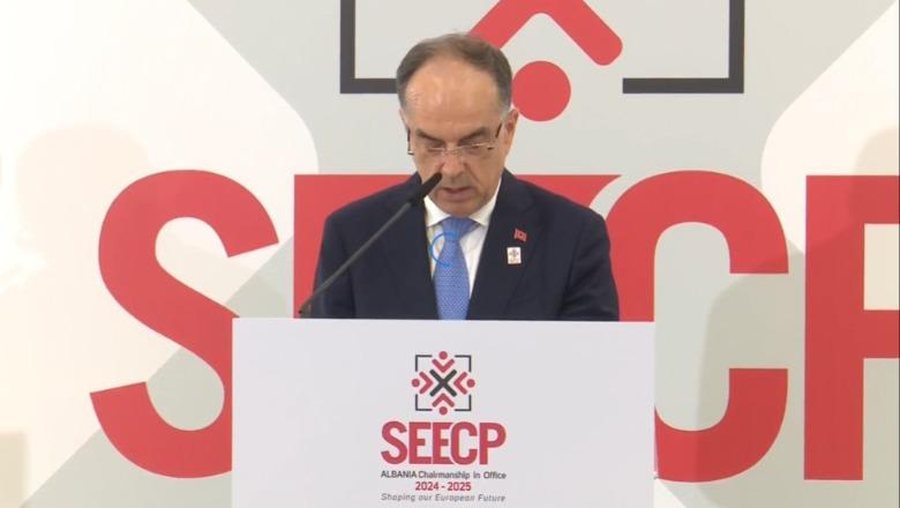
The Head of State also touched on the conflict between Iran and Israel, while appealing for tensions to be resolved through diplomatic channels.
The President of the Republic, Bajram Begaj, during the joint press conference with the President of Macedonia, Gordana Siljanovska Davkova and the President of Bulgaria, Rumen Radev, within the framework of the SEECP summit, said that Albania encourages the strengthening and regional cooperation in the European Union. The Head of State also touched on the conflict between Iran and Israel, while appealing for the tensions to be resolved through diplomatic channels.
"Albania is moving at a rapid pace towards European integration, our goal is to close negotiations by 2027. We are working to achieve this major goal. Albania expresses concern about the growing tensions towards Israel and Iran. These conflicts are a warning and Albania remains committed to issues related to regional stability. For this reason, EU countries should provide support ," he said.
Begaj further outlined Albania's strategic objective, which, according to him, is related to integration into the European Union by 2030.
" Our strategic goal is to close negotiations by 2027 and join the EU by 2030. We are working intensively to achieve this major goal and chairing the SEECP was further proof of our seriousness in our European journey ," the head of state affirmed.
During her speech, the President of North Macedonia, Gordana Silanovska-Davkova, said that she supports joint integration and that reforms also provide opportunities for the growth plan.
" Gratitude for everything they have done and for achieving common priorities. Solidarity should not remain an isolated gesture, but should be a foundation for change. Cooperation should be sustainable. It should also be directed towards European values and the future. I believe in regional unity and call for a strong regional voice that will shape our future in Europe ," she said, among other things.
President Rumen Radev stated that Bulgaria supports the countries of the region on their path towards the European Union.
'Bulgaria takes up the challenge of cooperation in the South-Eastern European process and we will also celebrate the 30th anniversary and starting from the joint declaration. We, being in the chairmanship for the fourth time, will develop what we have done so far, we will do our best with the vision and the necessity to solve all the challenges that our region faces. The priorities of the chairmanship will of course aim precisely at these, the acceleration of European integration within the region based on merit.
The connection between the other, also human capital, 150 million citizens. I would like to assure you that Bulgaria is the closest country and has a burning desire to extend a hand and be of help so that your society and the state can address the challenges more quickly. If we aim at the same goal that the countries of the region join the EU and become member states, Bulgaria as a long-time member of the EU and as the leader of this initiative is actively acting in foreign policy and supporting the processes ,' he said.
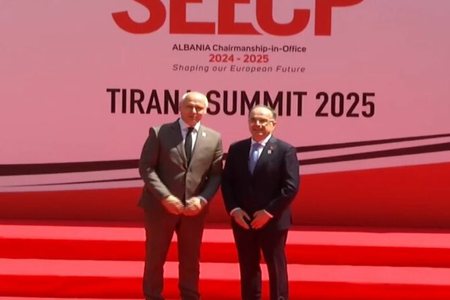
We recall that President Begaj hosted the President of Slovenia, Nataša Pirc Musar; the President of Montenegro, Jakov Milatović; the President of Kosovo, Vjosa Osmani; the Chairperson of the Presidency of Bosnia and Herzegovina, Željka Cvijanović; the President of Macedonia, Gordana Siljanovska Davkova and the President of Bulgaria, Rumen Radev. The latter will assume the rotating chairmanship of the SEECP for the coming year.
At the summit held in Tirana, a final declaration was made. Serbia and Bosnia and Herzegovina are the only two countries out of all the participating countries that have refused to sign the final declaration at the end of the meeting. The two main reasons were Russian aggression and the open conflict between Iran and Israel.
SEECP consists of 13 participating countries, which are also members of the Board of the Regional Cooperation Council (RCC), such as: Albania, Bosnia and Herzegovina, Bulgaria, Croatia, Greece, North Macedonia, Moldova, Montenegro, Romania, Serbia, Slovenia, Kosovo and Turkey.
The South East European Cooperation Process is an important political forum aimed at dialogue and cooperation in South East Europe, which concludes a successful year of the Albanian Presidency under the motto "Shaping our European future".
Tirana assumed the SEECP Chairmanship for the period July 2024 – June 2025, following the Chairmanship previously held by Skopje, and will be succeeded by Sofia.
The South East European Cooperation Process was initiated in 1996 during the meeting of the Ministers of Foreign Affairs of the participating countries in Sofia, while the first SEECP Summit was held in Crete in 1997.


Lini një Përgjigje