


 Shkruar nga Anita Likmeta
 Albania represents the tragedy of a continent that no longer knows how to distinguish freedom from survival...
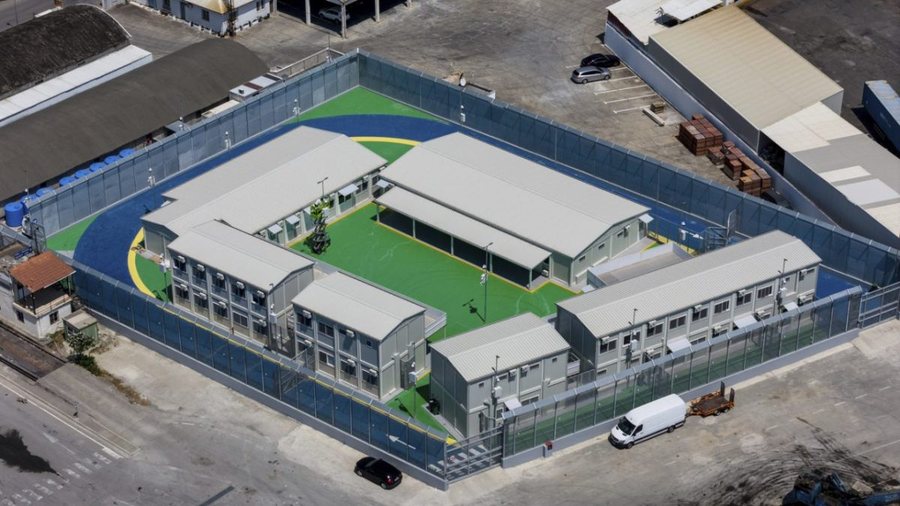
Edi Rama's Albania is a place left in suspense, a place where history is never just the past, and where modernity is never really the present. It is a theater where the drama of Balkan existence takes place between nostalgia and disappointment, between the aspiration for freedom and the perpetuation of the invisible slavery of its own history.
To put it in the words of Pier Paolo Pasolini, the reality out there is more complex than we want to admit. Albania is not only a Balkan country. It is a metaphor for Europe itself, with its greatest contradictions, and the constant oscillation between the promise of becoming a truly democratic country and the risk of a return to authoritarianism. The agreement with Giorgia Meloni to host rejected immigrants from Italy is not just a political move, but the symbol of a country that offers itself as a "repository" of Europe's sins.
As a good director, Edi Rama understood that to keep the country on the international stage, you have to make it look useful in the eyes of the most powerful. It is not a power game, but a necessary compromise: Albania does not have the luxury of being irrelevant.
In the case at hand we do not just have a humanitarian crisis: welcoming immigrants is also, and above all, a strategy to get funds, to wash the dirty laundry of others so that it can be mixed with yours, with consciousness that Albania, small and fragile, must survive in a hostile environment.
But at the same time, this movement reflects the reality of a nation that becomes an accomplice of a Europe incapable of solving its dramas. The recent idea proposed by Rama's ruling majority for the creation of an Islamic micro-state within Albania, governed by a cleric of the Sufi sect, offers us a further example of this strategy.
Rama seems to want to do for Islam what the Pope does for Catholicism, taming Islamophobia through a spiritual authority that gives this religion a more acceptable face in the Balkan region.
However, behind this facade may be hidden a more bitter truth: Islam is a pretext, a mirror in which European fears are reflected. This "Vatican of Muslims" does not so much symbolize an act of reconciliation as a power play, a subtle form of control that exploits marginalization to profit from anxiety.
The same logic follows the proposal to host British prisoners in Albanian prisons: Albania has turned into a wasteland, a prison for the shadows of the Western world. It is the logic in which the peripheral countries take on the burden that the center refuses to bear.
In this aspect, Rama is a master: He knows that Albania cannot compete with the giants, so he uses the policy of mediation, turning into a merchant who agrees to sell something of himself to stay in the game.
But behind this sly behavior hides a question: What price is Albania paying to avoid disappearing from the eyes of the world? And what does it have to give up to remain visible? This highlights a fundamental aspect of contemporary Albanian politics: the country is unable to develop its economic structure capable of being part of the global market.
However, despite all the criticisms that can be made against Rama, it is undeniable that he is the only leader capable of holding together a state in transition, still traumatized by the long nightmare of Enver Hoxha's communist regime.
His figure, although controversial, is at the center of a fragile democracy, where the opposition seems almost like a ghost. The head of the Democratic Party, Sali Berisha, called non-grata by the United States, cannot be considered a real political rival.
What about young Albanians? They run away, emigrate and do not believe in politics, and because Albania does not offer them a future. This departure of the most educated - a phenomenon that is also well known in Italy - is the real tragedy of the country: a democracy without young citizens is very fragile.
Seen from the outside, this emigration looks almost like a form of exile, a silent denunciation against a system that offers no hope. In the end, Edi Rama is the last bastion of a fragile democracy, which exists only because there is no one strong enough to oppose him.
Be careful though: you can't trade stability for progress. What Rama offers is the stability of a still place that doesn't know where to go. Democracy is not just a system of government, but a way of life, an ethic that requires participation, criticism, dissent.
And Albania has not yet developed the civil structure that makes democracy vital. Albanian democracy is the scenographer, and Rama is the director, the protagonist and the spectator.
The real problem is that Albania is still a prisoner of its history. Enver Hoxha's regime has left deep wounds, and the transition to democracy is still incomplete. The Albanian nation is experiencing an epic drama, where the past clings to the present, preventing the birth of the future. The Albanian people are disappointed, divided between nostalgia for a mythical and almost forgotten past, and the desire to escape from a present that does not keep its promises.
With his pragmatism and indisputable communication skills, Edi Rama has succeeded in making his place visible on the international scene. But his leadership is not the solution, but only a palliative cure (for a dying patient), and he himself is both part of the problem and part of the solution.
The Albanian Prime Minister is holding "by the hand" a country that has not yet learned to walk on its own, but is not able to make it really grow. Therefore, the real challenge is not only to maintain power, but also to create a democracy that is alive and able to give a voice to those who have none.
The vicissitudes of contemporary Albanian politics should be a warning to all of Europe: a democracy without people is a farce. And in this sense, Albania represents the tragedy of a continent that no longer knows how to distinguish freedom from survival./ Pamphlet & "Linkiesta"


Lini një Përgjigje