


 Shkruar nga Pamfleti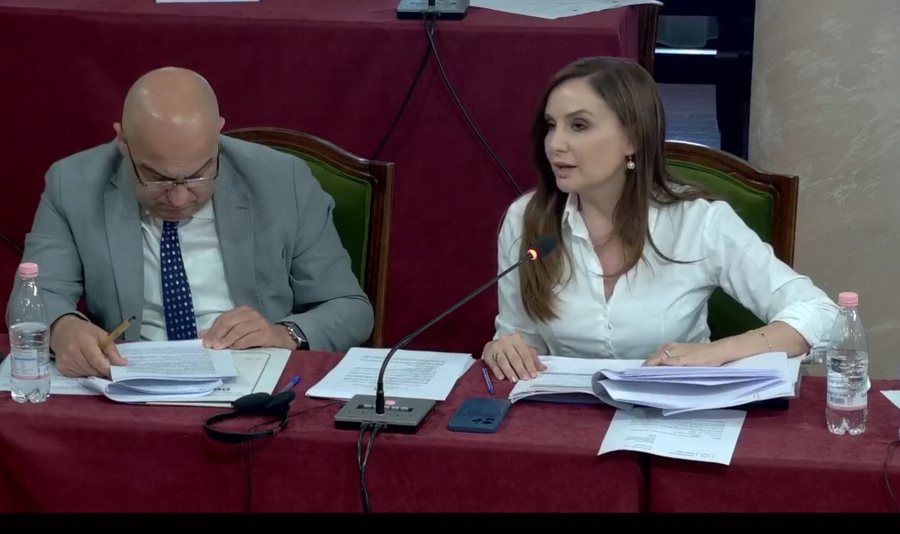
Democratic Party MP Jorida Tabaku criticized the government during the meeting of the Committee on Europe and Foreign Affairs, where the report on Albania's integration process into the European Union for 2025 and the period January-April 2026 was presented.
In the hearing with Minister of State and Chief Negotiator Majlinda Dhuka, Tabaku stated that the government report contains more references to laws than concrete reporting on the progress and quality of reforms.
"I read your report carefully, Madam Minister, and this is a government report that has more laws than reporting, 45 pages with these laws alone. Parliament is not a factory of laws, of course it also has importance for them, but it cares about the quality of reforms," said Tabaku.
The Democratic MP emphasized that the integration process cannot be carried out unilaterally and accused the government of not taking into consideration the opposition's proposals, citing as an example the draft law on the decriminalization of the media.
Regarding the justice system, Tabaku said that the report does not fully reflect the real situation and that the data on the judiciary is incomplete and outdated. She brought to attention the length of administrative court proceedings in the Court of Appeal.
"The data in this report on the judiciary is also incomplete. At least the information given to us here is not updated or complete. The duration of the administrative process in the second instance in Albania is 5326 days, or 14.5 years to obtain justice and this is not an achievement. These show how far the law is from practice. Another important point is justice, SPAK was mentioned here several times and included in the report and is an institution that has had achievements. It is about chapter 23, which the Government has also engaged in as part of the SPAK reform", argued Tabaku.
She also raised concerns about the level of corruption and the way public procurement is conducted, emphasizing that Albania has regressed in this regard.
"There are problems with the fight against corruption, and what I want to mention is public procurement. Albania has fallen by 11 places in this aspect. Since 2018, the public procurement chapter has not improved according to the recommendations given here. Even though a draft law was approved, there are still exceptions and this includes tenders and NAKSHI, according to EU recommendations. 14% of procedures are with a single bidder and this is a high figure, 15% of them are not published. 60% of the value of all tenders goes to only 12 companies, which for the sake of time I am not mentioning. Compared to the countries of the region, Serbia has 97.5% of procurements open. I am sorry that I am making this comparison with Serbia, but this is true. There is no improvement in Albania in this regard", she continued.
Tabaku also focused on laws that, according to her, have raised concerns from the European Commission, such as the law on ports and the law on strategic investments. She criticized the lack of transparency and the exclusion of the opposition from the discussion process.
"The European Commission has responded to me for at least 10 laws that I have expressed concerns about, especially for the Ports law where concern is expressed that the government does not make approximations. You should have brought here the law on ports, strategic investors including the AKSHI. They should have been here to be discussed. The Albanian government has been working for 12 years on a law on strategic investments and you have turned it from temporary to permanent. The quality of the laws is far from their implementation. With the maximum commitment of the opposition members, we brought the law on the media, for the complete decriminalization of the defamation article, the government went for a partial decriminalization. The opposition comes, engages, while you decide unilaterally," said Tabaku.
In conclusion, Tabaku emphasized that European integration requires cooperation between all parties and broader involvement of civil society and experts in negotiating groups.
"This process requires two parties, it cannot be done with one party. For years, there has been a demand for the negotiating groups to be enriched with civil society, experts, business representatives. But you kept them closed, but they should be shared with Parliament, to be open for discussion, but unfortunately it has not happened," concluded the Democratic MP.



Lini një Përgjigje