


 Shkruar nga Pamfleti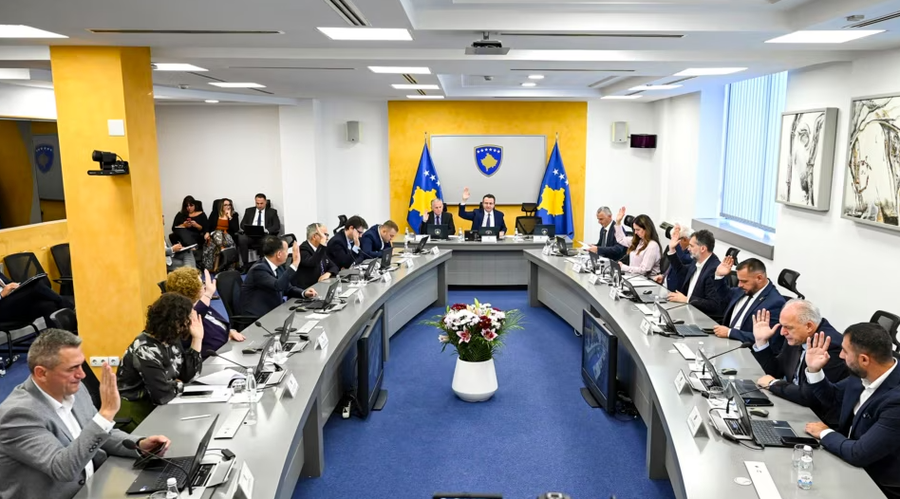
Kosovo's acting government approved the 2026 budget on Friday, which reaches a record figure of around 4 billion euros, despite the uncertainty that the Assembly can consider its approval.
The acting Prime Minister of Kosovo, Albin Kurti, said that the new budget foresees around 1 billion euros in capital investments.
"The new budget will be 4 billion euros. About 1 billion euros have been budgeted for capital investments. With this budget, there will be a 13th salary for all public sector workers. The implementation of a 0.5 percent increase in the basic salary for each year of work experience in the public sector is also included," Kurti said.
During this meeting, the incumbent Government also increased the minimum pension from 120 to 150 euros, as well as allowances for all children aged 0-16 by 50 percent.
Around 200,000 pensioners and over 400,000 children will benefit from these increases starting November 1, Kurti said.
Can the new Assembly approve the budget submitted by the incumbent Government?
It is not clear whether this draft law for the 2026 budget can be reviewed and voted on in the new Assembly of Kosovo.
A day earlier, the Speaker of the Assembly of Kosovo, Dimal Basha, failed to gain the support of parliamentary parties for the formation of parliamentary groups and committees, in order to convene an extraordinary session on the issue of the 2026 budget.
Basha admitted that it is unusual that he convened the Presidency of the Assembly, considering that in current practices, this body convenes only after the country has a new government.
Many legal experts believe that the incumbent Government cannot and does not have the authority to propose a budget for approval in the country's new Parliament.
In an interview with Radio Free Europe on Monday, finance expert Haki Shatri said that only a government with full powers can take initiatives to amend the budget law, or to continue budget allocations for the first months of 2026.
"If no solution is found to operationalize one-twelfth of the budget in January, even if there is an earthquake, no one dares to undertake anything," he said.
Albert Krasniqi from the Democracy Plus organization said that the incumbent government - elected by the previous legislature - cannot propose a draft law on the annual budget for the new legislature.
"The Assembly, which has not yet elected a new government, cannot pass laws without having its own government to implement them. The Assembly's Rules of Procedure provide that the draft budget be reviewed by parliamentary committees - committees that have not yet been established," he wrote.
He said that the distinction between the Government in resignation and the Government in office should be made clear, explaining that the Government in resignation is one that, during its mandate, after the resignation or dismissal of the Prime Minister, continues to exercise its functions until the formation of a new government, while still having a functional Assembly, established committees, and Government-Assembly communication channels.
Meanwhile, according to him, the incumbent government is a government elected by the previous legislature, which has no institutional connection with the new legislature that emerged from the elections.
"Therefore, according to the Law on Government, the government in resignation can propose the budget bill, while this right is not recognized for the government in office ," he added.
Gëzim Shala from the Kosovo Law Institute emphasized that the incumbent Government does not have the right to propose the budget, nor does the Assembly have the right to vote on the budget proposal of this incumbent Government.
"The government in resignation refers to a government that has been elected by a certain legislature, which continues its work until the moment of the election of the new Government, and not in cases where the Government's mandate has ended. In this specific case, the Government in office was not elected by this legislature and does not belong to it," he wrote./REL


Lini një Përgjigje